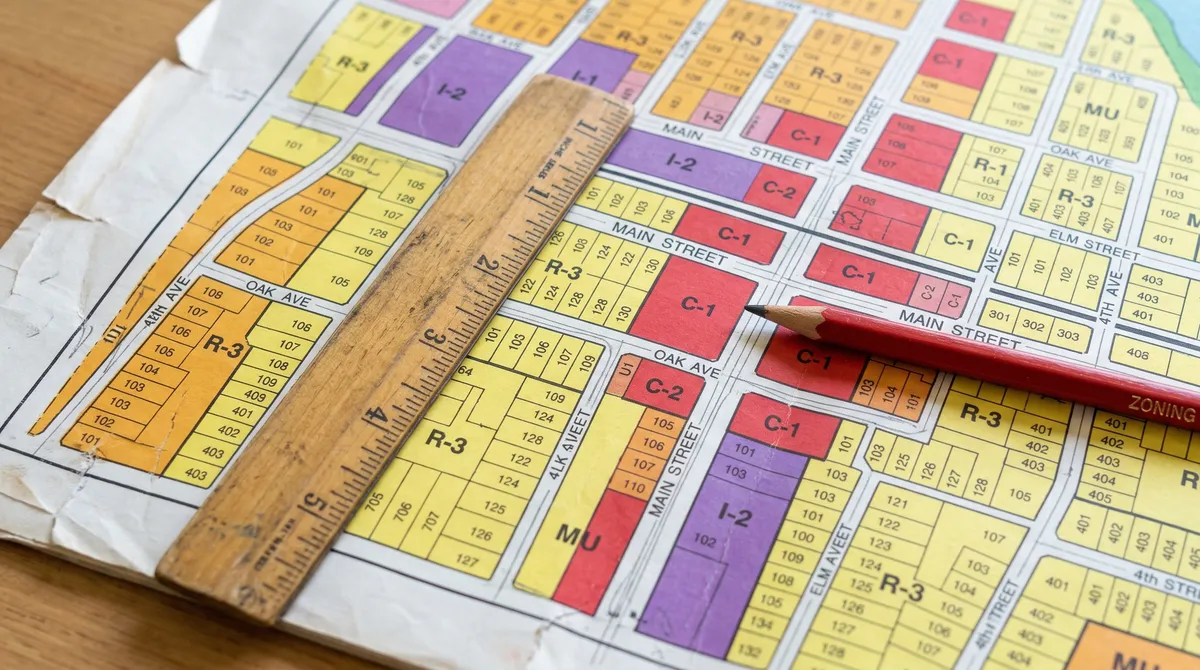
Worcester's zoning ordinance decides what you can build, lease, and operate on every one of the city's 4,563+ commercially zoned parcels. If you invest, develop, or lease here, knowing these classifications is the difference between a clean approval and months of variance hearings. It's also the difference between buying a site with real upside and buying one loaded with constraints you never saw coming.
Business Zones: Worcester features 3,250+ business-zoned parcels across 7 classifications, ranging from neighborhood retail (BL-1.0) to high-density regional commercial (BG-6.0).
Manufacturing Zones: The city also includes 1,313+ manufacturing-zoned parcels across 6 distinct categories, from light assembly (ML-0.5) to heavy industrial (MG-2.0).
Most Common Zone: BL-1.0 (Limited Business) is the most prevalent commercial zone with 1,420 parcels, but it also enforces the most restricted use table.
Widest Permitted Uses: BG-2.0 (General Business) allows the broadest range of uses by right, including office, retail, food service, multifamily housing, and R&D with manufacturing.
New Construction Value: Commercial buildings constructed after 2020 average $5.6 million each, significantly exceeding the value of older building stock.
Floor Area Ratio (FAR) is a zoning metric representing the total building floor area divided by the lot size. It directly indicates permitted development density, with a higher FAR allowing more building square footage on a parcel.
I put this guide together from the city's WPIS (Worcester Property Information System) database. It walks through every commercial and industrial zoning district in Worcester: parcel counts, what's permitted, what needs a special permit, and how to match your project to the right zone.
3,250+ business-zoned parcels across 7 district classifications, from neighborhood retail (BL-1.0) to regional commercial corridors (BG-6.0).
1,313+ manufacturing-zoned parcels across 6 district classifications, ranging from light assembly (ML-0.5) to heavy industrial (MG-2.0).
BL-1.0 (Limited Business) is the most common commercial zone with 1,420 parcels, but it has the most restricted use table.
BG-2.0 (General Business) permits the widest range of uses by right, including office, retail, food service, multifamily housing, and R&D with manufacturing.
New construction (2020+) averages $5.6 million per commercial building, totaling 3x the value of 1950-1979 stock and over 5x pre-1900 buildings.
Worcester's commercial zoning framework
Worcester sorts its commercial and industrial land into three families: business districts (B), manufacturing districts (M), and institutional/industrial park districts (IN/IP). The number after the letter code is the FAR (Floor Area Ratio), the total building floor area divided by the lot size. Higher FAR, denser development.
Take BG-2.0. It allows a building with up to 2.0 times the lot area in total floor space. On a 10,000 SF lot, that's 20,000 SF of building. BG-6.0 gets you 60,000 SF on that same lot.
That number matters when you're pricing density, because it feeds straight into what the underlying land is worth.
Business districts: 3,250+ parcels
Business districts are where Worcester's retail, office, restaurant, and service uses cluster. Seven classifications run from neighborhood-scale limited business up to high-density urban commercial.
Business district inventory
| Zone Code | Name | Parcels | Typical Location |
|---|---|---|---|
| BL-1.0 | Limited Business 1.0 | 1,420 | Neighborhood commercial, residential transitions |
| BG-3.0 | General Business 3.0 | 843 | Major corridors, established retail areas |
| BG-6.0 | General Business 6.0 | 325 | Downtown core, highest-density commercial |
| BG-2.0 | General Business 2.0 | 320 | Secondary corridors, mixed-use areas |
| BO-1.0 | Business Office 1.0 | 203 | Professional office clusters, medical corridors |
| BG-4.0 | General Business 4.0 | 127 | Regional retail, auto-oriented commercial |
| BO-2.0 | Business Office 2.0 | 12 | Campus-style office, institutional edges |
What the codes mean
BL (Business Limited) is the most restrictive business zone. BL-1.0 is Worcester's most common commercial classification with 1,420 parcels, but the permitted uses are narrow: mostly neighborhood retail, personal services, and small office. These parcels sit along residential transition corridors and side streets. If you're planning a restaurant with a liquor license, a drive-through, or a big-box retail store, BL-1.0 won't work without a variance or special permit.
BG (Business General) is the workhorse. BG districts permit the widest range of commercial uses, and the FAR number sets the density. BG-2.0 (320 parcels) is the most flexible on use variety. BG-3.0 (843 parcels) lines Worcester's major commercial arteries. BG-6.0 (325 parcels) concentrates in the downtown core where the city wants maximum density, six stories of commercial or mixed-use on a standard lot.
BO (Business Office) is restricted to professional and medical office. BO-1.0 (203 parcels) targets low-rise professional office along corridors like Lincoln Street and Park Avenue. BO-2.0 (12 parcels) allows denser office but stays the rarest business district in the city.
A closer look at what BG-2.0 permits
BG-2.0 is the district I point people to when they want to understand Worcester zoning, because it carries the most detailed use table. Here's what the ordinance allows.
Permitted by right (Y), no special permits or variances required:
- Office (general and professional)
- Retail sales (including incidental fabrication)
- Food service without alcohol
- Food service with alcohol and entertainment
- Retail food sales (grocery, specialty food)
- Bank, credit union
- Motel, hotel, inn
- Animal hospital, clinic, pet shop
- Indoor recreation, health club
- Motor vehicle service and repair
- Service shop, personal services
- Theatre, concert hall
- R&D with manufacturing
- Multi-family dwelling (low-rise and high-rise)
- Single-family attached and detached
Requires special permit (SP), approved through the Zoning Board of Appeals or Planning Board:
- Automobile refueling station
- Food service with drive-through
- Marijuana storefront retailer
- Self-storage facility
- Kennel
- Outdoor recreation
Not permitted (N), prohibited regardless of permit applications:
- Adult entertainment
- Marina
- Wholesale business and storage
- Motor freight terminal
- Open lot and salvage yard
- Rail freight terminal
Matching your business to the right zone
Opening a restaurant? BG-2.0, BG-3.0, BG-4.0, and BG-6.0 all permit food service with alcohol by right. BL-1.0 is tighter, so read the use table before you sign a lease. Drive-through food service needs a special permit in every business district, no exceptions.
Starting a retail business? General retail sales are permitted by right in all BG districts. BL-1.0 allows neighborhood-scale retail but may cap your square footage or signage. For large-format retail, go after BG-3.0 or BG-4.0 parcels along established corridors with the parking to match.
Building multifamily housing? BG-2.0 permits both low-rise and high-rise multifamily by right. That's a real edge for mixed-use developers who want ground-floor retail with apartments above. By-right status skips the special permit timeline that adds 6-12 months to projects in a lot of other towns.
Medical or professional office? BO-1.0 and BO-2.0 are built for office use, but every BG district permits offices by right too. The BO zones tend to be quieter, with lower rents and more parking, which suits practices that don't need retail foot traffic.
Cannabis retail? Marijuana storefront retailers need a special permit in every Worcester business district, and the city's licensing process sits on top of that. Budget 6-12 months for zoning and licensing combined.
Manufacturing districts: 1,313+ parcels
Worcester's manufacturing zones are where you find warehouse, distribution, flex, and production space. Six classifications run from clean light manufacturing to heavy industrial.
Manufacturing district inventory
| Zone Code | Name | Parcels | Typical Use |
|---|---|---|---|
| MG-2.0 | General Manufacturing 2.0 | 688 | Heavy industrial, warehousing, outdoor storage |
| ML-0.5 | Limited Manufacturing 0.5 | 177 | Light assembly, R&D, flex space |
| MG-1.0 | General Manufacturing 1.0 | 157 | Medium industrial, distribution |
| ML-2.0 | Limited Manufacturing 2.0 | 133 | Dense light manufacturing, tech flex |
| MG-0.5 | General Manufacturing 0.5 | 120 | Small-scale general industrial |
| ML-1.0 | Limited Manufacturing 1.0 | 38 | Mid-density light manufacturing |
The ML vs. MG distinction
This is the zoning distinction that matters most in Worcester's industrial market.
ML (Manufacturing Limited) is built for clean, low-impact industrial. ML zones permit light assembly, R&D, warehousing, and flex space, but they restrict heavy manufacturing, outdoor storage, and high-impact operations. These zones often sit next to residential or commercial areas and carry stricter noise, odor, and traffic standards. ML-0.5 (177 parcels) shows up along the West Boylston/Holden line corridor, where newer flex and light industrial buildings pull in biotech, advanced manufacturing, and technology tenants at $9-12/SF NNN.
MG (Manufacturing General) permits the full range of industrial uses, including heavy manufacturing, outdoor storage, truck terminals, and waste processing. MG-2.0 (688 parcels) is the dominant classification, more than half of all manufacturing-zoned land in Worcester. The Route 20/Stafford Street corridor and the Quinsigamond Avenue/Millbury Street corridor are predominantly MG-zoned, with lease rates from $6-10/SF NNN.
Why this matters for investors
The ML/MG split drives both property value and the tenant pool.
- ML properties command higher rents ($9-12/SF) because they draw higher-credit tenants, biotech firms, tech companies, clean manufacturers, who pay a premium for modern specs and a professional environment.
- MG properties carry a lower basis ($6-8/SF rents, lower price per SF at acquisition) but serve a wider tenant base, including heavy users who need outdoor storage, high power capacity, and truck access.
- Conversion potential: An MG-zoned property repositioned for ML-type tenants, with the building upgrades to back it up, can capture a real rent spread. It's one of the most common value-add plays in Worcester's industrial market.
""Half the industrial deals we broker in Worcester come down to one question: does the zoning match the use? MG-2.0 gives you maximum flexibility, and you can run a machine shop, a distribution center, or a food production facility on the same parcel. ML zones are cleaner and command higher rents, but they limit your tenant pool. Smart investors understand which side of that equation they want to be on before they make an offer," says **Todd Lornell**, Principal & Founder, Lornell Real Estate
Industrial park and institutional districts
Beyond the standard business and manufacturing classifications, Worcester carries two specialized zone types.
Industrial park: IP-0.33
Worcester has 16 parcels zoned IP-0.33 (Industrial Park). This one is built for planned industrial campuses with coordinated infrastructure, landscaping, and access standards. The 0.33 FAR holds density down so you get campus-style development with generous setbacks, parking, and green space.
IP-zoned parcels draw institutional-quality tenants: regional headquarters, large-scale distribution, and build-to-suit users who want a controlled environment. They're rare, and they usually command premium pricing thanks to their infrastructure advantages and the restrictive covenants that keep quality up.
Institutional districts
| Zone Code | Name | Parcels | Primary Use |
|---|---|---|---|
| IN-H | Hospital | 43 | Healthcare campus, medical office |
| IN-S | School | 18 | Educational campus |
The 43 IN-H (Hospital) parcels cluster around UMass Memorial Medical Center and St. Vincent Hospital, Worcester's two major healthcare campuses. They matter for medical office developers and healthcare tenants who want to be near an anchor hospital. UMass Memorial is Worcester's largest employer with over 13,000 employees, which makes the surrounding IN-H zone one of the highest-traffic commercial locations in the city.
The 18 IN-S (School) parcels ring Worcester's major schools, including WPI, Clark University, and the College of the Holy Cross. The parcels themselves are mostly reserved for educational use, but adjacent parcels in other zones ride the student and faculty foot traffic, which opens up retail, food service, and housing plays.
Commercial building stock by era
When a building went up tells you nearly as much about its value and potential as its zoning does. Here's Worcester's commercial, industrial, retail, and mixed-use stock broken out by construction era.
| Construction Era | Buildings | Average Assessed Value | Value Trend |
|---|---|---|---|
| Pre-1900 | 55 | $1.8 million | Historic rehab candidates |
| 1900–1949 | 466 | $1.0 million | Lowest-basis acquisition targets |
| 1950–1979 | 329 | $2.1 million | Value-add repositioning opportunities |
| 1980–1999 | 152 | $3.1 million | Stabilized, functional stock |
| 2000–2019 | 96 | $3.9 million | Modern specifications, lower capex |
| 2020+ | 18 | $5.6 million | Premium new construction |
What the data tells investors
The 1900-1949 cohort is the sweet spot for value-add. With 466 buildings averaging just $1.0 million in assessed value, this era holds the largest inventory of low-basis commercial property in Worcester. Plenty of these buildings sit in BG or MG zones with strong land value underneath. A smart renovation, new mechanicals, an updated facade, a modern interior buildout, can move a $1.0 million assessed building into a $2.5-3.0 million performing asset.
New construction commands a 5.6x premium over pre-1900 stock. The 18 buildings put up since 2020 average $5.6 million, which reflects both higher construction costs and what tenants pay for modern specs. If you're weighing a ground-up project, that number tells you the rent you need to make it pencil: tenants willing to pay $20+ per SF (office) or $12+ per SF NNN (industrial) to carry a $5+ million building cost.
The 1950-1979 cohort offers the best repositioning economics. These 329 buildings went up during Worcester's industrial peak. A lot of them have solid masonry or steel construction, generous floor plates, and MG zoning that permits a wide range of uses. At $2.1 million average assessed value, they land in the middle: functional enough to lease as-is, but with enough deferred maintenance to justify a value-add thesis at acquisition.
Navigating the Worcester zoning process
Permitted by right vs. special permit
The first question on any commercial project in Worcester: is your intended use permitted by right in the parcel's zoning district?
If yes, you go straight to building permits, no trip to the Zoning Board of Appeals (ZBA) or Planning Board. That saves 3-6 months and takes off the table the risk of a denial or conditions that blow up your project economics.
If your use needs a special permit, you apply to either the ZBA or Planning Board (depends on the use type), sit through a public hearing, and show the project meets the ordinance's special permit criteria. In Worcester, special permit applications usually run 60-120 days from filing to decision. Common triggers: drive-through food service, automobile refueling stations, marijuana retailers, self-storage facilities, and certain outdoor recreational uses.
If your use is not permitted, you need a variance, and that's a higher bar than a special permit. Variances require showing a hardship specific to the property (economic hardship alone won't cut it), and approval rates are lower. I steer clients away from variance-dependent projects whenever we can.
Zoning changes and overlay districts
Worcester updates its zoning map through periodic amendments. The Worcester market page tracks the major zoning changes, overlay districts, and Opportunity Zone designations. If you're playing a long-term development thesis, watching proposed amendments can surface upside before the market prices it in.
Zoning and investment strategy: putting it together
For retail investors
Target BG-3.0 (843 parcels) and BG-4.0 (127 parcels) along Worcester's established commercial corridors. These zones permit the widest range of retail by right, support the parking ratios you need, and sit on arterial roads with the traffic counts retail tenants require. Together, those 970 parcels are Worcester's primary retail inventory.
For industrial and warehouse investors
Start with MG-2.0 (688 parcels). It's Worcester's largest industrial zone by parcel count and permits everything from light warehousing to heavy manufacturing. For modern flex and light industrial, look at ML-0.5 (177 parcels) and ML-2.0 (133 parcels), where higher-credit tenants and stronger rent growth justify paying up on basis. Our industrial broker guide gets into corridor-level dynamics in detail.
For office and medical investors
BO-1.0 (203 parcels) holds Worcester's professional office inventory. These parcels run cheaper on land than BG-zoned alternatives and tend to sit in quieter, parking-rich locations that medical and professional tenants prefer. With 43 IN-H parcels around UMass Memorial and St. Vincent Hospital, there's natural demand for medical office in the adjacent zones.
For mixed-use developers
BG-2.0 (320 parcels) is the most developer-friendly zone in Worcester. It permits multifamily, both low-rise and high-rise, by right, alongside retail, food service, and office. A BG-2.0 parcel lets you build ground-floor retail with apartments above without a single special permit hearing. Pair that with the 2.0 FAR and you get real density on a modest lot.
For value-add investors
Cross-reference the building era data against zoning. A 1900-1949 building (average assessed value $1.0 million) in an MG-2.0 or BG-3.0 zone, sitting on an arterial corridor, is a textbook value-add: low basis, permissive zoning, strong underlying demand. Worcester has 466 commercial buildings from this era, the largest single cohort in the city. For more on sizing up Worcester opportunities, see our complete guide for small business owners and our Worcester market overview.
Key takeaways for commercial investors
- Know your zone before you make an offer. Worcester has 16 distinct commercial and industrial zoning classifications. The gap between BG-2.0 and BL-1.0 can decide whether your use is permitted by right, needs a 6-month special permit process, or is off the table entirely.
- MG-2.0 dominates industrial Worcester. With 688 parcels, it's the single largest manufacturing zone and permits the broadest range of industrial uses. If you're buying warehouse, distribution, or manufacturing space, odds are it sits in MG-2.0.
- BL-1.0 is common but restrictive. Its 1,420 parcels make it the most prevalent commercial zone, but the limited use table means a lot of standard operations, restaurants with alcohol, drive-throughs, large-format retail, need special permits or can't operate at all.
- Building era drives acquisition economics. The 466 buildings from 1900-1949 averaging $1.0 million offer the lowest acquisition basis in the city. New construction since 2020 averages $5.6 million, a 5.6x premium for modern specs and higher construction costs.
- By-right permitting saves real money. Skipping a special permit or variance hearing saves 3-6 months and takes entitlement risk off the table. Match your use to a by-right zone from the start.
How Lornell Real Estate helps navigate Worcester zoning
Zoning tables tell you what's technically permitted. They don't tell you which parcels are actually available, what landlords are asking, where the city is pushing development, or how to structure a deal around the zoning constraints and opportunities.
That's where local brokerage earns its keep. At Lornell Real Estate we keep an active database of every commercially zoned property in Worcester, cross-referenced with ownership, assessed value, building specs, and current occupancy. When a client walks in with a use requirement, we don't start with a listing search. We start with the zoning map and work outward, pulling every parcel that permits their use by right, then narrowing on availability, price, and location.
Browse our current Worcester listings or explore the Worcester market to see what's on the board now. For zoning-specific guidance on a property or a development site, reach me at Lornell Real Estate at (774) 745-0015 or [email protected].
Data sourced from the Worcester Property Information System (WPIS) database, City of Worcester Zoning Ordinance, and Worcester Assessor's Office records. All figures current as of March 2026.
Limitations: Regulatory information reflects statutes and rules in effect at publication. Legislation, enforcement deadlines, zoning ordinances, and municipal requirements change through legislative action, court decisions, and administrative rulemaking. Compliance obligations vary by municipality and property type. This article does not constitute legal advice. Consult a qualified attorney for guidance on specific regulatory compliance requirements.
Sources & References
- City of Worcester
This article cites data from the sources listed above. For the most current figures, consult the original publications directly.
Data current as of publication date. Market conditions, rates, and regulations may have changed. Consult a qualified commercial real estate professional before making investment decisions.
Get the full Central MA market data
Commercial tax-base growth, development activity, and demographics across Central MA, town by town.