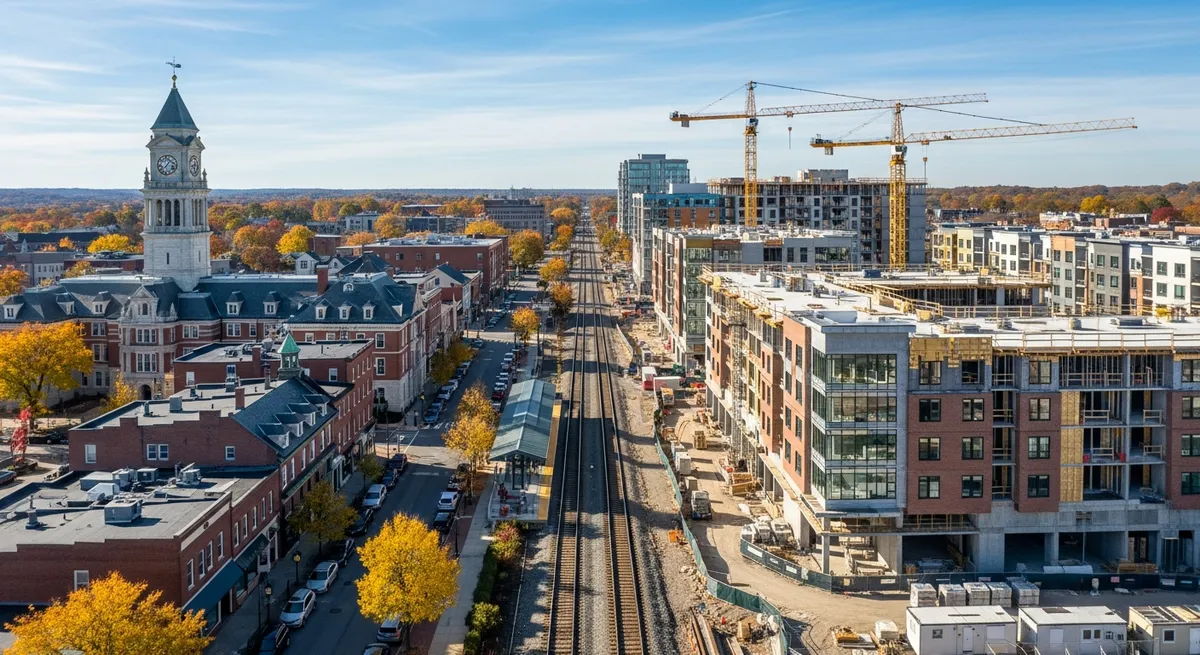
The MBTA Communities Act is the biggest mandatory zoning change I've seen in Massachusetts in my career. It requires 177 cities and towns to create as-of-right multifamily zoning near transit stations. The Massachusetts Executive Office of Housing and Livable Communities (EOHLC) says the law is opening up tens of thousands of new housing units across the state, and developers are saving $200,000 to $500,000 per project by skipping the traditional special permit process.
177 communities affected: All cities and towns in the MBTA service area must create as-of-right multifamily zoning.
Developer cost savings: Developers can save $200,000-$500,000 per project by eliminating special permit processes.
Approval timeline reduction: Projects under "as of right" zoning can be approved in 60-90 days, compared to 12-24 months for special permits.
Central MA pipeline: Worcester alone has over 2,500 units in planning or permitting stages due to this reform.
As of Right Zoning is a regulatory framework where projects meeting pre-defined criteria are approved administratively without discretionary public hearings, significantly reducing approval timelines and political risk for developers.
177 communities affected: All cities and towns in the MBTA service area must create as-of-right multifamily zoning (Massachusetts EOHLC)
Developer cost savings: $200,000-$500,000 per project by eliminating special permit processes (EOHLC)
Approval timeline reduction: 60-90 days for as-of-right vs. 12-24 months for special permits (EOHLC)
Central MA pipeline: 2,500+ units in planning/permitting in Worcester alone (City of Worcester)
Understanding the MBTA Communities Act
The law was signed in 2021 and started rolling out in 2023. It requires cities and towns served by MBTA transit to zone for multifamily housing near their stations.
The basic requirements
Who's Affected: 177 cities and towns in the MBTA service area
What's Required: Each community must:
- Create at least one zoning district allowing multifamily housing "as of right"
- District must be within 0.5 miles of a transit station
- Minimum density of 15 units per acre
- No age restrictions on housing
- District must have capacity for minimum unit count (varies by community)
Timeline:
- Initial compliance deadline: December 31, 2024
- Most communities now compliant or in compliance process
- Non-compliant communities lose access to certain state funding
Community categories
The law sorts communities into categories, each with its own requirements:
| Category | Example Communities | Minimum Units Required | District Size |
|---|---|---|---|
| Rapid Transit | Cambridge, Somerville | 1,500-8,000+ | Large |
| Commuter Rail | Worcester, Framingham | 750-1,500 | Medium |
| Adjacent | Shrewsbury, Northborough | 400-750 | Smaller |
| Adjacent Small | Many suburban towns | 200-400 | Modest |
The development opportunity
What "as of right" means
The traditional Massachusetts development process runs like this:
- Propose project
- Apply for special permit
- Endure public hearings (often contentious)
- Negotiate with planning board
- Risk denial or onerous conditions
- Timeline: 12-24 months
Under MBTA Communities Act:
- Propose project meeting zoning requirements
- Submit site plan for administrative review
- Receive approval (if requirements met)
- Timeline: 60-90 days
""As of right" zoning removes the greatest risk in Massachusetts development: political approval. Projects that meet the code must be approved.
Why this matters financially
Risk Reduction:
- No special permit denial risk
- Predictable approval timelines
- Reduced legal costs
- Lower carrying costs during approvals
Cost Savings:
| Cost Category | Special Permit | As of Right | Savings |
|---|---|---|---|
| Legal fees | $100,000+ | $25,000 | $75,000 |
| Engineering (extra studies) | $75,000 | $40,000 | $35,000 |
| Carrying costs | $200,000+ | $50,000 | $150,000 |
| Timeline | 18 months | 4 months | 14 months |
Total typical savings: $200,000-500,000 per project
Central Massachusetts implementation
Worcester
Compliance Status: Compliant (adopted December 2024)
District Details:
- Five transit-oriented zones created
- Union Station area: 25 units/acre maximum
- Shrewsbury Street corridor: 20 units/acre
- Lincoln Square: 18 units/acre
Development Pipeline:
- 2,500+ units in planning/permitting
- Several projects already under construction
- Strong rental demand supporting development
Framingham
Compliance Status: Compliant
District Details:
- Two commuter rail station areas
- Downtown Framingham: 40 units/acre maximum
- Framingham Centre: 30 units/acre
- Mixed-use encouraged in both
Market Dynamics:
- Significant pent-up demand
- Limited recent development due to prior zoning
- Strong demographics (Framingham State, corporate employers)
Marlborough
Compliance Status: Compliant
District Details:
- Downtown/MBTA area rezoned
- 25 units/acre density allowed
- Height limits increased to 4-5 stories
- Parking requirements reduced near transit
Opportunity:
- Relatively underdeveloped downtown
- Growing employment base
- Route 20 connectivity
Other key communities
| Community | Status | Density Allowed | Key Opportunity |
|---|---|---|---|
| Shrewsbury | Compliant | 18 units/acre | RT 9 corridor |
| Westborough | Compliant | 20 units/acre | Commuter rail area |
| Grafton | In process | 15 units/acre | Commuter rail area |
| Northborough | In process | 15 units/acre | Village center |
Site selection criteria
What to look for
Location Factors:
- Within designated MBTA overlay district
- Walking distance to transit station
- Proximity to amenities (retail, dining)
- Safe pedestrian connections
Physical Characteristics:
- Parcel size adequate for efficient development
- Limited environmental constraints
- Reasonable topography
- Utility availability
Zoning Verification:
- Confirm parcel is in compliant zone
- Verify density allowances
- Understand height limits
- Check parking requirements
Due diligence checklist
Before you buy a site in an MBTA zone, run through this:
Regulatory:
- Confirm zone compliance with EOHLC
- Review local design guidelines
- Understand any overlay restrictions
- Check for historic district overlaps
- Verify utility capacity letters
Physical:
- Phase I/II environmental
- Geotechnical analysis
- Survey and title
- Traffic study (may still be required)
- Stormwater management feasibility
Market:
- Comparable rent analysis
- Absorption study
- Competition pipeline review
- Demographic analysis
Financing considerations
How MBTA zoning affects underwriting
Positive Impacts:
- Lower entitlement risk = lower required returns
- Faster development timeline = lower carrying costs
- Predictable approval = easier construction financing
- Strong demand fundamentals
Lender Perspective:
- Many lenders familiar with MBTA zones
- Reduced permitting risk viewed favorably
- Faster closing possible with streamlined approvals
Typical capital stack
For MBTA-zone multifamily development:
| Source | Percentage | Terms |
|---|---|---|
| Senior construction loan | 60-65% | SOFR + 350-400 bps |
| Mezzanine/preferred | 10-15% | 12-14% fixed |
| Developer equity | 25-30% | Promotes above 8% pref |
State Incentives Available:
- MassHousing financing programs
- LIHTC (if affordable component included)
- Energy efficiency incentives
- Municipal TIF agreements
Design and development standards
Common requirements
Most MBTA-compliant zoning includes:
Dimensional Standards:
- Minimum lot size: None or minimal
- Maximum lot coverage: 80-90%
- Minimum setbacks: 10-20 feet
- Maximum height: 40-65 feet (4-5 stories)
Parking Standards (reduced near transit):
- Studios: 0.5-0.75 spaces
- 1-bedroom: 0.75-1.0 space
- 2-bedroom: 1.0-1.25 spaces
- 3+ bedroom: 1.25-1.5 spaces
Design Guidelines:
- Building orientation to street
- Ground floor activation (retail or lobby)
- Stepbacks at upper floors
- Material and façade variety
- Pedestrian-scale elements
Best practices
The MBTA-zone projects that work tend to do these things:
1. Maximize Density
- Build to maximum allowed density
- Efficient unit layouts
- Reduced parking footprint
2. Amenity Focus
- Common areas that attract renters
- Rooftop/outdoor spaces
- Fitness and coworking areas
- Pet-friendly features
3. Transit Integration
- Clear wayfinding to station
- Bike storage and sharing
- EV charging infrastructure
- Reduced parking emphasis
Market forecast
Supply pipeline
Here's what I expect for MBTA-zone development in Central MA:
- 2025: 1,200 units under construction
- 2026: 2,400 units projected starts
- 2027: 2,800 units projected starts
Absorption Capacity:
- Historical absorption: 1,500-2,000 units/year
- With new supply: Expect 2,500-3,000 units/year
- Demand drivers: Job growth, household formation, Boston migration
Rent projections
| Year | Class A Rents (Worcester) | Growth |
|---|---|---|
| 2025 | $2.15/SF | Baseline |
| 2026 | $2.25/SF | 4.7% |
| 2027 | $2.32/SF | 3.1% |
| 2028 | $2.40/SF | 3.4% |
Action steps for developers
Getting started
1. Market Selection
- Identify compliant communities with strong demographics
- Evaluate existing competition and pipeline
- Assess transit quality and ridership
2. Site Sourcing
- Work with brokers familiar with MBTA zones
- Monitor tax-foreclosed properties
- Consider assemblage opportunities
- Evaluate repositioning candidates
3. Team Assembly
- Attorney experienced with MBTA compliance
- Architect familiar with transit-oriented design
- Civil engineer with local relationships
- General contractor with multifamily experience
4. Capital Relationships
- Establish construction lender relationships
- Identify equity partners interested in MA
- Explore state financing programs
Lornell Real Estate tracks MBTA Communities Act implementation across Central Massachusetts. Contact us for guidance on compliant sites, development opportunities, and strategic advice.
Limitations: Regulatory information reflects statutes and rules in effect at publication. Legislation, enforcement deadlines, zoning ordinances, and municipal requirements change through legislative action, court decisions, and administrative rulemaking. Compliance obligations vary by municipality and property type. This article does not constitute legal advice. Consult a qualified attorney for guidance on specific regulatory compliance requirements.
Sources & References
- City of Worcester
- Executive Office of Housing and Livable Communities
- MBTA
- Massachusetts EOHLC
- Massachusetts Executive Office of Housing and Livable Communities
This article cites data from the sources listed above. For the most current figures, consult the original publications directly.
Data current as of publication date. Market conditions, rates, and regulations may have changed. Consult a qualified commercial real estate professional before making investment decisions.
Get the full Central MA market data
Commercial tax-base growth, development activity, and demographics across Central MA, town by town.