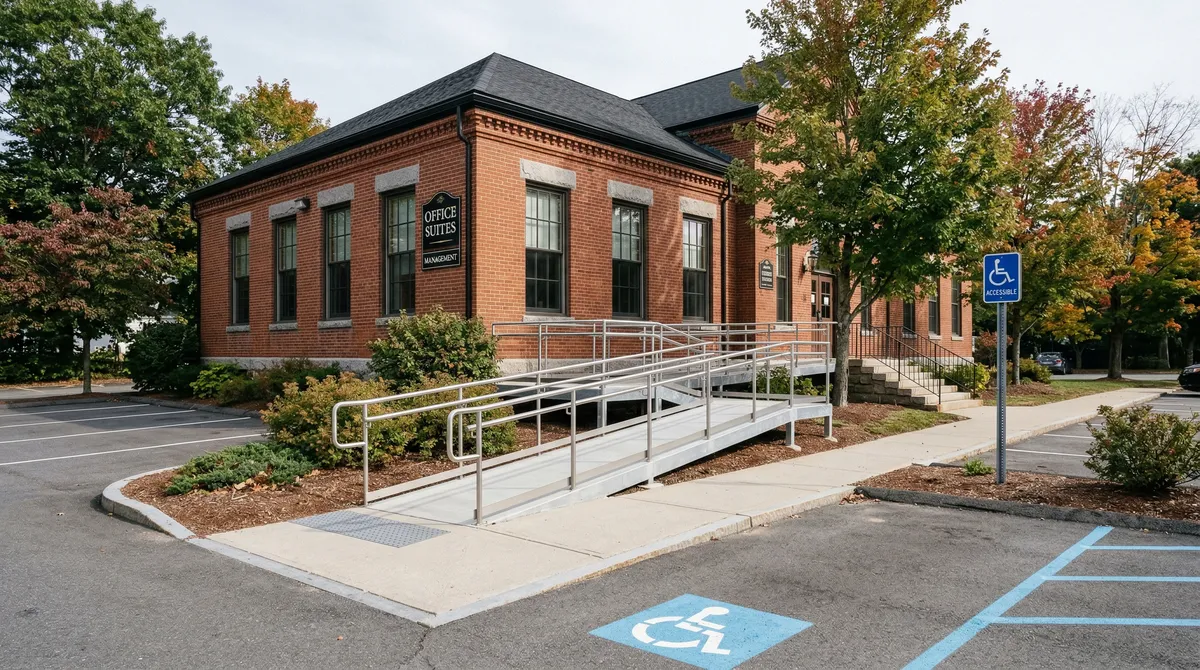
The Americans with Disabilities Act has been federal law since 1990, but ADA lawsuits against commercial property owners still hit a record 11,258 federal filings in 2023, according to Seyfarth Shaw's annual ADA litigation report. In Massachusetts you carry two compliance obligations at once: federal ADA Title III requirements and the Massachusetts Architectural Access Board's 521 CMR regulations. In several areas the state code is stricter than the federal law.
Dual compliance: Massachusetts commercial properties have to meet both federal ADA Title III standards and the state's 521 CMR regulations, which are stricter on door hardware, signage, and parking.
Litigation surge: ADA federal lawsuits hit 11,258 in 2023; Massachusetts ranks among the top 10 states for filing volume.
Readily achievable standard: Existing buildings have to remove barriers when doing so is "readily achievable," meaning easily accomplishable without much difficulty or expense.
Tax incentives: The federal Disabled Access Credit (up to $5,000/year) and Barrier Removal Deduction (up to $15,000/year) offset a good chunk of the cost.
Readily Achievable is the ADA's standard for barrier removal in existing buildings, defined as "easily accomplishable and able to be carried out without much difficulty or expense." The standard weighs the property's size, type, cost of removal, and the owner's financial resources. It is a lower bar than the "undue burden" standard that applies to other ADA requirements.
11,258 federal ADA lawsuits filed in 2023 alone, with commercial property accessibility as the leading claim category.
521 CMR is Massachusetts' accessibility code, enforced by the Architectural Access Board, and stricter than federal ADA in several key areas.
$5,000 + $15,000 in annual federal tax benefits available: the Disabled Access Credit (Section 44) plus the Barrier Removal Deduction (Section 190).
$75,000+ per violation is the potential first-offense federal civil penalty, plus attorney's fees and injunctive relief.
Title III sets the federal floor
Title III of the ADA covers "places of public accommodation," which is basically any private commercial property open to the public. That takes in retail stores, restaurants, offices open to clients, medical facilities, hotels, shopping centers, and industrial properties with public-facing areas.
What Title III requires
What you owe depends on the building's age and whether you've renovated:
| Building Category | Standard | Key Requirement |
|---|---|---|
| New construction (after Jan 26, 1993) | Full compliance with ADA Standards for Accessible Design | Must be fully accessible; no exceptions |
| Alterations to existing buildings | Altered areas must comply; path of travel must be upgraded up to 20% of alteration cost | Triggered by any renovation affecting usability |
| Existing buildings (no alterations) | Readily achievable barrier removal | Must remove barriers when "easily accomplishable" |
That 20% path-of-travel rule matters a lot for Worcester County owners renovating older buildings. Spend $200,000 on a tenant build-out and you have to put up to $40,000 toward making the path of travel accessible: entrances, corridors, restrooms, drinking fountains.
521 CMR: where the state code goes further
The Massachusetts Architectural Access Board (AAB) enforces 521 CMR, the state accessibility code. In several spots it goes past federal ADA.
Where they differ
- Trigger threshold: 521 CMR requires full accessibility compliance for any renovation costing $100,000 or more. Federal ADA has no fixed dollar trigger for existing-building renovations; it uses the "readily achievable" standard instead.
- Parking: 521 CMR requires accessible spaces to be 8 feet wide with an 8-foot access aisle (16 feet total), versus the federal standard of 8 feet with a 5-foot aisle. Van-accessible spaces need an 8-foot aisle under both codes.
- Door hardware: 521 CMR requires lever handles on all doors in the accessible path; federal ADA allows any hardware you can operate without tight grasping.
- Signage: Massachusetts requires tactile and Braille signage at every permanent room, not just the rooms federal ADA calls out.
- Enforcement: The AAB can deny variances and block building permits, which gives it direct leverage over a commercial project.
The $100,000 renovation trigger
This is the one that catches most Worcester County owners off guard. Under 521 CMR Section 3.3, if your renovation costs on a building cross $100,000 in any 36-month window, the entire building has to be brought up to current accessibility standards. For the older masonry and frame buildings that make up 76% of Worcester's commercial inventory (built before 1980), that can add $50,000 to $200,000 or more to a project.
The 10 violations I see cited most
Based on DOJ enforcement actions and litigation patterns, these are the ones that draw the most complaints and lawsuits:
- Insufficient accessible parking: wrong number of spaces, incorrect signage, missing access aisles, excessive slope
- Inaccessible entrances: steps without ramps, heavy doors without automatic openers, narrow doorways (must be 32" clear minimum)
- Restroom noncompliance: grab bars missing or in the wrong spot, insufficient turning radius (60" diameter), inaccessible fixtures
- Missing or incorrect signage: no Braille/tactile signs, signs mounted at the wrong height (centered 60" above floor), no directional signage to accessible features
- Counter heights: service counters above 36" with no lowered section or alternative way to serve
- Inaccessible route of travel: changes in level greater than 1/4", running slope over 5%, cross-slope over 2%
- Protruding objects: wall-mounted objects between 27" and 80" above floor sticking out more than 4" into the path of travel
- Website inaccessibility: under current DOJ guidance, commercial property websites must comply with WCAG 2.1 Level AA standards
- Lack of accessible parking on resurfacing: when a lot is resurfaced or restriped, accessible spaces and signage have to be brought into compliance
- Emergency egress: accessible means of egress not provided or not connected to areas of rescue assistance
What noncompliance can cost you
Federal penalties
- First violation: Civil penalties up to $75,000
- Subsequent violations: Up to $150,000
- Attorney's fees: Prevailing plaintiffs recover their attorney's fees, and that is what drives serial ADA litigation
- Injunctive relief: Courts can order specific modifications with deadlines
Massachusetts penalties
- The AAB can issue orders requiring compliance within set timeframes
- Failure to comply can bring fines and building-permit holds
- Private lawsuits under Massachusetts law (M.G.L. Chapter 93, Section 103) let plaintiffs recover triple damages
- The Massachusetts Attorney General can bring enforcement actions
The serial litigation problem
ADA litigation has turned into a business of its own. A handful of law firms and plaintiffs file thousands of cases a year, going after properties with visible violations, usually parking and entrance issues. In 2023 the top 10 ADA plaintiff law firms accounted for over 40% of all federal filings. Owners in high-traffic spots along corridors like Route 9 in Spencer or Route 20 in Auburn are especially exposed, because a serial plaintiff can document a visible violation from the parking lot.
Tax breaks that offset the cost
Congress wrote two federal tax provisions specifically to encourage ADA compliance.
Disabled Access Credit (IRC Section 44)
- Who qualifies: Small businesses with gross receipts under $1 million or fewer than 30 full-time employees
- Credit amount: 50% of eligible access expenditures between $250 and $10,250
- Maximum annual credit: $5,000
- Eligible expenses: Barrier removal, interpreters, accessible formats, equipment modifications
Barrier Removal Tax Deduction (IRC Section 190)
- Who qualifies: Any business, no size limit
- Deduction amount: Up to $15,000 per year for qualified barrier removal
- Eligible expenses: Removing architectural and transportation barriers for people with disabilities
- Not limited to ADA compliance: Applies to any accessibility improvement
Using them together
An owner spending $25,000 on ADA work can potentially claim a $5,000 tax credit (Section 44) plus a $15,000 deduction (Section 190), which brings the net cost down to roughly $5,000 to $8,000 depending on tax bracket. For a Worcester County commercial property owner renovating an older building, those two provisions take a real bite out of the compliance cost.
A compliance roadmap I'd give any owner
Step 1: Get an ADA survey. Bring in a certified access specialist (CASp) or ADA consultant to audit the property. Figure $2,000 to $5,000 for a typical retail or office building. You get a prioritized fix list, and it shows good-faith effort.
Step 2: Hit the high-impact items first. Parking, entrances, and restrooms. Those draw the most complaints and they're the most visible.
Step 3: Put compliance in your capital plan. Set aside 5 to 10% of your annual capital budget for accessibility work, and time it with tenant improvement cycles to hold down the incremental cost.
Step 4: Document everything. Keep records of every accessibility improvement, survey report, and dollar spent. A record of ongoing good-faith barrier removal is a defense if you get sued.
Step 5: Check your insurance. Confirm your commercial general liability policy actually includes ADA defense coverage. A lot of standard policies exclude or limit it. Specialized ADA liability endorsements are available.
Sources & References
- Seyfarth Shaw ADA Title III Litigation Report (2023)
- U.S. Department of Justice, ADA Title III regulations (28 CFR Part 36)
- Massachusetts Architectural Access Board, 521 CMR
- Internal Revenue Code Sections 44 and 190
- ADA Standards for Accessible Design (2010)
Data current as of publication date. ADA regulations, Massachusetts 521 CMR standards, and tax provisions are subject to legislative and regulatory changes. Consult qualified legal, architectural, and tax professionals before making compliance decisions.
Need an accessibility assessment for your commercial property? Contact Lornell Real Estate at (774) 745-0015 or [email protected]. We connect property owners with qualified ADA consultants and help factor compliance costs into acquisition and renovation budgets.
Limitations: This article is general guidance on ADA and Massachusetts accessibility requirements and is not legal advice. ADA compliance is property-specific and turns on building age, renovation history, use classification, and other factors. Tax incentive availability depends on individual circumstances. Consult a qualified attorney, certified access specialist, and tax advisor before making compliance or investment decisions.
Get the full Central MA market data
Commercial tax-base growth, development activity, and demographics across Central MA, town by town.