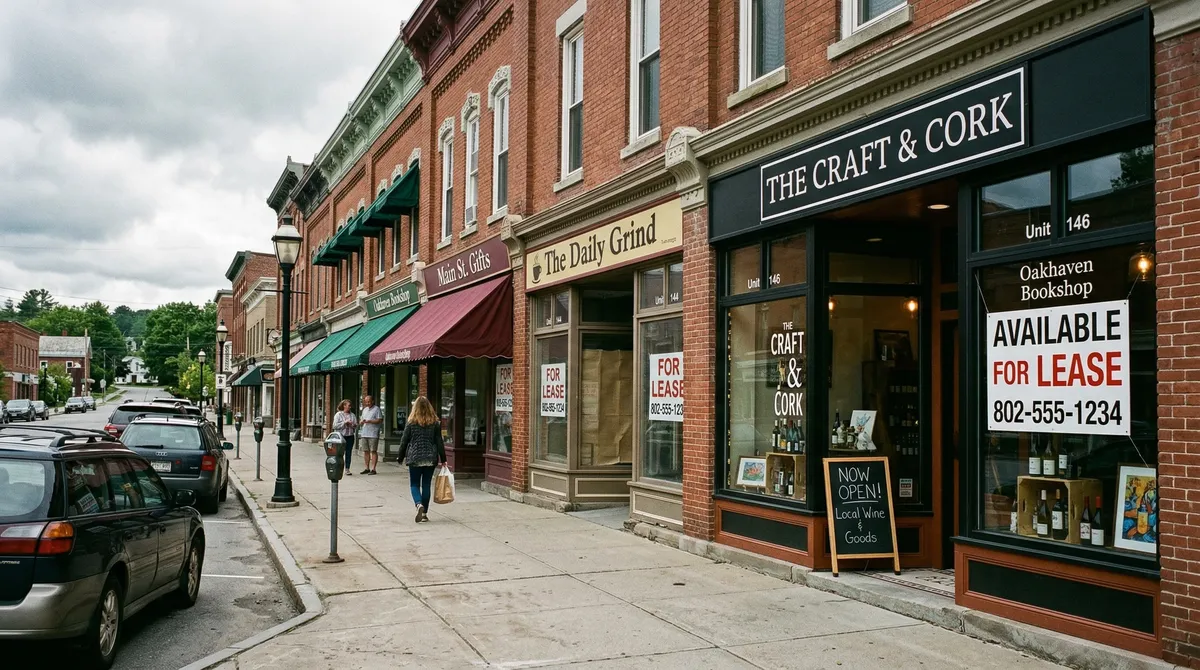
Right now Worcester has over 80 retail listings and 41 industrial listings open for lease, and commercial rents run anywhere from $6/SF NNN for warehouse space up to $28/SF for premium downtown retail. The population here grew 14.1% over the last decade (that's the Census Bureau's number), and that many new residents means real demand for the businesses that serve them. One thing that surprises a lot of first-time tenants: a tenant rep broker costs you nothing, because the landlord pays the commission.
A tenant rep broker costs you nothing. Landlords cover the commission.
Worcester's population grew 14.1% over the last decade, which puts more customers in front of every small business.
Worcester County has pulled in $161 million in state economic development grants, and it shows in the commercial market.
If you need a small warehouse under 6,000 SF, move fast. Those spaces go quicker than anything else in this market.
Rents run from $6/SF NNN for warehouse to $28/SF for premium downtown retail, with average retail landing at $20-22/SF.
NNN is a commercial lease where the tenant pays base rent plus a pro-rata share of the property's operating expenses, including property taxes, insurance, and common area maintenance (CAM).
Rent ranges: strip retail $12-22/SF NNN, downtown retail $18-28/SF, warehouse $6-12/SF NNN, professional office $14-22/SF (CoStar Group)
Tenant rep brokers cost the tenant nothing; the landlord pays all commissions (National Association of Realtors)
Worcester grew 14.1% from 2010 to 2020, adding thousands of potential customers (U.S. Census Bureau)
Budget 4-8 weeks for lease negotiation after you submit a Letter of Intent (CBRE)
Why Worcester, and why now
Worcester is the second-largest city in New England, and it's growing fast. The population climbed 14.1% over the last decade, thousands of new potential customers for local businesses. A revitalized downtown anchored by Polar Park, expanding rail service to Boston, and $161 million in state economic development grants for Worcester County have reshaped the commercial market.
For a small business owner, that growth is opportunity. But leasing commercial space for the first time can be intimidating. This guide walks through how to find, evaluate, and lease commercial space in Worcester, MA.
Step 1: Know what type of space you need
Commercial real estate isn't one-size-fits-all. The type of space you lease drives your rent, your lease structure, your build-out costs, and your customers' experience.
Space types at a glance
| Type | Best For | Avg. Rent (Worcester) | Avg. Size |
|---|---|---|---|
| Retail | Restaurants, shops, salons, fitness studios | $20-22/SF | 2,927 SF (strip) to 11,612 SF |
| Office | Professional services, tech, consultants | $16-20/SF | 1,500-5,000 SF |
| Industrial/Warehouse | Manufacturing, distribution, contractors | ~$10/SF | 40,245 SF avg. |
| Flex | Businesses needing office + warehouse combo | $10-14/SF | 3,000-15,000 SF |
| Coworking | Freelancers, startups, solo practitioners | $300-600/month per desk | N/A |
One thing on industrial space: small warehouse spaces under 6,000 SF are moving extremely fast in Worcester. If your business needs a small warehouse or workshop, act the day you find availability. These listings do not last.
Right now the Worcester market has roughly 81 retail listings and 41 industrial listings available. Sounds like a lot, but the inventory is uneven. Some neighborhoods have plenty of options; others have almost none.
Step 2: Pick the right neighborhood
Location drives foot traffic, employee commutes, supplier access, and how customers read your brand. Worcester's commercial districts each fit different business types.
Downtown Worcester (most listings, ~8 retail spaces)
The city's densest commercial district. Best for restaurants, professional offices, and businesses that live off foot traffic. Polar Park and the restaurant row on Shrewsbury Street keep pedestrian activity steady. Rents run higher here, expect $22-28/SF for prime ground-floor retail.
Shrewsbury Street corridor
Worcester's restaurant and nightlife hub. Highly competitive for food and beverage tenants. Availability is limited, but the foot traffic and name recognition are strong.
Booth Apartments / South Worcester (~5 listings each)
More affordable neighborhoods with growing residential density. Good fits for service businesses that serve the people who live nearby rather than destination shoppers: laundromats, convenience stores, auto services, medical offices.
Green Hill / West Side
Residential neighborhoods with pockets of commercial zoning along the main arteries. Lower rents and less competition, which works for neighborhood retail or professional offices.
Route 9 corridor (Auburn, Leicester, Spencer)
The major east-west commercial corridor west of Worcester. Route 9 carries roughly 16,000 average daily traffic through Spencer and higher counts closer to Auburn. Strip retail centers, freestanding buildings, and flex space line this corridor. Rents drop as you move west: retail space in Spencer averages $12.00/SF NNN against $20+ in Worcester proper.
Auburn and suburban Worcester
I-90 and Route 20 access make Auburn a distribution and retail hub. National chains cluster here, and sharing a center with an established retailer can pull traffic to a smaller operator.
Step 3: Understand lease types (in plain English)
Lease structures decide who pays what. Get this wrong and you can blow your budget by thousands of dollars a year.
Triple net (NNN), most common in Worcester retail
With a triple net lease you pay base rent plus property taxes, insurance, and maintenance (the CAM charges).
NNN is the most popular lease type in Worcester, and most available retail listings use it. Your landlord quotes a base rent, say $12.00/SF, but your total occupancy cost lands higher once you add the NNN charges. Always ask: "What are the estimated NNN expenses per square foot?" A typical NNN add-on in Worcester runs $3.00-6.00/SF, so your $12.00/SF base rent becomes $15.00-18.00/SF all-in.
Gross lease
With a gross lease you pay one flat rent amount, and the landlord covers taxes, insurance, and maintenance. Simpler to budget, but the landlord builds those costs into a higher base rent. You see it a lot in office space.
Modified gross
With a modified gross lease you pay base rent plus some operating expenses, and it varies. You might pay base rent plus your share of property taxes while the landlord covers insurance and maintenance. Every modified gross lease is different, so read the details.
Key takeaway
Always calculate your total occupancy cost, not just the advertised rent. A $20/SF gross lease and a $14/SF NNN lease with $6/SF in additional charges cost the same, but they don't feel the same when you first see the listing.
Step 4: Budget for the full picture
Rent is the biggest line item, but it isn't the only one. First-time tenants routinely lowball these:
Costs beyond rent
- Security deposit: typically 1-3 months' rent, sometimes more for a new business with no track record.
- Tenant improvements (TI): the build-out for your space, walls, flooring, electrical, HVAC, plumbing. Budget $30-80/SF for a basic retail fit-out, $80-150+/SF for restaurants and medical offices.
- CAM charges: Common Area Maintenance, your share of parking lot upkeep, snow removal, landscaping, and shared utilities in multi-tenant properties.
- Signage: permits, fabrication, and installation. Worcester sign permits require Board of Appeals review in some zoning districts.
- Insurance: commercial general liability, property contents, business interruption. Your landlord will spell out the minimum coverage.
- Utilities: ask whether the space is separately metered. Shared utilities with fuzzy cost splits are where the surprises live.
What to expect on pricing
| Space Type | Low End | High End | Notes |
|---|---|---|---|
| Strip retail | $12/SF NNN | $22/SF NNN | Varies heavily by traffic and co-tenancy |
| Downtown retail | $18/SF | $28/SF | Premium for ground-floor, high-visibility |
| Professional office | $14/SF | $22/SF | Class B/C more affordable than Class A |
| Warehouse/industrial | $6/SF NNN | $12/SF NNN | Under 6,000 SF commands premium |
| Flex space | $10/SF | $14/SF | Office/warehouse combo |
Worcester retail spaces run from 150 SF (a kiosk or pop-up) to 81,500 SF (big-box anchor space). Most small businesses land in the 1,000-3,000 SF range for retail or 1,500-5,000 SF for office.
Step 5: The leasing process, start to finish
1. Define your requirements
Before you tour a single space, write down your non-negotiables: square footage range, budget ceiling (total occupancy cost, not just rent), parking needs, specific equipment requirements (grease trap, three-phase power, loading dock), and location priorities.
2. Engage a tenant rep broker
A commercial broker representing you, the tenant, costs you nothing. The landlord pays the commission. A good tenant rep surfaces off-market opportunities, negotiates lease terms, and flags risks you'd walk right past. There's no rational reason to skip this step.
3. Tour and evaluate spaces
Visit at different times of day. Check parking at peak hours. Count foot traffic. Talk to the neighboring tenants. Look at the roof, the HVAC units, and the electrical panel, not just the paint and flooring.
4. Submit a Letter of Intent (LOI)
The LOI lays out proposed terms: rent, lease term, TI allowance, free rent period, renewal options. It's a negotiation document, not a binding contract. Your broker drafts it.
5. Negotiate the lease
The landlord's attorney sends a lease draft. Your attorney reviews it. The points that matter: rent escalations, renewal options, exclusivity clauses, assignment rights, and who pays for what in the build-out. Budget 4-8 weeks for lease negotiation.
6. Build out and open
Once the lease is signed, construction begins. Simple spaces take 4-6 weeks; restaurants and medical offices take 3-6 months. Negotiate a rent commencement date that starts after build-out, not at lease signing.
Step 6: Questions you must ask before signing
These questions separate informed tenants from the ones who get burned:
- "What are the estimated CAM charges and how are they reconciled annually?" CAM overcharges are one of the most common landlord-tenant disputes.
- "What TI allowance are you offering?" Plenty of landlords will put $5-20/SF toward the build-out in exchange for a longer lease term.
- "Is there an exclusivity clause?" If you're opening a pizza restaurant, you want a clause that keeps the landlord from leasing to another pizza restaurant in the same center.
- "What are the rent escalation terms?" Fixed annual increases (2-3%) are predictable; CPI-based escalations are not.
- "Can I assign or sublease?" If your business needs change, can you transfer the lease or sublease part of your space?
- "What is the parking ratio?" Retail tenants need 4:1 or better (4 spaces per 1,000 SF). Anything below 3:1 will hurt your business.
- "What are the permitted uses under the lease and the zoning?" Your lease might allow "restaurant," but the zoning might require a special permit for a drive-through.
- "Who is responsible for HVAC, roof, and structural repairs?" In a NNN lease, know exactly which maintenance costs fall to you.
Step 7: Common mistakes (and how to avoid them)
Fixating on rent and ignoring total occupancy cost. A $16/SF NNN lease with $6/SF in additional charges costs more than an $18/SF gross lease. Always compare apples to apples.
Underestimating build-out costs and timelines. That "move-in ready" space still needs your signage, your equipment, your IT infrastructure, and probably some cosmetic work. A restaurant build-out you pencil in at $100,000 will cost $150,000. Plan accordingly.
Skipping the attorney. Commercial leases are not residential leases. They're 30-60 page contracts drafted by the landlord's attorney to protect the landlord. You need your own attorney. Budget $2,000-5,000 for lease review.
Ignoring parking. If your customers can't park easily, they won't come. Period. Count the spaces, watch the lot at peak hours, and verify your lease guarantees a minimum parking allocation.
Not negotiating. Every lease term is on the table: rent, TI allowance, free rent, escalations, renewal options, exclusivity. Landlords expect it. First-time tenants who sign the first draft leave money behind.
Choosing location on rent alone. The cheapest space is rarely the best value. A $24/SF location with 15,000 ADT and anchor-tenant traffic will outperform a $14/SF space on a dead-end street.
Why work with a broker
Commercial brokers who represent tenants get paid by the landlord, so there's no cost to you. Here's what a tenant rep does that's hard to do on your own:
- Market access: brokers hear about spaces before they hit the public listings, including off-market ones.
- Comparable data: a broker can tell you what similar tenants are paying nearby, which gives you leverage in negotiations.
- Lease negotiation: brokers negotiate commercial leases every week. You do it once every 5-10 years.
- Risk identification: an experienced broker spots the clauses that can cost you thousands, demolition clauses, relocation rights, radius restrictions.
- Time savings: instead of calling 30 landlords, your broker hands you a shortlist matched to your requirements.
Start your search
Worcester's commercial market is active, growing, and full of opportunity for small businesses willing to do the homework. Whether you're after retail space on Shrewsbury Street, a flex building off I-290, or an affordable storefront along Route 9, the right space is out there. You just need to find it before someone else does.
Lornell Real Estate handles commercial leasing across Worcester County and Central Massachusetts. Our team knows every corridor, every landlord, and every available space in this market. Tenant representation is free, we're paid by the landlord, so there's zero cost to you.
Browse current Worcester listings: Retail Space for Rent | Office Space for Rent | Industrial Space | Warehouse for Rent | All Commercial Space for Lease
Contact Lornell Real Estate at (860) 305-7432 or visit lornellre.com to start your commercial space search.
Limitations: The lease rates, vacancy figures, and expense estimates cited here are Central Massachusetts market averages at publication and may not apply to a specific property or municipality. Actual occupancy costs depend on individual lease terms, property condition, location, and landlord negotiations. Commercial lease structures vary widely. This article is not legal advice. Have a commercial real estate attorney review any lease before you sign.
Sources & References
- CBRE
- Census Bureau
- CoStar
- CoStar Group
- National Association of Realtors
- U.S. Census Bureau
This article cites data from the sources listed above. For the most current figures, consult the original publications directly.
Data current as of publication date. Market conditions, rates, and regulations may have changed. Consult a qualified commercial real estate professional before making investment decisions.
Get the full Central MA market data
Commercial tax-base growth, development activity, and demographics across Central MA, town by town.