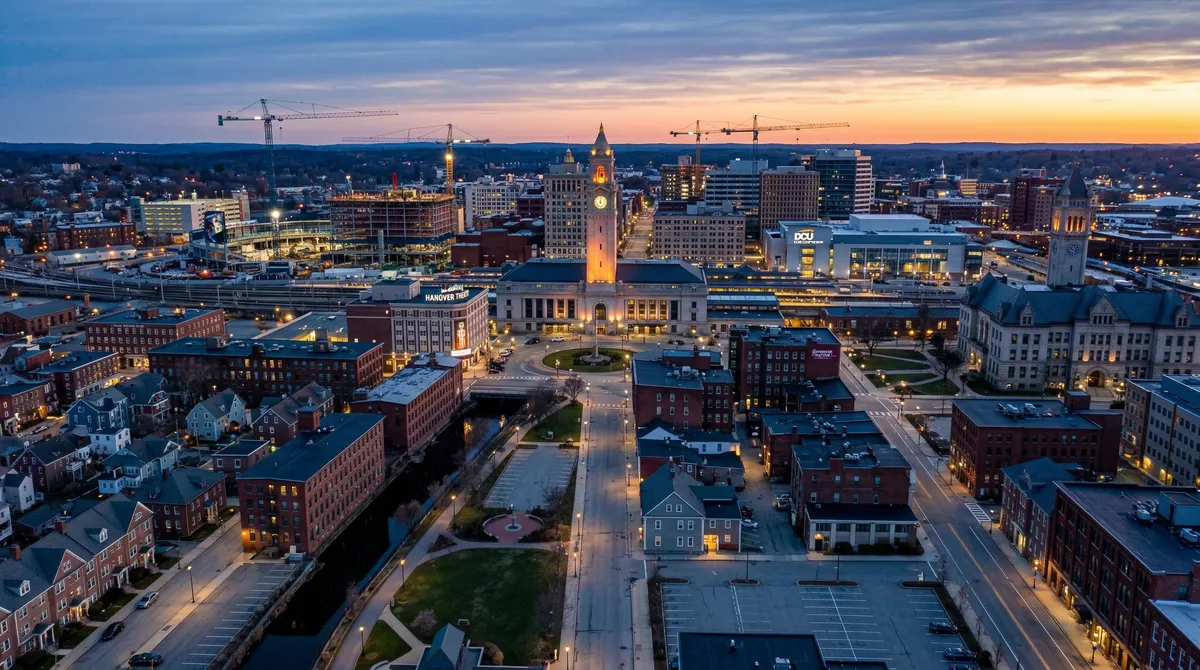
2026 is the best year to buy commercial real estate in Central Massachusetts that I've seen in a decade. The Federal Reserve's December 2025 projections have rates falling to 3.1% by the end of 2026, and roughly $1.2 trillion in commercial loans are maturing (Mortgage Bankers Association) with owners who can't refinance at today's rates. Cheaper money and motivated sellers, in the same year.
Interest rates: The Federal Reserve projects rates falling to 3.1% by year-end 2026, which lowers borrowing costs on acquisitions.
Loan maturities: About $1.2 trillion in commercial loans mature in 2025-2026, pushing owners who can't refinance to sell.
Cap rates: Industrial cap rates are forecast to compress to 4.85% by late 2026, which raises property values.
Lending standards: Only 9% of banks were tightening standards as of June 2025, down from 67.4% in April 2023.
Cap Rate is a real estate metric calculated by dividing a property's Net Operating Income by its purchase price or market value, providing investors with an estimated annual rate of return.
Fed rates at 3.5-3.75% with projections to 3.1% by end of 2026, reducing borrowing costs for commercial acquisitions.
$1.2 trillion in commercial loans maturing in 2025-2026 (Mortgage Bankers Association), creating forced-seller opportunities at discounted valuations.
Industrial cap rates compressing to 4.85% by late 2026 (Statista), which raises property values.
Only 9% of banks tightening lending standards (Federal Reserve SLOOS, June 2025), down from 67.4% in April 2023.
What the rate move actually means here
The Fed's December 2025 meeting was the turn. In a 9-3 vote it cut its benchmark rate 25 basis points, to between 3.5% and 3.75%, the third cut of 2025. Its quarterly dot plot then put rates at 3.1% by the end of 2026.
For commercial real estate, that matters more than the headline number suggests.
How rates move values
Lower rates cut borrowing costs, which makes more deals pencil and brings more buyers to the table. Two things follow.
Financing is easing off its 2024 peak. Owners quoted 7% or more eighteen months ago are seeing the low-to-mid 6s now, and I expect that to keep drifting down.
Cap rates are compressing with it. Statista's 2025 CRE forecast has industrial cap rates going from 5.35% in Q4 2023 to 4.85% by late 2026. That compression shows up directly as value: a 50 basis point drop on a property with $5 million in NOI is worth more than $500,000.
Why Central Massachusetts
Boston pricing is steep. Worcester County gives you the same region at a friendlier basis.
Worcester sits where I-90, I-290, and I-190 meet, with Boston 40 miles east, Hartford 60 miles southwest, and Providence 40 miles south. For anyone running distribution or logistics across New England, that location does real work.
There's inventory to buy. Worcester has about 2.1 million square feet of industrial space across 19 listings right now, averaging $235 per square foot at cap rates near 6.68%, well above what you'd clear in Boston.
And the talent stays put. WPI, Clark, and UMass Medical keep feeding local employers, which is what holds a market up over the long run.
The $1.2 trillion piece
The near-term opportunity I'd watch most closely is the maturity wall. About $1.2 trillion in commercial loans come due across 2025 and 2026, at an average rate around 4.59% to 4.91%, well under today's refinancing rates above 6%.
That gap forces decisions:
- Owners who can't refinance or add equity have to sell, often below peak pricing
- Distressed and opportunistic funds are shopping, but nothing like the frenzy of 2021-2022
- Buy at today's reset basis and you're positioned for the upside when the market normalizes
How I read the cycle
Real estate moves in cycles, and 2026 is a rare place to step in:
Rates have peaked. The Fed has clearly turned to cutting.
Distress is creating sellers. Owners are running out of good refinancing options.
Lending is loosening. The Fed's Senior Loan Officer Opinion Survey (SLOOS) has only 9% of banks tightening standards, down from 67.4% in April 2023.
The fundamentals hold. Industrial demand is strong and retail vacancy is at 20-year lows.
""Falling rates, maturing-loan distress, and Central Mass fundamentals are lining up at the same time. It's the best risk-adjusted buying window I've seen since 2010 to 2012," says **Todd Lornell**, Principal & Founder, Lornell Real Estate
Buy carefully in 2026, good assets at reset prices with financing that keeps improving, and I think you'll look back on this as one of the better entry points of the decade.
Where I'd look
If you're considering Central Massachusetts, I'd start with:
- Industrial and warehouse with real highway access and modern specs
- Neighborhood retail anchored by necessity tenants in growing suburbs
- Value-add multifamily in towns that have adopted MBTA Communities Act zoning
None of this stays open forever. As rates fall further and the distressed deals clear, more buyers show up and pricing tightens back. The argument is for moving while those deals are still on the table.
Call Lornell Real Estate and we'll talk through specific opportunities in Central Massachusetts.
Limitations: Market data, projections, and trend analyses reflect conditions at publication. Commercial real estate markets are inherently cyclical, and submarket and property-level performance can diverge significantly from the regional averages cited. Demographic data, employer information, and regulatory conditions are subject to change. This article does not constitute investment advice. Conduct property-specific due diligence and consult qualified professionals before making investment decisions.
Sources & References
- Federal Reserve
- Federal Reserve SLOOS
- MBTA
- Mortgage Bankers Association
- Statista
This article cites data from the sources listed above. For the most current figures, consult the original publications directly.
Data current as of publication date. Market conditions, rates, and regulations may have changed. Consult a qualified commercial real estate professional before making investment decisions.
Get the full Central MA market data
Commercial tax-base growth, development activity, and demographics across Central MA, town by town.