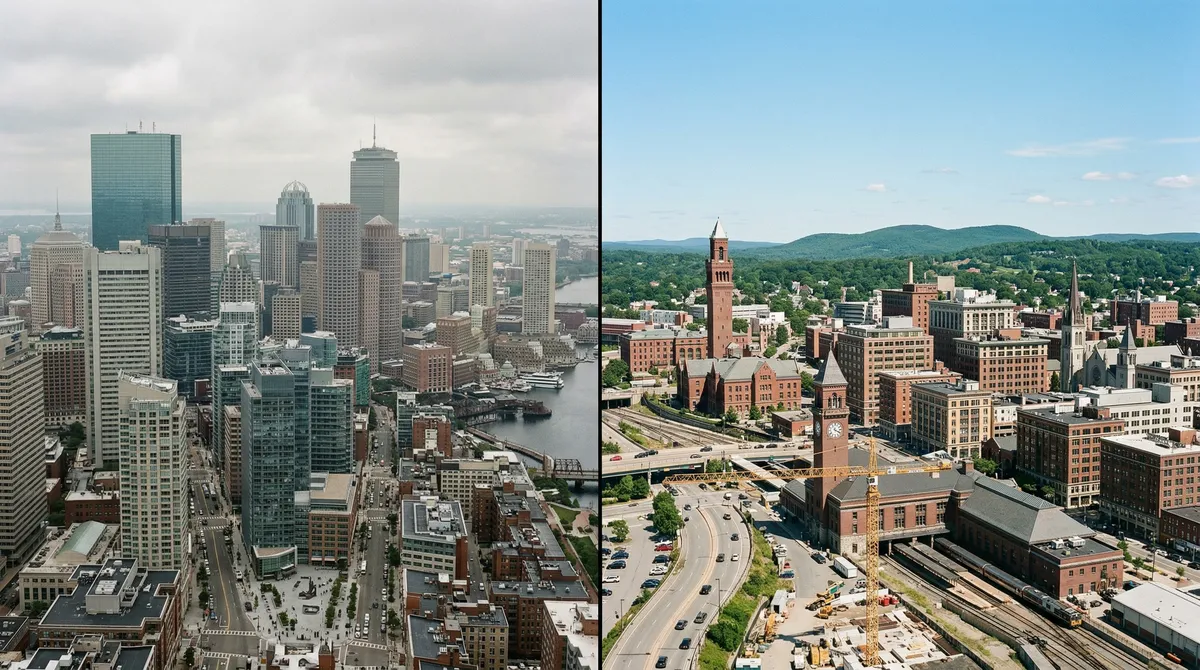
Worcester County gives commercial real estate investors cap rates 150-200 basis points higher than Greater Boston, with entry prices 60-70% lower across every property type. That combination is why I keep telling priced-out Boston buyers to look 40 miles west. Per CoStar Group, Worcester industrial trades at $80-150/SF against $250-400/SF in Boston. Meanwhile the city posted 14.1% population growth (U.S. Census Bureau) and a #3 national housing market ranking (Realtor.com), so the commercial demand behind those numbers is not going anywhere.
Higher cap rates: Worcester runs 150-200 basis points above Greater Boston across industrial, retail, and multifamily.
Lower entry prices: Industrial entry prices are 60-70% lower per square foot than Boston.
Real growth: Worcester grew 14.1% from 2010-2020, the fastest of any major New England city.
Capital coming in: More than $4 billion in public and private investment, including $161 million in state grants.
Cap rate is the capitalization rate, a core commercial real estate metric. You divide a property's net operating income by its current market value, and you get the rate of return.
Cap rate premium: 150-200 basis points above Greater Boston across industrial, retail, and multifamily (CoStar Group)
Entry price discount: 60-70% lower per SF for industrial, 50-60% lower per unit for multifamily vs. Boston (CoStar Group)
Population growth: 14.1% from 2010-2020, fastest of any New England city over 100,000 residents (U.S. Census Bureau)
Public investment: $4+ billion in recent public and private investment including $161M in state grants (City of Worcester / mass.gov)
Why Boston stops penciling for most buyers
Greater Boston is one of the strongest commercial real estate markets in the country. It is also one of the most expensive and most competitive, and for a lot of investors it is simply out of reach.
Look at the barriers:
- Industrial: $250-400/SF with cap rates of 4.5-5.5%. A 20,000 SF warehouse runs $5-8 million.
- Retail: prime locations command $40-60/SF NNN. Neighborhood centers trade at sub-6% cap rates.
- Multifamily: $300,000+ per unit in core locations. Class B in the suburbs trades at 4.5-5% cap rates.
- Office: 17% vacancy and climbing. With remote work still unsettled, underwriting it is a guess.
If you are an institutional buyer writing $50 million-plus per deal, Boston works fine. If you are a private investor, a family office, or a newer operator working with $500,000 to $5 million in equity, Boston increasingly does not pencil. The entry points are too high, the cap rates are too compressed, and you are bidding against well-capitalized institutions every time.
So the capital is moving 40 miles west, to Worcester.
What Worcester actually offers, in numbers
Price comparison
| Metric | Greater Boston | Worcester County | Advantage |
|---|---|---|---|
| Industrial price/SF | $250 - $400 | $80 - $150 | 60-70% lower |
| Retail price/SF | $200 - $350 | $100 - $175 | 50-55% lower |
| Multifamily price/unit | $250K - $400K | $100K - $200K | 50-60% lower |
| Office price/SF | $150 - $300 | $60 - $120 | 55-65% lower |
Cap rate comparison
| Property Type | Boston Metro | Worcester County | Spread |
|---|---|---|---|
| Industrial | 4.5% - 5.5% | 6.0% - 7.5% | +150-200 bps |
| Retail | 5.0% - 6.5% | 6.5% - 8.0% | +150 bps |
| Multifamily | 4.0% - 5.0% | 5.5% - 7.0% | +150-200 bps |
| Flex / R&D | 5.0% - 6.0% | 6.5% - 8.0% | +150-200 bps |
The cap rate spread is the whole story. Put $1 million of equity into a leveraged Worcester industrial deal and you capture 150-200 basis points more yield than the same equity in Boston, on a property that costs 60-70% less to buy. That math works for a private investor in Worcester. In Boston it does not.
Worcester is not sitting still
The price and cap rate advantage would matter less if Worcester were a dead market. It is not. By several measures it is the fastest-growing major city in New England.
Population growth
Worcester grew 14.1% between 2010 and 2020, the fastest of any New England city over 100,000 residents. Current population is roughly 206,000. Boston grew 12.2% over the same stretch off a base four times larger. On a percentage basis, Worcester is outpacing the state's biggest city.
Housing demand
Realtor.com ranked Worcester the #3 housing market nationally for 2026, projecting 12.6% growth in home sales and 2.4% price appreciation. Homes sell in an average of 24 days with 3 offers per listing. Inventory sits at 1.8 months, well under the 6-month balanced-market line.
That demand is not speculative. It is affordability migration out of Boston. Worcester's median home price of roughly $450,000 is 40% below Greater Boston's median. Remote and hybrid work has made the 40-mile commute workable for people who need to be in Boston two or three days a week.
Investment and infrastructure
- $4+ billion in recent public and private investment in Worcester
- Polar Park (opened 2021) kicked off the Canal District turnaround
- $161 million in state economic development grants announced for Worcester County
- Commuter rail running direct into Boston's Back Bay and South Station
- Major corridor work along Route 146, I-290, and Route 9
Employment diversification
Worcester's economy is no longer riding on legacy manufacturing. The current employment base includes:
- Healthcare: UMass Memorial Health (13,000+ employees), St. Vincent Hospital
- Education: WPI, Clark University, Holy Cross, UMass Chan Medical School
- Biotech / Life Sciences: 1.1 million SF of lab space in the pipeline, nearly 25% of MA biomanufacturing jobs in Worcester County
- Financial Services: Hanover Insurance, Unum Group, Commerce Bank
- Technology: a growing startup ecosystem anchored by university R&D
A spread-out employment base like that supports commercial demand across every property type. Markets that live and die on one industry do not have that.
Sector by sector
Industrial
Boston: the industrial market is basically institutional. Deals under $5 million are hard to find, competition is fierce, and cap rates below 5% force you to underwrite aggressive rent growth just to hit acceptable returns. A lot of what is available is dated and needs real capital to fix.
Worcester: a deep supply of industrial, from 3,000 SF small-bay buildings to 100,000+ SF warehouse and distribution. Pricing at $80-150/SF puts quality assets in reach of private investors. Cap rates of 6-7.5% give you immediate positive leverage at current financing rates. The Route 146 corridor is turning into a regional logistics hub with institutional-grade new construction.
My read: Worcester wins for private investors on price, yield, and how much product is available. Boston wins on institutional scale and liquidity.
Retail
Boston: core retail is expensive and competitive. Suburban retail in the Route 128 belt trades at tight cap rates with limited upside. Neighborhood centers in gateway communities carry operational headaches.
Worcester: retail vacancy is at or near 20-year lows statewide, and Worcester County neighborhood centers anchored by necessity tenants (grocery, pharmacy, dollar stores) throw off stable cash flow at cap rates 150-plus basis points above suburban Boston retail. Population growth is the tailwind: every 1,000 new residents drives demand for 15,000-20,000 SF of retail space.
My read: Worcester gives you better yield on necessity-anchored retail. Boston gives you higher tenant quality and foot traffic in core urban spots.
Multifamily
Boston: sub-5% cap rates in core locations with little upside. There are value-add plays in Class B/C suburban assets, but institutional and REIT buyers have compressed the returns. Rent control risk adds a regulatory question mark.
Worcester: cap rates of 5.5-7% on stabilized multifamily, with genuine value-add for operators who can renovate and re-position. Housing inventory at 1.8 months of supply keeps rental demand steady. No rent control. The MBTA Communities Act is driving zoning changes that open up new development.
My read: Worcester wins clearly for value-add operators and anyone chasing cash flow. Boston wins for trophy assets and parking institutional capital.
Office
Boston: 17% vacancy and rising. The flight to quality has split the market. Class A towers hold occupancy while Class B/C buildings bleed tenants. Remote work has permanently cut aggregate office demand.
Worcester: same headwinds, at far lower price points. If you can pick up a distressed office asset at $60-80/SF and convert it to medical office, flex, or residential, the returns are there. That adaptive reuse math works more easily here than in Boston, where the acquisition cost alone kills the conversion.
My read: both markets are fighting the same office problem. Worcester has the price point that makes adaptive reuse pencil.
The liquidity question
The most common pushback I get from Boston-focused investors: "Can I sell it when I need to?"
Fair question. Boston's deeper buyer pool and institutional presence do create more liquidity. Properties trade faster there with more competitive bidding. Worcester's buyer pool is smaller and more regional.
But the gap is closing. As more capital comes into Worcester, drawn by the fundamentals above, the buyer pool grows. Deals that took 9-12 months to sell five years ago now trade in 3-6 months in core locations and the desirable asset classes: industrial, anchored retail, stabilized multifamily.
And that liquidity discount is already baked into Worcester cap rates. The 150-200 basis point premium over Boston is your compensation for the thinner market. Take that trade and you earn a meaningfully higher current yield while the market matures underneath you.
Who should be buying in Worcester
The Worcester investor this fits
- Private investors putting $250,000 to $3 million in equity into a deal
- Business owners who want to buy their space instead of lease (see our SBA 504 guide)
- Value-add operators who can renovate and re-position underperforming assets
- Family offices looking for yield Boston cannot give them
- 1031 exchange buyers who need to redeploy into higher-yielding markets
- First-time commercial investors who want an accessible entry point with manageable risk
Who should stay in Boston
- Institutional funds writing $20 million-plus per transaction
- Foreign capital chasing trophy assets with maximum liquidity
- REITs that need daily liquidity and public-market comparables
The convergence thesis
Here is the thesis, plain: Worcester's cap rates will compress toward Boston's over the next 5-10 years as the market matures.
That is not a guess. It is what happens to a market that keeps getting population growth, infrastructure spending, and institutional attention. The Route 146 industrial buildout, the Canal District turnaround, and the life sciences pipeline are all institutional capital voting for the market.
Buy a stabilized industrial asset at a 7% cap rate today and you may watch it trade at a 5.5-6% cap in five years as the market tightens. On a $1.5 million acquisition, that 100-150 basis point compression is $300,000-$500,000 in value appreciation, on top of the cash flow you collect during the hold.
That is the dual-return engine: yield today plus appreciation as the market matures.
The bottom line
Boston will always be New England's premier commercial real estate market. It has the institutional depth, the tenant quality, and the global name recognition no other regional market touches.
But for the private investors, operators, and business owners who make up most of the people buying commercial real estate, Worcester offers what Boston cannot: an accessible price point, real current yield, and a growth path pointing toward appreciation.
The capital moving from Boston to Worcester is not confused. It is doing math.
Lornell Real Estate advises investors, landlords, and tenants across Worcester County and Central Massachusetts. Contact our team at (860) 305-7432 to discuss opportunities in this market.
Limitations: Market data, projections, and trend analyses reflect conditions at publication. Commercial real estate markets are inherently cyclical, and submarket and property-level performance can diverge significantly from the regional averages cited. Demographic data, employer information, and regulatory conditions are subject to change. This article does not constitute investment advice. Conduct property-specific due diligence and consult qualified professionals before making investment decisions.
Sources & References
- Census Bureau
- City of Worcester
- CoStar
- CoStar Group
- MBTA
- U.S. Census Bureau
This article cites data from the sources listed above. For the most current figures, consult the original publications directly.
Data current as of publication date. Market conditions, rates, and regulations may have changed. Consult a qualified commercial real estate professional before making investment decisions.
Get the full Central MA market data
Commercial tax-base growth, development activity, and demographics across Central MA, town by town.