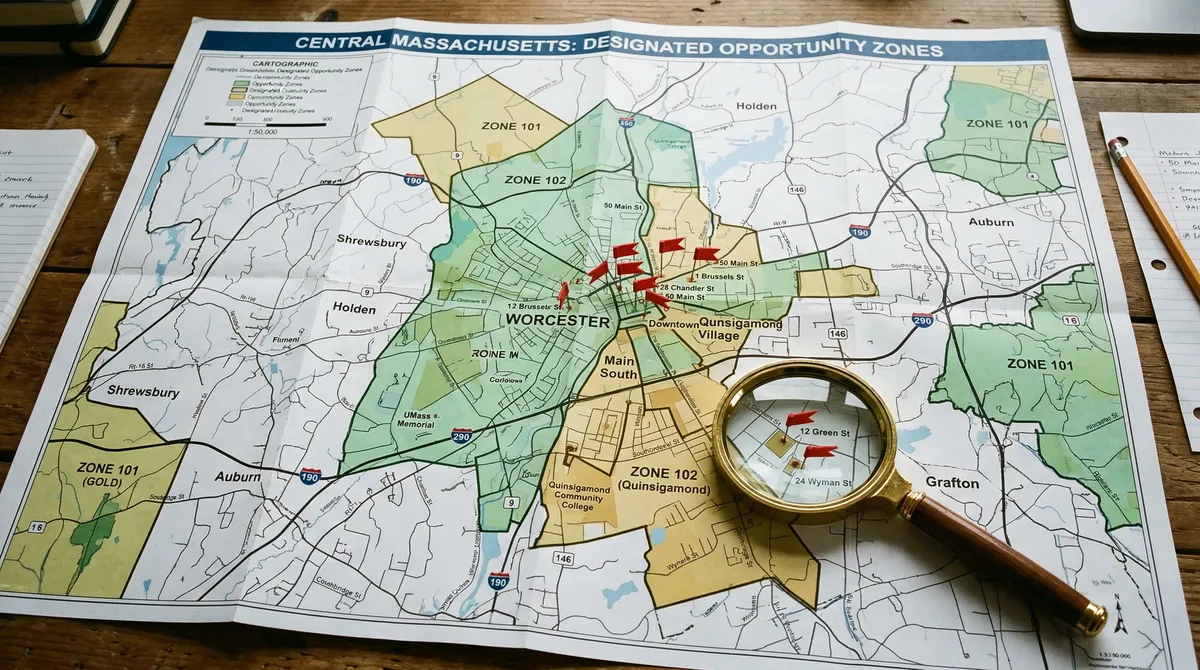
Opportunity Zones came out of the Tax Cuts and Jobs Act of 2017, and the headline is simple: hold a qualifying investment 10 years or more and you pay zero federal capital gains tax on the appreciation. That is about as good as the tax code gets in real estate. The IRS map puts several designated Opportunity Zones right here in Worcester and Central Massachusetts, and you get in by rolling capital gains into a Qualified Opportunity Fund that develops or substantially improves qualifying property.
Long-term benefit: Qualify for zero federal capital gains tax on appreciation from Opportunity Zone investments held for over 10 years.
Investment method: Deploy capital gains into a Qualified Opportunity Fund (QOF) within 180 days of realization to access tax benefits.
Short-term deferral: Defer existing capital gains recognition until December 31, 2026, by investing in a QOF.
Property requirement: Fulfill the Substantial Improvement Test by investing capital equal to the building's original basis within 30 months.
Local focus: Several designated Opportunity Zones exist across Central Massachusetts, including specific areas in Worcester, Fitchburg, and Gardner.
Qualified Opportunity Fund (QOF) is an investment vehicle that invests at least 90% of its assets into qualifying Opportunity Zone property, allowing investors to defer and potentially reduce capital gains taxes.
Zero tax on appreciation: Hold OZ investments 10+ years and pay no federal tax on gains from the OZ asset (IRS)
Capital gains deferral: Defer recognition of existing capital gains until December 31, 2026 by investing in a QOF (IRS)
Substantial improvement test: Must invest capital equal to the building's original basis within 30 months (IRS Treasury Regulations)
Worcester OZ locations: Downtown/Main South, Green Island/Canal District, and Shrewsbury Street corridor all designated (U.S. Treasury CDFI Fund)
What an Opportunity Zone actually is
The Tax Cuts and Jobs Act of 2017 set up Opportunity Zones to pull investment into economically distressed communities.
The two benefits that matter
1. Capital Gains Deferral: Roll gains into a Qualified Opportunity Fund (QOF) and defer recognition until December 31, 2026.
2. Gain Exclusion on OZ Investment: Hold 10 years or more and pay zero federal tax on the appreciation in the OZ asset.
The 10-year exclusion is the one worth building a deal around. It effectively makes the appreciation tax-free.
How it works
Step 1: Realize a capital gain
Any capital gain works: stock sales, real estate, a business sale, cryptocurrency.
Step 2: Invest in a Qualified Opportunity Fund
You have 180 days from when the gain is recognized.
Step 3: Hold and qualify
For real estate, the property has to sit in a designated OZ, and either the original use begins with the QOF or the QOF substantially improves the property.
Substantial Improvement Test: Invest capital equal to the building's original basis within 30 months.
Step 4: Take the tax benefit
After 10 years, sell with zero tax on the OZ appreciation.
Central Massachusetts Opportunity Zones
Worcester zones
Downtown/Main South (Census Tract 7311): the Main Street corridor and the Union Station area.
Green Island (Census Tract 7317): the Kelley Square area.
Main South/Clark University Area (Census Tract 7314): student housing potential.
Other Central MA zones
| Municipality | Focus |
|---|---|
| Fitchburg | Downtown revitalization |
| Gardner | Industrial, mixed-use |
| Leominster | Industrial corridor |
| Southbridge | Mill conversions |
| Webster | Mill conversions |
Running the numbers
What the tax break is worth
Scenario: $1,000,000 capital gain invested in OZ
Traditional Investment (No OZ):
- Tax on gain (23.8%): $238,000
- Net invested: $762,000
- 10-year appreciation (7%): $1,499,000
- Tax on appreciation: $357,000
- Net after-tax: $1,904,000
OZ Investment:
- Full amount invested: $1,000,000
- 10-year appreciation (7%): $1,967,000
- Tax on original gain (2026): $238,000
- Tax on OZ appreciation: $0
- Net after-tax: $2,729,000
OZ Advantage: $825,000 (43% more)
Three ways to play it
Strategy 1: Ground-up development
Meets the original use test on its own. No substantial improvement requirement to worry about.
Strategy 2: Substantial rehabilitation
Buy an existing building and improve it. This works best on older buildings carrying a low basis.
Strategy 3: Operational businesses
A QOF can invest in businesses that earn 50% or more of their income from OZ activity.
Stacking it with other incentives
Historic Tax Credits + OZ:
- 20% federal historic credit
- 20% Massachusetts state credit
- Plus the OZ gain exclusion
Take a historic mill conversion inside an OZ, and you can capture all three.
Lornell Real Estate identifies Opportunity Zone investment opportunities across Central Massachusetts. Contact us to discuss OZ-qualified properties.
Limitations: Cap rates, pricing, and transaction volume cited reflect market-level averages at the time of publication and may not apply to individual properties. Property values depend on asset-specific factors including condition, tenant credit quality, lease terms, location, and financing structure. Tax rules (including 1031 exchange provisions, capital gains rates, and depreciation schedules) change with legislation. This article does not constitute investment, tax, or legal advice. Consult a qualified CPA, attorney, and commercial real estate broker before making transaction decisions.
Sources & References
- IRS
This article cites data from the sources listed above. For the most current figures, consult the original publications directly.
Data current as of publication date. Market conditions, rates, and regulations may have changed. Consult a qualified commercial real estate professional before making investment decisions.
Get the full Central MA market data
Commercial tax-base growth, development activity, and demographics across Central MA, town by town.