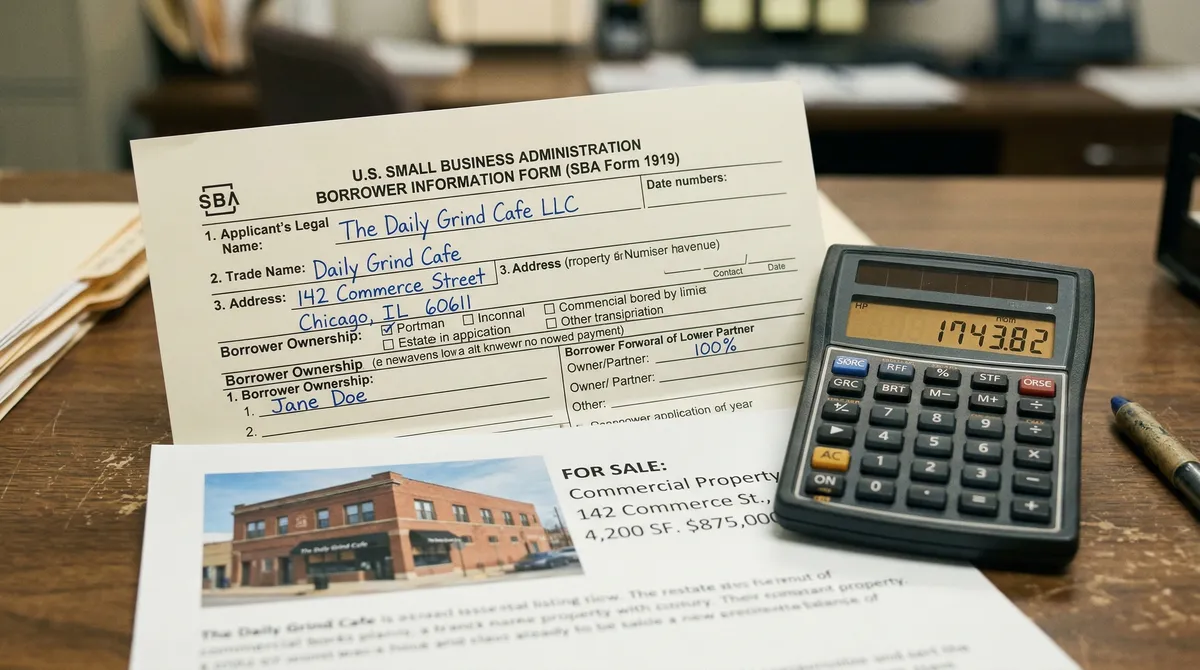
SBA 504 loans let a small business owner buy commercial real estate with as little as 10% down and a below-market fixed rate for up to 25 years. In 35 years of brokering in Central Mass, it's one tool I see owners overlook again and again. The U.S. Small Business Administration puts up to $5.5 million behind owner-occupied properties through the program, and in Worcester County, where commercial buildings run $200,000 to $800,000, an owner can buy their own space for a down payment in the range of a house.
Minimum Investment: Acquire owner-occupied commercial real estate with as little as a 10% down payment, significantly below conventional commercial mortgage requirements.
Long-Term Security: Lock in below-market fixed interest rates for up to 25 years on the 40% SBA-backed second mortgage portion of your loan.
Substantial Funding: Utilize SBA 504 loans to finance up to $5.5 million for eligible owner-occupied commercial properties.
Worcester Opportunity: Worcester-area properties from $200,000-$800,000 mean down payments can be as low as $20,000-$80,000.
Financial Benefit: Choosing to buy with SBA 504 financing can result in lower monthly costs and build equity compared to leasing commercial space.
Certified Development Company (CDC) is a non-profit corporation certified by the SBA that partners with conventional lenders to provide long-term, fixed-rate financing for commercial real estate and equipment through the 504 loan program.
Down payment: As low as 10% vs. 25-30% for conventional commercial mortgages (U.S. Small Business Administration)
Fixed rates: SBA debenture portion locked for 10, 20, or 25 years at below-market rates (U.S. Small Business Administration)
Maximum financing: Up to $5.5 million for the SBA portion; no cap on total project size (U.S. Small Business Administration)
Worcester advantage: Commercial properties available at $200,000-$800,000, enabling down payments of $20,000-$80,000 (CoStar Group)
What an SBA 504 loan actually is
The SBA 504 program is federal financing built to help small businesses buy or improve commercial real estate and major equipment. It runs through Certified Development Companies (CDCs) working alongside conventional lenders.
The structure is what makes it work for the borrower:
| Component | Source | Typical Share | Rate Type |
|---|---|---|---|
| First mortgage | Bank or credit union | 50% | Market rate (variable or fixed) |
| Second mortgage | CDC (SBA-backed) | 40% | Fixed for 10, 20, or 25 years |
| Down payment | Borrower | 10% | N/A |
The SBA doesn't lend to you directly. It guarantees the CDC's debenture, the 40% second position, and that guarantee is what lets the CDC hand you a below-market fixed rate. The bank sits in first position with only 50% loan-to-value exposure, so its risk is low and its terms on the first mortgage are usually better than they'd otherwise be.
The result: you can buy commercial property with as little as 10% down at a blended rate well below a conventional commercial mortgage.
Why 504 loans matter for Worcester-area buyers
Leasing versus owning
For a lot of businesses in Worcester County, the math favors buying, and 504 financing is what tips it. Here's a typical case:
| Metric | Leasing | SBA 504 Purchase |
|---|---|---|
| Monthly cost | $4,500/mo ($15/SF NNN on 3,600 SF) | $4,200/mo (blended P&I on $540,000 property) |
| Annual escalation | 2-3% per year | Fixed for 20+ years |
| Equity building | $0 | ~$2,500/mo in principal reduction |
| Tax benefits | Rent deduction | Depreciation + interest deductions |
| Control | Landlord controls renewals | You own the asset |
| 10-year cost | $585,000+ (with escalations) | $504,000 (fixed) + equity of $300,000+ |
After 10 years the tenant has spent $585,000 and owns nothing. The owner-occupant paid less per month, put over $300,000 in equity into their pocket, and holds an appreciating asset. And the gap grows every year, because the rent keeps climbing while the 504 payment sits still.
Worcester pricing is what makes it work
Central Mass pricing is the unlock. Boston-area commercial space regularly runs $300 to $500/SF, which puts a seven-figure down payment on the table even with SBA help. Worcester County gives you functional commercial space at prices an owner can actually reach:
| Property Type | Worcester County Price Range | 10% Down Payment |
|---|---|---|
| Small industrial / warehouse (3,000-8,000 SF) | $250,000 - $800,000 | $25,000 - $80,000 |
| Retail storefront (1,500-4,000 SF) | $200,000 - $600,000 | $20,000 - $60,000 |
| Office / flex space (2,000-6,000 SF) | $200,000 - $700,000 | $20,000 - $70,000 |
| Mixed-use (retail + residential) | $400,000 - $1,200,000 | $40,000 - $120,000 |
An owner can buy their own space in Spencer, Leicester, Southbridge, or Worcester proper for a down payment on par with a house. Put that accessibility together with the 504's fixed rate and the program does real work in this market.
SBA 504 eligibility
Who qualifies
To be eligible for a 504 loan, your business has to check these boxes:
- For-profit business operating in the United States
- Net worth under $20 million
- Average net income under $6.5 million (after taxes) for the prior two years
- Owner-occupied: the business must occupy at least 51% of the property for existing buildings (60% for new construction)
- No passive investment. You have to actually run the business in the space.
What 504 loans can finance
Eligible uses:
- Purchase of existing commercial real estate
- Construction of new commercial buildings
- Renovation or modernization of existing buildings
- Purchase of major equipment with a useful life of 10+ years
- Refinancing existing commercial real estate debt (with conditions)
Not eligible:
- Speculative investment properties (must be owner-occupied)
- Working capital or inventory
- Residential real estate (except mixed-use where commercial use exceeds 51%)
Loan limits
- Standard maximum: $5 million for the CDC portion (SBA debenture)
- Manufacturing businesses: up to $5.5 million
- Total project size: no cap. Only the SBA debenture is limited. A $12 million project could use a $5 million SBA debenture with a $6 million first mortgage and $1.2 million down.
How the 504 process works
Step 1: Find the property
Find a building that fits your business and where you'll occupy at least 51% of the space. Use a commercial broker who knows the 504 rules, because the occupancy threshold, the environmental standards, and the appraisal requirements all shape which properties will actually clear.
Step 2: Engage a CDC
Certified Development Companies are the nonprofits the SBA authorizes to run 504 loans. Massachusetts has several that are active:
- MassDevelopment, the state's finance and development authority
- Granite State Development Corporation, covering New England
- New England Certified Development Corporation
The CDC reviews your business plan, your projections, and the property to check eligibility.
Step 3: Secure the first mortgage
The bank or credit union puts up the 50% first mortgage. Because the SBA debenture sits behind them, the bank's risk drops. They hold a first lien on a property where they're only exposed to 50% LTV, and that usually buys you better terms than a standalone commercial mortgage.
Step 4: SBA approval and closing
The CDC sends the package to the SBA for approval. Once it's approved, closing brings three parties together: you, the bank, and the CDC. Figure 60 to 90 days from application to closing, longer on complicated deals.
Step 5: Funding
The first mortgage funds at closing. The CDC debenture funds shortly after, through a debenture sale. The CDC bridges the gap in between.
Where 504 rates sit now
SBA 504 debenture rates track the 5-year and 10-year Treasury plus a spread. As of early 2026, effective 504 rates run about:
| Term | Approximate Rate | Rate Type |
|---|---|---|
| 10-year debenture | 5.5% - 6.0% | Fixed for 10 years |
| 20-year debenture | 5.75% - 6.25% | Fixed for 20 years |
| 25-year debenture | 6.0% - 6.5% | Fixed for 25 years |
Those are for the 40% CDC portion. The 50% first mortgage is at market rate, currently the low-to-mid 6% range for qualified borrowers. Across the full stack the blended rate typically comes in 50 to 100 basis points below a conventional 80% LTV commercial mortgage.
504 loans versus conventional commercial mortgages
| Feature | SBA 504 | Conventional |
|---|---|---|
| Down payment | 10% | 20-30% |
| Interest rate (CDC portion) | Fixed 10-25 years | Variable or 5-year fixed |
| Amortization | 10, 20, or 25 years | 20-25 years (5-10 year balloon) |
| Balloon payment | None on CDC portion | Yes (5-10 year term) |
| Prepayment penalty | Yes (declining over 10 years) | Varies |
| Closing costs | Higher (two closings) | Standard |
| Processing time | 60-90 days | 30-60 days |
| Occupancy requirement | 51%+ owner-occupied | None |
The three that matter most are the low down payment, the long-term fixed rate, and no balloon payment on the CDC portion. That last one is underrated. No balloon means no refinancing risk, and refinancing risk is exactly what's put a lot of conventional borrowers in a bind as their loans mature into today's higher rates.
A real-world 504 scenario in Worcester County
The business: a regional HVAC contractor working out of leased space in Auburn, paying $5,500 a month and running out of room.
The property: a 6,000 SF industrial building with a small office component in Leicester, listed at $475,000.
The 504 structure:
| Component | Amount | Rate | Monthly Payment |
|---|---|---|---|
| First mortgage (50%) | $237,500 | 6.25% (fixed 5 yr) | $1,654 |
| CDC debenture (40%) | $190,000 | 5.90% (fixed 20 yr) | $1,424 |
| Down payment (10%) | $47,500 | ||
| Total monthly | $3,078 |
The result: monthly occupancy cost drops from $5,500 to $3,078, a 44% reduction, and the business is now building equity in a building it owns. Over 20 years that CDC debenture rate never moves, even if the market runs to 8%, 9%, or higher.
Tips for a clean 504 application
1. Get your financials in order. Lenders want 2-3 years of business tax returns, personal financial statements, and a business plan that shows how the property supports growth.
2. Keep your personal credit strong. SBA loans are more forgiving than conventional, but a score above 680 meaningfully improves your odds and your terms.
3. Budget for closing costs. 504 loans cost more to close than conventional loans, because of the two closings and the SBA fees. Set aside 3-5% of total project cost.
4. Start the conversations early. Get a CDC and a commercial lender involved before you make an offer. Pre-qualification strengthens your position at the table and tells you the timeline you're working with.
5. Use a CRE broker who knows 504. The 51% occupancy rule, the environmental review, and the appraisal all decide which buildings work for 504 financing. A broker who's done these will point you at compatible properties and steer you clear of the deal-breakers.
The bottom line
If you're a Worcester-area owner leasing your space, the SBA 504 program is a path to ownership that's a lot more affordable than most people assume. Ten percent down, a rate fixed for up to 25 years, and Central Mass pricing that keeps the down payment reachable: that's how a tenant becomes an owner.
For a business planning to stay put 5 years or more, the math almost always favors owning. And in Worcester County, where values are backed by population growth, infrastructure spending, and a diversifying base of industry, owning the building adds a wealth-building layer on top of the operational upside.
Lornell Real Estate works with business owners across Worcester County who are weighing the move from tenant to owner. Call our team at (860) 305-7432 to talk through properties that qualify for SBA 504 financing and what's on the market now.
Limitations: Cap rates, pricing, and transaction volume cited reflect market-level averages at the time of publication and may not apply to individual properties. Property values depend on asset-specific factors including condition, tenant credit quality, lease terms, location, and financing structure. Tax rules (including 1031 exchange provisions, capital gains rates, and depreciation schedules) change with legislation. This article does not constitute investment, tax, or legal advice. Consult a qualified CPA, attorney, and commercial real estate broker before making transaction decisions.
Sources & References
- CoStar
- CoStar Group
This article cites data from the sources listed above. For the most current figures, consult the original publications directly.
Data current as of publication date. Market conditions, rates, and regulations may have changed. Consult a qualified commercial real estate professional before making investment decisions.
Get the full Central MA market data
Commercial tax-base growth, development activity, and demographics across Central MA, town by town.