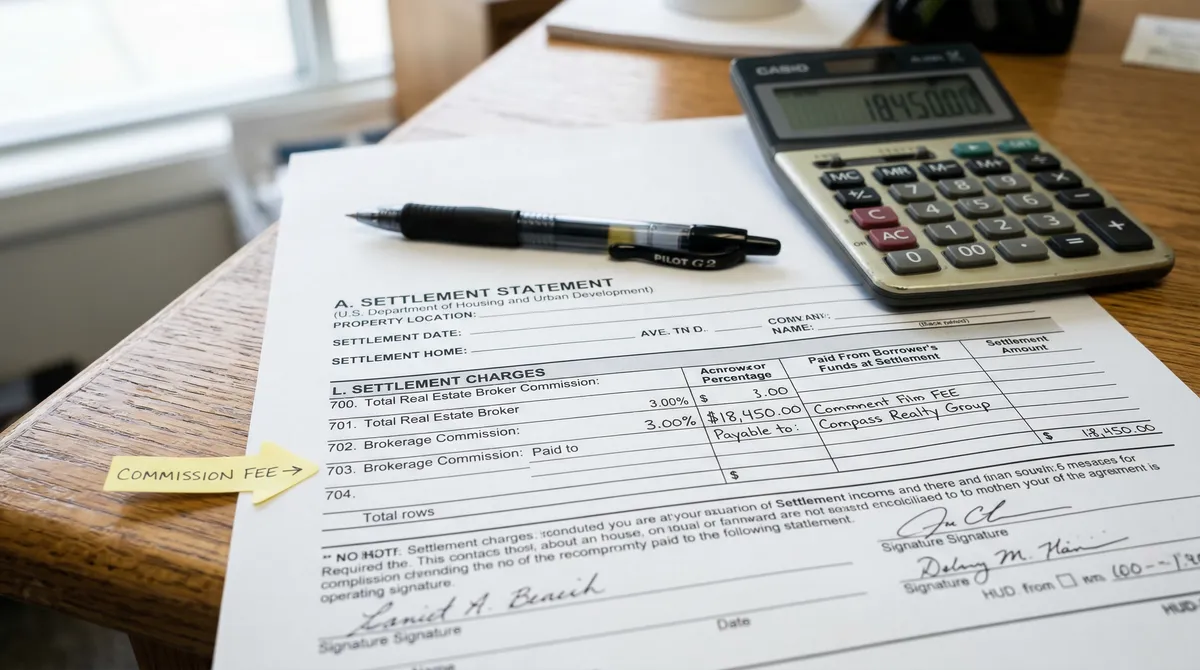
Commercial real estate broker commissions usually run between 3% and 6% of the sale price, with the seller paying the whole commission at closing and that fee split between the listing broker and the buyer's broker. The National Association of Realtors puts it plainly: commercial brokerage fees are fully negotiable and move with deal size, property type, and complexity. Smaller deals (under $1M) tend to land at 5-6%, and larger ones ($5M+) at 2-4%.
Seller Responsibility: The seller pays the full broker commission, usually 3% to 6% of the gross sale price, taken out of proceeds at closing.
Negotiate Fees: Commercial fees are fully negotiable. No standard rate, no mandated split, so you have to negotiate.
Deal Size Scales: The percentage generally drops as the deal gets bigger. Under $1M often runs 5-6%; over $5M can fall to 2-4%.
Minimum Fees: A lot of commercial brokers write in a minimum fee, often $15,000-$30,000, on smaller deals to cover marketing and management.
Factor in Complexity: Property type, deal complexity, how much marketing is involved, and market conditions all move the rate.
Investment Sales is the commercial real estate practice focused on the acquisition and disposition of income-producing properties, where the primary motivation is financial return rather than owner-occupancy.
Commission range: 3-6% of gross sale price, with rates decreasing as deal size increases (National Association of Realtors)
Seller pays: The full commission is deducted from the seller's proceeds at closing, covering both listing and buyer's broker (National Association of Realtors)
Typical split: Total commission split evenly or listing-heavy between listing broker and buyer's broker (e.g., 2.5%/2.5% or 3%/2%) (CBRE)
Minimum fees: Many commercial brokers require $15,000-$30,000 minimums on smaller transactions to cover marketing and management costs (Cushman & Wakefield)
Commercial fees don't work like residential
If you're coming out of the residential world, you probably expect a fixed rate. Residential has run on a fairly standard structure for a long time, with the listing agent and buyer agent splitting a percentage that barely moves from one deal to the next.
Commercial is a different animal. Rates are fully negotiable, they move with the size and complexity of the deal, and the conventions change depending on whether you're doing a sale or a lease. There's no industry-standard rate, no MLS-mandated split, no published fee schedule.
Here's how commercial brokerage fees actually work in Massachusetts, what a seller should expect to pay, and how I'd think about the economics of the relationship.
The usual range: 3% to 6%
Commercial broker commissions on investment sales usually fall between 3% and 6% of the gross sale price. Where you land depends on a few things:
| Factor | How It Affects the Fee |
|---|---|
| Deal size | Larger deals tend to carry lower percentage rates |
| Property type | Commodity assets (NNN retail, stabilized industrial) may command lower rates; complex or difficult-to-sell properties may warrant higher rates |
| Transaction complexity | Multi-tenant properties, environmental issues, or challenging deal structures may justify higher fees |
| Exclusivity and marketing scope | Full-service engagements with extensive marketing typically carry higher rates than limited-scope or open listings |
| Market conditions | Competitive broker pitches can create fee pressure; difficult markets may justify higher rates for the additional effort required |
How the rate tracks deal size
Every engagement gets negotiated on its own, but here's the general framework for how rates line up with deal size in the Massachusetts market:
| Sale Price | Typical Total Commission | Approximate Dollar Amount |
|---|---|---|
| Under $1M | 5-6% | $50,000 - $60,000 |
| $1M - $3M | 4-5% | $40,000 - $150,000 |
| $3M - $5M | 3-4% | $90,000 - $200,000 |
| $5M - $10M | 2-4% | $100,000 - $400,000 |
| $10M+ | 1.5-3% | $150,000+ |
Those are total commissions, split between the listing broker and the buyer's broker. On a $2 million industrial sale at 5%, the total is $100,000, usually $50,000 to each side.
One thing worth understanding: on smaller deals (under $1 million), a 5-6% commission is normal because the work isn't proportionally less than on a bigger deal. The marketing, the negotiations, running due diligence, coordinating the closing, all of it takes roughly the same amount of time whether the property sells for $600,000 or $6 million. The percentage is higher on the smaller deals because the absolute dollars have to justify the broker's time.
Who pays what
The seller pays the commission
In a standard commercial sale, the seller pays the entire commission out of the sale proceeds at closing. That covers both:
- The listing broker's fee: Compensation for marketing the property, managing the sale process, and representing the seller
- The cooperating (buyer's) broker's fee: Compensation for bringing a qualified buyer to the transaction
The commission comes out of the seller's proceeds at closing, same as residential. The buyer doesn't pay a separate fee.
The split between brokers
The listing broker and the buyer's broker split the total according to the cooperating commission offered in the listing agreement. Common structures:
| Total Commission | Listing Broker | Buyer's Broker |
|---|---|---|
| 5% (even split) | 2.5% | 2.5% |
| 5% (listing-heavy) | 3% | 2% |
| 4% (even split) | 2% | 2% |
Why the buyer's broker share matters: The cooperating commission you offer directly affects how hard outside brokers push your property to their buyers. Offer below market and you give buyer's brokers a reason to steer clients elsewhere. Offer a competitive number and you give them a reason to bring their best buyers.
This isn't theory, it's arithmetic. A buyer's broker who can earn 2.5% on your $2 million listing ($50,000) versus 1.5% on a competitor's $2 million listing ($30,000) is going to show your property first. The marginal cost to you is $20,000, but the difference can be a bidding war versus a listing that sits.
What the commission covers
Sellers ask me this all the time: "What am I actually paying for?" It varies by broker, but a full-service commercial listing engagement usually includes:
Pre-marketing
- Broker Opinion of Value with comparable sales analysis and cap rate research
- Pricing strategy development
- Professional photography and drone imagery
- Offering memorandum preparation (typically 15-40 pages)
- Financial analysis and pro forma modeling
- Marketing plan and buyer targeting strategy
Active marketing
- Listing on commercial platforms (CoStar, LoopNet, Crexi)
- Direct outreach to qualified buyers in the broker's database
- Email marketing campaigns to investor and broker networks
- Coordination of property tours and buyer inquiries
- Screening and qualifying prospective buyers (proof of funds, lending capacity, track record)
Transaction management
- Offer analysis and negotiation
- Letter of Intent drafting and negotiation
- Due diligence management and document coordination
- Communication with buyer's broker, attorneys, lenders, and environmental consultants
- Appraisal coordination (providing comparable data to the buyer's appraiser)
- Closing coordination with title company and attorneys
- Problem-solving when issues arise during due diligence or closing
Market intelligence
- Real-time market data that informs pricing and negotiation strategy
- Relationships with active buyers, lenders, and other brokers in the market
- Knowledge of recent comparable sales, including terms and conditions that are not publicly available
Flat fee vs. percentage: when each fits
Percentage-based (standard)
Most commercial sales use a percentage commission. Why it works:
- Aligned incentives: The broker earns more when the sale price is higher, so there's a real motive to fight for price
- No upfront cost: You pay nothing until the property closes
- Scalable: The fee adjusts automatically with the sale price
Flat fee
Some sellers, mostly on larger deals, negotiate a flat dollar amount instead of a percentage. That can make sense when:
- The deal is big enough that a percentage fee ends up larger than the value of the broker's work
- You've already got a buyer and need limited marketing
- The deal is clean (single-tenant, no environmental issues, straightforward)
A caution: Flat fees can pull the incentives apart. If the broker earns the same dollars no matter the final price, the drive to squeeze out the last $50,000 or $100,000 fades. For most sellers the percentage produces a better result, because the broker's money stays tied to yours all the way through the last round of negotiation.
Minimum fee
A lot of commercial brokers put a minimum fee clause in the listing agreement. It protects the broker on smaller deals where the percentage might not cover the actual cost of marketing and running the sale. Typical minimums run $15,000 to $30,000 depending on the broker and market.
Net listing vs. gross listing
Gross listing (standard)
The commission is a percentage of the gross sale price. If the property sells for $2 million at a 5% commission, the broker earns $100,000 whether that price came in above or below the original ask.
Net listing
In a net listing, the seller sets a minimum net price they want to walk away with, and the broker keeps everything above it. Say the seller wants to net $1.8 million. If the broker sells for $2.1 million, the broker earns $300,000. If the broker sells for $1.85 million, the broker earns $50,000.
Net listings are uncommon, and for good reason. They set up a conflict of interest: the broker benefits from getting the highest price, which sounds fine until you realize the broker also benefits from lowballing the value up front to set a lower net floor. Most experienced sellers and brokers would rather have the transparency of a percentage-based gross listing.
Legal note: Net listings are legal in Massachusetts but are disfavored by regulators and the professional community due to the inherent conflicts of interest.
The economics: is the commission worth it?
That's the real question. On a $2 million sale, a 5% commission is $100,000. Real money. Is it justified?
The comparison that matters
The comparison isn't "commission vs. no commission." It's "net proceeds with a broker vs. net proceeds without one."
Take a $2 million property:
| Scenario | Sale Price | Commission | Net to Seller |
|---|---|---|---|
| With broker (5% fee, full market exposure, competitive offers) | $2,000,000 | $100,000 | $1,900,000 |
| Without broker (limited exposure, single buyer, weaker negotiation position) | $1,750,000 | $0 | $1,750,000 |
In this case the broker's $100,000 fee produced $150,000 in additional net proceeds. The commission paid for itself and then some.
I'm not making that up to sell you a listing. The most common thing that happens when an owner sells commercial property without representation is a lower price. Without a broker you're up against:
- A smaller buyer pool: No access to commercial listing platforms, broker networks, or investor databases
- A weaker negotiating position: Buyers and their brokers do this for a living. An unrepresented seller is at a disadvantage
- Information asymmetry: The buyer knows what they'll pay. Without comparable sales and cap rate analysis, you don't know what you should accept
- Due diligence exposure: Without someone managing the transaction, sellers give up concessions during due diligence that chip away at the net
When the commission may be harder to justify
There are situations where a full-commission engagement may not be the right fit:
- You already have a buyer: If a neighbor, a tenant, or an unsolicited buyer is seriously interested, you may not need full marketing. A reduced-scope engagement at a lower fee can make sense
- You're selling to family or a partner: Internal transfers need legal and tax guidance, not marketing
- The property is part of a portfolio sale: Bulk portfolio deals often carry lower per-property rates
How to judge a broker's fee proposal
When you interview listing brokers, the rate shouldn't be your first question. It should be near the last, after you've looked at:
1. Market knowledge
Does the broker know your submarket? Can they name recent comparable sales without looking them up? Do they know who the active buyers are for your property type?
2. Marketing plan
What exactly will they do to market the property? How is their approach different from the next broker's? What platforms, databases, and buyer networks will they use?
3. Track record
How many commercial properties have they sold in your market in the last 24 months? What were the listing-to-sale price ratios? How long did those properties sit?
4. Communication
How often will you hear from them? By email, phone, written reports? Will you deal with one person or get handed off to a junior associate?
5. Commission structure
Only after all of that should you compare fees. A broker who charges 4% but delivers a weak marketing effort, a thin buyer pool, and soft negotiation can cost you far more than a broker at 5% who gets you a higher price on a faster timeline.
The cheapest broker is rarely the cheapest option.
Lease commissions run differently
This article is about investment sales, but you should know that lease commissions work on a different structure. They're usually a percentage of total lease value or a dollar-per-square-foot rate:
| Lease Type | Typical Commission |
|---|---|
| New lease | 4-6% of total lease value, or $1-$4/SF/year |
| Lease renewal | 2-3% of total lease value (lower because less work is involved) |
| Sublease | 3-5% of total sublease value |
This matters to sellers because a property with leases coming up for expiration may need your broker or a tenant-rep broker to renew or replace tenants before the sale. That's a separate engagement and a separate fee.
How the commission is taxed
A commission paid on the sale of commercial property isn't deductible as a business expense. It's treated as a selling expense that reduces your capital gain.
| Item | Amount |
|---|---|
| Sale price | $2,000,000 |
| Less: brokerage commission (5%) | ($100,000) |
| Less: other selling expenses | ($15,000) |
| Less: adjusted cost basis | ($1,200,000) |
| Taxable capital gain | $685,000 |
The commission lowers your taxable gain, which lowers your tax bill. At combined federal and Massachusetts capital gains rates of roughly 28-33%, part of the commission cost comes back to you at tax time. A $100,000 commission cuts your tax bill by about $28,000 to $33,000.
The bottom line
Broker fees are a real transaction cost, but they're not arbitrary. The commission pays a professional to market your property to the widest buyer pool, negotiate the highest price you can get, run a complicated due diligence and closing process, and solve the problems that always come up along the way.
The right question isn't "how do I minimize the commission?" It's "how do I maximize my net proceeds?" Most of the time the answer to the second one is hire a capable broker and pay a fair commission, because the price gap between a well-marketed property and a poorly marketed one almost always beats the commission.
Lornell Real Estate provides transparent fee structures alongside every listing proposal. Our complimentary Broker Opinion of Value includes a detailed net proceeds analysis so you can see exactly what you will walk away with after commissions, closing costs, and taxes. Contact us at (774) 230-3634 or visit our seller page to request yours.
Related seller guides: Complete Guide to Selling Commercial Property in MA | How to Sell a Warehouse in Massachusetts | How Long Does It Take to Sell?
Limitations: Cap rates, pricing, and transaction volume cited reflect market-level averages at the time of publication and may not apply to individual properties. Property values depend on asset-specific factors including condition, tenant credit quality, lease terms, location, and financing structure. Tax rules (including 1031 exchange provisions, capital gains rates, and depreciation schedules) change with legislation. This article does not constitute investment, tax, or legal advice. Consult a qualified CPA, attorney, and commercial real estate broker before making transaction decisions.
Sources & References
- CBRE
- CoStar
- Cushman & Wakefield
- National Association of Realtors
This article cites data from the sources listed above. For the most current figures, consult the original publications directly.
Data current as of publication date. Market conditions, rates, and regulations may have changed. Consult a qualified commercial real estate professional before making investment decisions.
For owners
What would a sale leave you?
Put in a price. The commission and attorney start at the typical figures for a building at that price; change any line to your own.
Deed excise at $4.56 per $1,000; Cape Cod (Barnstable County) pays $6.48, so enter it as Elsewhere.
Enter a sale price to see your sheet.