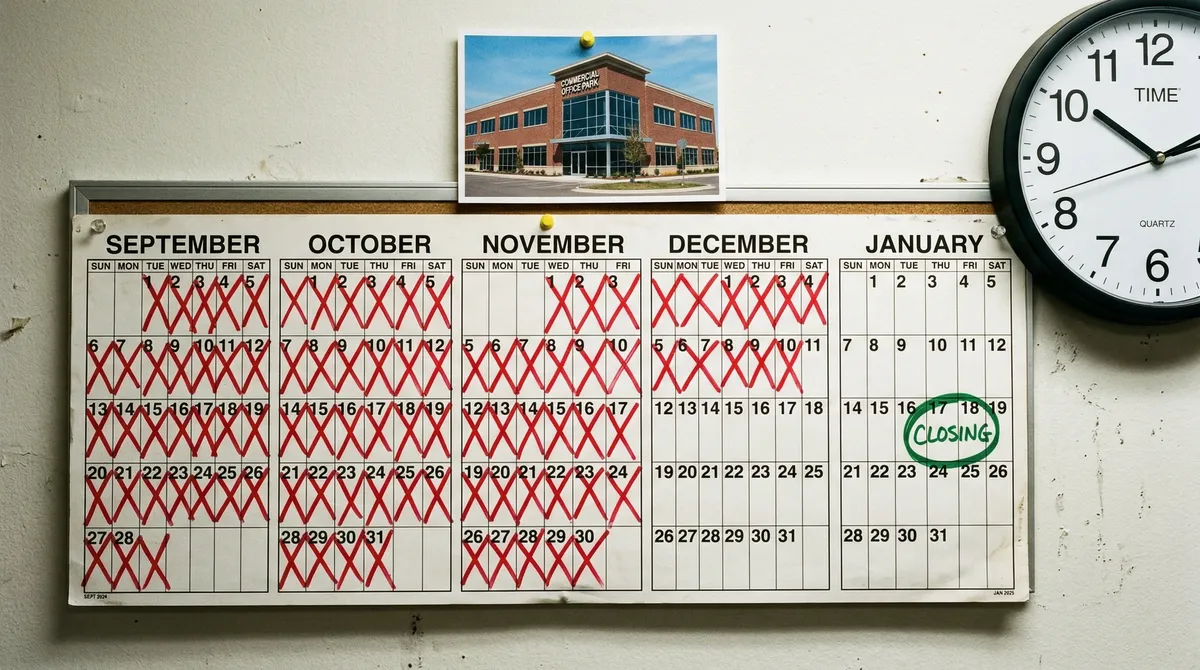
A commercial sale in Massachusetts runs 5 to 10 months from listing to closing. A well-priced industrial building can close in as few as 3 months. A challenged office property can take over a year. Right now, per CoStar Group, industrial buildings in Central Massachusetts are pulling offers within 60 to 90 days of listing on the back of e-commerce demand. And in my 35 years, pricing is the single biggest lever on how long a building sits: price it 15% over the market and it often sells for less than a correctly priced building would have.
Average Sale Duration: Commercial properties in Massachusetts typically take 5 to 10 months to sell from listing to closing.
Industrial Velocity: Well-priced industrial buildings often secure offers within 60-90 days, making them the fastest-selling asset class.
Pricing Strategy: Overpricing a property by 15% or more significantly extends the sale timeline and often results in a lower final sale price.
Pre-Marketing Importance: Thorough pre-marketing preparation, including financial organization and environmental review, takes 2-4 weeks and prevents significant delays later.
Due Diligence Factor: Buyers' due diligence commonly requires 30-60 days, with commercial appraisals alone taking 3-5 weeks in Massachusetts.
Offering Memorandum is a comprehensive document prepared by a broker to market a commercial property, containing financial analysis, market data, property details, and investment highlights for potential buyers.
Total timeline: 4-10 months from listing to closing for commercial property in Massachusetts (National Association of Realtors)
Industrial speed: Well-priced industrial with modern specs generates offers within 60-90 days in the current market (CoStar Group)
Pricing impact: Properties priced 5-10% above market take 4-6 months; 15%+ above market takes 8-12+ months or fails to sell (CBRE)
Due diligence: 30-60 days standard; commercial appraisals alone require 3-5 weeks in Massachusetts (Appraisal Institute)
The short answer: 5 to 10 months
Selling a commercial building is not quick. Residential goes under contract in days and closes in 30 to 45. Commercial moves through separate phases, and each one eats weeks or months.
Here's the typical timeline for selling commercial property in Massachusetts:
| Phase | Duration |
|---|---|
| Pre-marketing preparation | 2-4 weeks |
| Active marketing | 2-6 months |
| Offer negotiation and LOI | 1-3 weeks |
| Due diligence | 30-60 days |
| Closing preparation | 2-4 weeks |
| Total | 4-10 months |
Some buildings sell faster. Some take a lot longer. The difference comes down to a handful of variables, and most of them are either in your control or at least something you can see coming.
Phase 1: pre-marketing preparation (2-4 weeks)
Before your building hits the market, your broker builds the marketing package. Buyers never see this phase, but it sets up everything that follows.
What happens during prep
- Financial assembly. We pull together rent rolls, trailing 12-month P&L statements, lease abstracts, tax bills, and operating expense records. If your records are a mess, this piece alone can run 3-4 weeks.
- Offering memorandum. Your broker builds the marketing document: property photos, financial analysis, market data, and investment highlights.
- Pricing strategy. We finalize the asking price off a Broker Opinion of Value, comparable sales, and where the market sits today.
- Environmental and compliance review. We order or update a Phase I Environmental Site Assessment, confirm zoning, and clear any open code issues.
- Property preparation. We handle deferred maintenance, clean up common areas, and get the building ready to show well on tours.
What slows this phase down
The number one delay in pre-marketing is disorganized financials. When an owner can't produce clean rent rolls, lease copies, or expense records, the broker has to rebuild the financial picture off bank statements and tax returns. That adds 2-3 weeks.
To move faster, get your financials in order before you hire a broker. A complete document package on day one can cut this phase to 1-2 weeks.
Phase 2: active marketing (2-6 months)
This is usually the longest phase and the one with the widest swing. How long it takes depends on your property type, your price, the market, and your marketing strategy.
Timeline by property type
Not all commercial buildings sell at the same pace. Demand swings hard by asset class:
| Property Type | Typical Marketing Period | Why |
|---|---|---|
| Industrial / Warehouse | 2-4 months | High demand, limited supply, deep buyer pool |
| Retail (NNN, single-tenant) | 2-4 months | Institutional investor demand, predictable income |
| Retail (multi-tenant strip) | 3-6 months | More complex underwriting, tenant rollover risk |
| Flex / Light Industrial | 3-5 months | Growing demand but smaller buyer pool |
| Office (suburban) | 4-8 months | Recovering market, buyer caution post-pandemic |
| Office (urban/CBD) | 6-12+ months | Highest vacancy rates, uncertain demand trajectory |
| Special use | 6-12+ months | Limited buyer pool, complex valuations |
Industrial is king right now. In Central Massachusetts, well-priced industrial with modern specs (28+ foot clear heights, dock-high loading, adequate power) is drawing multiple offers within 60 to 90 days. E-commerce demand, almost no new construction, and supply chains coming back closer to home have made this a seller's market.
Office is the outlier. Greater Boston office vacancy hit 17% in 2024 and the recovery has crawled. Suburban office in Central Massachusetts is holding up better than urban CBD, but buyers are still cautious and the marketing periods run longer.
Timeline by pricing accuracy
Price is the single biggest factor in how long a building sits. And the relationship isn't linear, it's exponential:
| Pricing Scenario | Typical Result |
|---|---|
| Priced at market | Offers within 60-90 days |
| 5-10% above market | Extended marketing, eventual price reduction, 4-6 months |
| 15%+ above market | Stale listing, loss of buyer confidence, 8-12+ months or no sale |
An overpriced building doesn't just take longer. It often sells for less than a correctly priced one would have. Buyers watch listing age. A building that's been out there 6+ months reads as distress or an unrealistic seller, and that's what draws the lowball offers.
Timeline by marketing strategy
How you take a building to market moves the clock:
- Off-market or pocket listing. Can produce a deal in 30-60 days if the right buyer is already in your broker's network. Smaller pool, though, so less competitive pressure.
- Targeted marketing. 60-120 days is typical. Balances speed against exposure.
- Full market exposure. 90-180 days is typical. Gets you the best price through competition, but you need some patience.
Phase 3: offer negotiation and LOI (1-3 weeks)
Once a buyer puts in an offer or a Letter of Intent (LOI), it usually takes 1-3 weeks to agree on the key terms.
What gets negotiated
The LOI sets the major business terms before the attorneys draft the formal Purchase and Sale Agreement:
- Purchase price, plus any seller financing or price adjustments
- Earnest money deposit amount and timing
- Due diligence period length and scope
- Financing contingency (if any) and proof of funds
- Target closing date
- Conditions: environmental, zoning, inspection, tenant estoppels
What slows this phase down
- Multiple offers. Good for price, but working several parties takes time. Figure an extra 1-2 weeks for a best-and-final round.
- Complex deal structures. Seller financing, earnest money disputes, or odd contingencies add negotiation cycles.
- Committee decisions. Buyers who need board, partner, or investor sign-off add delay.
- Attorney review. In Massachusetts, both sides typically have counsel review the LOI before it's signed.
What speeds this up
- A clean, well-documented offering memorandum. Fewer buyer questions, more confidence.
- Knowing your parameters ahead of time. Have your floor price, your max due diligence period, and your non-negotiables set before offers land.
- Responsive communication. Sitting on buyer questions or counters reads as disinterest or disorganization.
Phase 4: due diligence (30-60 days)
After the Purchase and Sale Agreement is signed, the buyer goes into due diligence. This is the contractual window where they dig into the property and can walk if they turn up something material.
What the buyer investigates
| Area | Typical Timeline |
|---|---|
| Physical inspections (roof, structure, HVAC, electrical) | Weeks 1-2 |
| Phase I Environmental Site Assessment | Weeks 2-4 |
| Title search and survey | Weeks 1-3 |
| Lease and financial document review | Weeks 1-2 |
| Commercial appraisal (lender-ordered) | Weeks 3-5 |
| Zoning and permit verification | Weeks 1-2 |
| Tenant estoppel certificates | Weeks 2-4 |
The appraisal is usually the longest single item. Commercial appraisers in Massachusetts typically need 3-5 weeks to turn a report, and the buyer's lender won't commit without it.
What slows due diligence down
- Environmental issues. If the Phase I flags a Recognized Environmental Condition (REC), the buyer orders a Phase II. That adds 4-8 weeks and can blow up the whole timeline.
- Tenant estoppel delays. If tenants drag their feet returning estoppels confirming their lease terms, the buyer can't verify the income.
- Appraisal shortfall. If the appraisal comes in under the purchase price, you're back at the table.
- Title defects. Encroachments, easement fights, or open liens need legal cleanup.
- Deferred maintenance surprises. Roof failure, structural concerns, an HVAC replacement found on inspection all lead to a price renegotiation or a walk.
What speeds due diligence up
- Put a current Phase I out upfront. If yours is under 18 months old, sharing it during marketing knocks 3-4 weeks off due diligence.
- Pre-assemble everything. Leases, amendments, financials, tax bills, insurance, utility records, capital expenditure history. A full data room on day one of DD looks professional and cuts down the follow-up requests.
- Get your tenants on board. Tell them ahead of time that estoppels are coming and walk them through it.
Phase 5: closing preparation (2-4 weeks)
Once due diligence is satisfied and any renegotiations are settled, both sides get ready to close.
Closing requirements in Massachusetts
- Deed preparation. Your attorney drafts the deed for recording.
- Title insurance. The buyer's title company issues a commitment and prepares the policy.
- Municipal lien certificate. This confirms property taxes, water and sewer, and municipal assessments are current. Massachusetts municipalities can take 1-2 weeks to issue one.
- Loan documents. If the buyer is financing, their lender's closing docs have to be drafted and reviewed.
- Prorations. Rent, taxes, insurance, and operating expenses get prorated between buyer and seller as of the closing date.
- Transfer tax. The deed excise tax of $4.56 per $1,000 of sale price gets calculated and paid at closing.
What slows closing down
- Lender delays. The buyer's bank takes longer than expected on the loan docs. This is the most common closing hang-up.
- Municipal lien certificate. Some Massachusetts towns have processing backlogs.
- Title curative work. Last-minute title issues (an old mortgage paid off but never discharged, an estate matter, a boundary dispute) have to be cleared before closing.
- 1031 exchange coordination. If either side is doing a 1031, working with the Qualified Intermediary adds moving parts.
Real-world timeline examples
Fast sale: industrial warehouse in Worcester (4 months total)
| Phase | Duration |
|---|---|
| Pre-marketing (organized owner, clean records) | 2 weeks |
| Marketing (high demand, priced at market) | 8 weeks |
| LOI negotiation (single strong offer) | 1 week |
| Due diligence (clean Phase I provided upfront) | 35 days |
| Closing | 2 weeks |
| Total | ~4 months |
Average sale: retail strip center in Auburn (7 months total)
| Phase | Duration |
|---|---|
| Pre-marketing (financial cleanup needed) | 4 weeks |
| Marketing (moderate demand, priced correctly) | 14 weeks |
| LOI negotiation (two competing offers, best-and-final) | 3 weeks |
| Due diligence (standard, no surprises) | 45 days |
| Closing (SBA loan, slower lender process) | 4 weeks |
| Total | ~7 months |
Slow sale: suburban office in Shrewsbury (12+ months total)
| Phase | Duration |
|---|---|
| Pre-marketing | 3 weeks |
| Marketing (weak demand, price reduction at month 4) | 9 months |
| LOI negotiation | 2 weeks |
| Due diligence (appraisal shortfall, renegotiation) | 60 days |
| Closing | 3 weeks |
| Total | ~12.5 months |
How to shorten your timeline
Look at the patterns above and most of the delays are preventable. Here's where sellers get the most out of their effort:
Before listing
- Organize your financials. Clean rent rolls, trailing P&Ls, lease copies, and expense records save 2-3 weeks.
- Order a Phase I. A current environmental report shared during marketing takes out a major due diligence bottleneck.
- Handle deferred maintenance. Fix what you can before a buyer uses it as a lever.
- Price it right. This is the one decision that matters most. Priced correctly, a building pulls serious buyers fast. Overpriced, it pushes them away.
During marketing
- Answer inquiries within 24 hours. Slow replies send buyers to the next opportunity.
- Build a professional data room. Every property document organized and available to qualified buyers.
- Be flexible on tours. Make the building available on the buyer's schedule, not yours.
During due diligence
- Have your documents ready before DD starts. Don't wait for the buyer to ask for items one at a time.
- Notify tenants early. Give them a heads-up on estoppels and inspections.
- Be straight about known issues. Disclosing upfront keeps late surprises from killing the deal.
The bottom line
How long it takes to sell a commercial building in Massachusetts comes down to what you can control (price, prep, responsiveness) and what you can't (demand for your property type, interest rates, the buyer's financing).
The 5-to-10-month range is real, but it isn't fixed. Well-prepared sellers with correctly priced buildings in high-demand classes routinely close in 4 to 5 months. Unprepared sellers with overpriced buildings in soft sectors can spend a year or more on the market and still take a lower number than a disciplined approach would have gotten them from the start.
The variable most in your control is preparation. The second is pricing. Get both right and the timeline handles itself.
Lornell Real Estate sells commercial, industrial, and retail properties across Worcester County and Central Massachusetts. Our team gives you a realistic market timeline alongside every complimentary Broker Opinion of Value, so you know what to expect before you commit. Contact us at (860) 305-7432 or visit our seller page to start the conversation.
Related seller guides: Complete Guide to Selling Commercial Property in MA | How to Sell a Warehouse in Massachusetts | Broker Fees Explained
Limitations: Cap rates, pricing, and transaction volume cited reflect market-level averages at the time of publication and may not apply to individual properties. Property values depend on asset-specific factors including condition, tenant credit quality, lease terms, location, and financing structure. Tax rules (including 1031 exchange provisions, capital gains rates, and depreciation schedules) change with legislation. This article does not constitute investment, tax, or legal advice. Consult a qualified CPA, attorney, and commercial real estate broker before making transaction decisions.
Sources & References
- CBRE
- CoStar
- CoStar Group
- National Association of Realtors
This article cites data from the sources listed above. For the most current figures, consult the original publications directly.
Data current as of publication date. Market conditions, rates, and regulations may have changed. Consult a qualified commercial real estate professional before making investment decisions.
Get the full Central MA market data
Commercial tax-base growth, development activity, and demographics across Central MA, town by town.