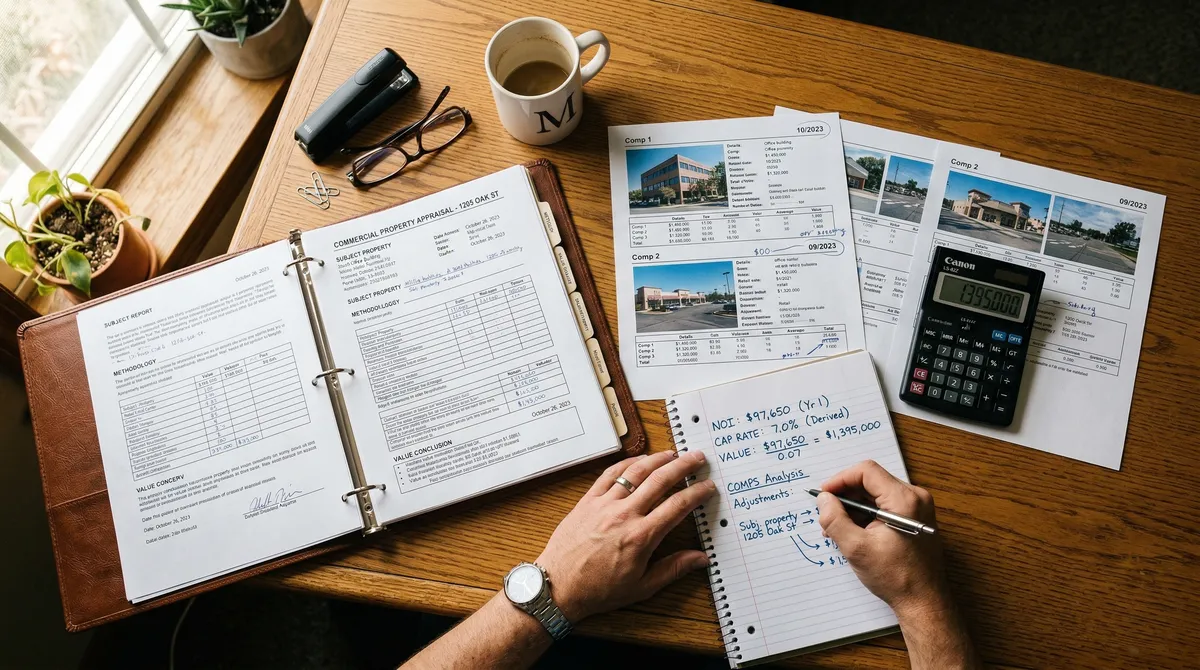
Commercial property is priced mostly on income, not comparable sales or the number on your tax bill, and a small move in the cap rate can swing the value by hundreds of thousands of dollars. The Appraisal Institute treats income capitalization as the most widely used and most reliable method for valuing income-producing commercial real estate. A Broker Opinion of Value (BOV) from a qualified commercial broker is the most accessible professional valuation an owner can get, usually at no cost. If your property is in Worcester County or Central Massachusetts, you can request a free BOV here and have a real number in hand within days.
Income-Based Valuation: Commercial value comes mostly from income, not comparable sales or assessed value, which is why income capitalization is the most reliable approach.
Cap Rate Sensitivity: A 50-basis-point move in the cap rate changes value by more than $276,000 on a property with $135,000 NOI.
Free Professional Valuation: A Broker Opinion of Value (BOV) from a commercial broker is usually free and gives you a professional read.
Formal Appraisal Cost: Formal appraisals run $3,000-$8,000+ for commercial properties and are required for lending, litigation, and tax appeals.
Key Valuation Formula: The Income Capitalization Approach is Net Operating Income (NOI) divided by the Capitalization Rate (Cap Rate).
Capitalization Rate (Cap Rate) is a property's net operating income divided by its market value. It is the return an investor expects on a commercial purchase.
Five valuation methods: Income capitalization, sales comparison, cost approach, broker opinion of value (BOV), and formal appraisal (Appraisal Institute)
Cap rate sensitivity: A 50-basis-point cap rate shift can move property value by $276,000+ on a property with $135,000 NOI (CoStar Group)
BOV cost: Typically provided at no charge by commercial brokers competing for your listing (National Association of Realtors)
Formal appraisal cost: $3,000-$8,000+ for commercial properties, required for lending, litigation, and tax appeals (Appraisal Institute)
The most expensive guess you will ever make
Every owner asks me the same question eventually: what is my property worth?
Maybe a neighbor sold their building and you want to know how yours stacks up. Maybe a buyer called out of the blue and you need to know whether the offer is real. Maybe you are thinking about retirement, a 1031 exchange, or rebalancing the portfolio, and you need an actual number, not a feeling.
Here is the trouble: commercial valuation is not intuitive. A retail building the same size as a warehouse on the same street can be worth twice as much, or half as much, depending on the lease structure, tenant credit, ceiling height, and where cap rates sit. The number on your tax bill is almost always wrong. Zillow does not do commercial. And asking another owner what he "thinks" your building is worth just gets you a second guess.
There are five legitimate ways to figure out what commercial real estate is worth. Each has a use, a cost, and a level of precision. Knowing the difference keeps you from deciding on bad numbers.
Method 1: Income Capitalization Approach
This is the method buyers and lenders lean on, and it is the one that matters most for income-producing property.
How It Works
The income approach values a property on the income it throws off. The formula is simple:
Property Value = Net Operating Income (NOI) / Capitalization Rate (Cap Rate)
NOI is your annual income after operating expenses but before debt service (your mortgage) and capital expenditures:
| Line Item | Example |
|---|---|
| Gross potential rental income | $210,000 |
| Vacancy and collection loss (5%) | ($10,500) |
| Effective gross income | $199,500 |
| Property taxes | ($28,000) |
| Insurance | ($8,500) |
| Maintenance and repairs | ($12,000) |
| Property management | ($10,000) |
| Utilities (landlord-paid) | ($6,000) |
| Net Operating Income | $135,000 |
The cap rate is the return the market wants for your property type and location. You get it by looking at recent sales of comparable properties:
| Property Type | Typical Cap Rate Range (Central MA, 2026) |
|---|---|
| Industrial / Warehouse | 6.0% - 7.5% |
| Retail (NNN, single-tenant) | 5.5% - 7.0% |
| Retail (multi-tenant strip) | 6.5% - 8.0% |
| Office (suburban) | 7.0% - 9.0% |
| Flex / Light Industrial | 6.5% - 8.0% |
| Multifamily (5+ units) | 5.5% - 7.0% |
Take the example above, $135,000 NOI at a 7.0% cap rate:
$135,000 / 0.07 = $1,928,571, call it $1.93 million.
Why the cap rate moves the whole number
Watch what happens when the cap rate moves by half a point:
| Cap Rate | Indicated Value | Difference |
|---|---|---|
| 6.5% | $2,076,923 | +$148,352 |
| 7.0% | $1,928,571 | Baseline |
| 7.5% | $1,800,000 | -$128,571 |
Same building, same income, and you get a $276,923 range depending on the cap rate you apply. That is why picking the right cap rate, off actual comparable sales rather than a hunch, is the single most important call in commercial valuation. And it is why you want someone who knows the local market cold to make that call.
When to Use This Method
The income approach is the go-to for any property with tenants and rent. It is how buyers underwrite acquisitions and how lenders size loans. If you are looking at a possible sale, this is the number that counts.
Limitation
The income approach falls short on owner-occupied buildings with no rent, vacant buildings, or properties where leases sit well above or below market and distort the current NOI.
Method 2: Sales Comparison Approach
The sales comparison approach values your property against what similar properties recently sold for, adjusted for the differences between those sales and yours.
How It Works
A broker or appraiser pulls 3-5 recent sales of properties comparable in:
- Property type (industrial, retail, office, flex)
- Size (square footage and lot size)
- Location and submarket
- Age and condition
- Tenancy and lease structure
Then each sale gets adjusted for the differences. If a comparable warehouse sold for $85 per square foot but had a newer roof, was 20% larger, and had highway frontage your building lacks, you quantify those differences and apply them as adjustments:
| Comparable Sale | Sale Price/SF | Adjustment | Adjusted Price/SF |
|---|---|---|---|
| 45 Industrial Dr, Worcester | $92 | Inferior condition (+$5) | $97 |
| 120 Commerce Way, Auburn | $88 | Superior access (-$4) | $84 |
| 78 Mill St, Leicester | $79 | Smaller size (+$3), older (+$6) | $88 |
| Adjusted average | $90/SF |
Apply that to a 22,000 SF building: $90 x 22,000 = $1,980,000.
When to Use This Method
The sales comparison approach works best when:
- The property is owner-occupied with no rent to capitalize
- There are sufficient recent sales of properties that are genuinely comparable
- You want a quick sanity check against the income approach
Limitation
Commercial comps are harder to find than residential. A 45,000 SF industrial building on 3 acres with rail access in Worcester is not comparable to a 12,000 SF retail building on half an acre in Auburn, even if both sold the same quarter. The smaller your submarket and the more specialized your building, the fewer real comparables exist, and the adjustments turn into judgment calls.
In Central Massachusetts, where the deal volume runs below metro Boston, finding three strong comparables inside the past 12 months is not always possible. That is exactly where the income approach earns its keep as the primary or confirming method.
Method 3: Cost Approach
The cost approach asks what it would cost to replace the building today, minus depreciation, plus the land.
How It Works
Replacement Cost Approach:
| Component | Calculation |
|---|---|
| Current construction cost per SF | $175/SF |
| Building size | 30,000 SF |
| Replacement cost (new) | $5,250,000 |
| Less: physical depreciation (age, wear) | ($1,050,000) |
| Less: functional obsolescence (outdated layout) | ($262,500) |
| Depreciated building value | $3,937,500 |
| Plus: land value (by comparable land sales) | $600,000 |
| Indicated property value | $4,537,500 |
When to Use This Method
The cost approach matters most for:
- Special-purpose properties with few comparable sales (churches, schools, manufacturing plants with specialized improvements)
- New or nearly-new construction where depreciation is minimal
- Insurance purposes, setting a replacement cost for coverage
- Properties where the land is a big share of total value, since the cost approach separates building value from land value
Limitation
For most income-producing commercial property, the cost approach is the weakest of the three. It does not reflect what a buyer will actually pay for the income stream. A building that cost $4 million to put up but throws off only $150,000 in NOI is not worth $4 million to an investor. It is worth $150,000 divided by the market cap rate.
The cost approach also leans on a depreciation estimate, which is a lot of judgment, especially on older buildings with mixed condition and partial renovations.
Method 4: Broker Opinion of Value (BOV)
A Broker Opinion of Value is a market analysis put together by a licensed commercial broker. It usually pulls in all three methods above, income, sales comparison, and cost, weighted by how relevant each is to your specific property, and reconciled into one value.
What a BOV Includes
A credible commercial BOV should cover:
- Rent roll analysis: Are your rents at, above, or below market? What would the property bring if you re-leased it today?
- Operating expense review: Are your expenses in line with comparable properties, or are there inefficiencies a buyer would fix?
- Comparable sales analysis: What have similar properties in your submarket sold for, and at what cap rates?
- Cap rate selection: What is the right cap rate for your type, location, condition, and tenancy, backed by transaction evidence?
- Value-add identification: Is there upside a buyer would pay a premium for, like below-market rents, vacant space, or conversion potential?
- Market conditions assessment: How do current rates, buyer demand, and inventory in your submarket move the price?
Cost
Most commercial brokers do a BOV at no charge as part of a listing proposal. We put in the time because the BOV shows what we know about the market, backs up the price we recommend, and earning your listing is worth the work.
That makes the BOV the most accessible professional valuation an owner can get. You can ask for one with no commitment to sell.
BOV vs. Appraisal
| Feature | Broker Opinion of Value | Commercial Appraisal |
|---|---|---|
| Prepared by | Licensed commercial broker | Licensed/certified appraiser |
| Cost | Typically free | $3,000 - $8,000+ |
| Turnaround | 1-2 weeks | 3-6 weeks |
| Accepted by lenders | No | Yes |
| Market perspective | Active market participant with real-time insight | Independent, standardized methodology |
| Best used for | Pricing decisions, sell/hold analysis, estate planning | Lending, litigation, tax appeals, partnership disputes |
Key distinction: A BOV comes from someone actively transacting in your market, a broker who knows what buyers are paying today, which deals are falling apart and why, and what is trading versus sitting. An appraisal is a formal, independent valuation that follows USPAP standards and carries legal weight. They do different jobs.
Method 5: Commercial Appraisal
A commercial appraisal is a formal valuation from a state-licensed or state-certified appraiser, following the Uniform Standards of Professional Appraisal Practice (USPAP).
When You Need an Appraisal
You need an appraisal, or want one, in these situations:
- Commercial mortgage financing: Lenders require an appraisal for nearly all commercial loans. The buyer's lender orders one during due diligence
- Estate and trust valuations: Probate, estate tax filing, and trust administration all require a formal appraisal
- Partnership dissolution: When partners disagree on value, an independent appraisal gives you a number you can defend
- Tax appeals: Challenging your assessment with the local Board of Assessors or the Appellate Tax Board requires an appraisal
- Litigation: Eminent domain, divorce, and insurance disputes require USPAP-compliant appraisals
- 1031 exchange documentation: Not legally required, but an appraisal supports the fair market value on exchange properties
Cost and Timeline
Commercial appraisals in Massachusetts usually run $3,000 to $8,000, depending on the property's complexity, size, and how many income tenants it has. Turnaround is 3-6 weeks. Complex properties (portfolios, mixed-use, special purpose) cost more and take longer.
What to Expect
The appraiser will:
- Physically inspect the property and the area around it
- Review the financials (rent roll, expenses, leases)
- Research comparable sales, rents, and market conditions
- Apply all three approaches (income, sales comparison, cost)
- Reconcile the three into a single opinion of value
- Deliver a written report, usually 40-80 pages
Limitation
Appraisals look backward. They value the property on historical data and current conditions. They do not price in future development potential, the odds of a rezoning, or market momentum the way a broker read can. They also take weeks, so the data is already aging by the time the report lands.
What affects your property's value in Massachusetts
Beyond the method you pick, a few Massachusetts-specific factors move what your property is worth right now.
Interest Rates and the Buyer Pool
With the Fed at 3.5-3.75% and signaling more cuts, commercial mortgage rates have eased into the low-to-mid 6% range. Lower rates mean lower debt service for buyers, so they can pay more and hit the same cash-on-cash return. The buyer pool is growing. That is a tailwind for sellers on price.
Municipal Tax Rates
Massachusetts commercial tax rates swing hard from town to town, and they feed straight into value because buyers underwrite the tax bill:
| Municipality | Commercial Tax Rate (per $1,000) |
|---|---|
| Worcester | $30.77 |
| Auburn | $18.38 |
| Leicester | $16.72 |
| Spencer | $16.03 |
| Oxford | $16.76 |
| Southbridge | $18.89 |
An industrial building pulling the same rent in Spencer versus Worcester carries a very different tax load, so a different NOI, so a different value. That is one reason properties in the towns around Worcester often trade at lower cap rates (higher value per dollar of gross rent) than comparable Worcester properties.
Environmental Status
A clean Phase I Environmental Site Assessment adds value because it takes risk off the buyer. A known environmental issue, especially one without a completed remediation plan under the Massachusetts Contingency Plan (MCP), shrinks your buyer pool down to specialists who want a steep discount.
Lease Quality
The market draws a hard line between investment-grade tenancy (national credit tenants on long-term NNN leases) and local tenancy (smaller operators on shorter gross leases). A Dollar General on a 15-year NNN lease trades at a very different cap rate than a local pizza shop on a 3-year gross lease, even in the same building type and location.
The most common valuation mistakes
Using the Tax Assessment as Market Value
Massachusetts assessments are supposed to reflect fair market value, but they are mass-produced numbers built on limited data. They often lag the actual market by 1-3 years. A property assessed at $1.2 million might be worth $1.6 million, or $900,000, depending on its income, condition, and current demand.
Applying Residential Thinking
Residential value runs on comparable sales, upgrades, and how much people want the neighborhood. Commercial value runs on income and cap rates. A $50,000 cosmetic renovation that adds no rent adds no commercial value. A $10,000 lease renewal that extends a tenant's term by 5 years can add $100,000+ in value.
Ignoring Lease Expiration Risk
A property doing $150,000 in NOI with leases expiring in 6 months is not worth the same as one doing $150,000 with 8 years of term left. Buyers discount near-term expirations because they are underwriting the vacancy risk. If you want to know what your property is worth, the first thing to look at is your lease expiration schedule.
Anchoring to Purchase Price
What you paid has nothing to do with what it is worth now. The market does not care about your basis. Buildings bought in 2019 at the top may be worth less today. Buildings bought in 2012 near the bottom are worth a lot more. Value comes from current income and current conditions, not what you paid.
Which method should you use?
| Situation | Recommended Method |
|---|---|
| Exploring whether to sell | BOV (free, fast, market-informed) |
| Refinancing or obtaining a loan | Appraisal (lender requirement) |
| Settling a partnership or estate | Appraisal (legal defensibility) |
| Appealing your property tax assessment | Appraisal (required by tax board) |
| Evaluating an unsolicited offer | BOV (quick answer, no commitment) |
| Pricing a property for sale | BOV + appraisal (BOV sets strategy, appraisal confirms) |
| Quick self-assessment | Income approach (if you know your NOI and can estimate the cap rate) |
For most owners, start with a Broker Opinion of Value. It costs nothing, gets you a data-backed answer in 1-2 weeks, and does not commit you to selling. You get a professional read on your property's market value and the information you need to decide clearly whether to sell, hold, refinance, or exchange.
The bottom line
Your property's value is not a mystery. It is a math problem. But it is a math problem with variables that take local market knowledge, current transaction data, and judgment to solve right.
The income approach tells you what a buyer will pay on cash flow. The sales comparison approach tells you what similar properties have traded for. The cost approach tells you what it would take to rebuild. A BOV runs all three through the eyes of someone actively transacting in your market. A formal appraisal gives you the legal and institutional backing that certain situations demand.
The most expensive mistake is not picking the wrong method. It is making a sell, hold, or refinance decision on no method at all. A number grounded in data beats a guess every time, and the gap between the two can easily run past $200,000.
Lornell Real Estate provides complimentary Broker Opinions of Value for commercial, industrial, and retail properties across Worcester County and Central Massachusetts. No obligation, no listing commitment, just an honest, data-backed answer to what your property is worth today. Contact us at (860) 305-7432 or visit our seller page to request your free valuation.
Related seller guides: Complete Guide to Selling Commercial Property in MA | How to Sell a Warehouse in Massachusetts | How Long Does It Take to Sell?
Limitations: Cap rates, pricing, and transaction volume cited reflect market-level averages at the time of publication and may not apply to individual properties. Property values depend on asset-specific factors including condition, tenant credit quality, lease terms, location, and financing structure. Tax rules (including 1031 exchange provisions, capital gains rates, and depreciation schedules) change with legislation. This article does not constitute investment, tax, or legal advice. Consult a qualified CPA, attorney, and commercial real estate broker before making transaction decisions.
Sources & References
- Appraisal Institute
- Central MA, 2026
- CoStar
- CoStar Group
- National Association of Realtors
This article cites data from the sources listed above. For the most current figures, consult the original publications directly.
Data current as of publication date. Market conditions, rates, and regulations may have changed. Consult a qualified commercial real estate professional before making investment decisions.
Get the full Central MA market data
Commercial tax-base growth, development activity, and demographics across Central MA, town by town.