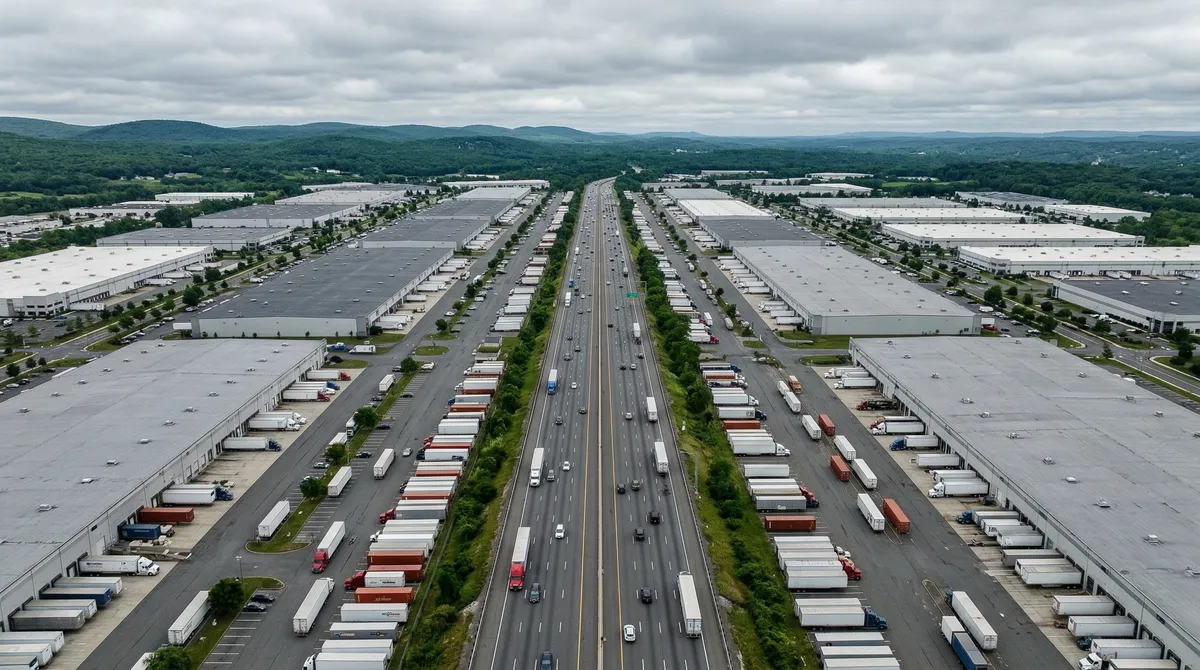
The Route 146 corridor between Worcester and Providence has turned into a logistics corridor in a hurry, with nearly 2.75 million square feet of new industrial space in development across Douglas, Sutton, and Uxbridge. Prologis puts national industrial demand up 47% since 2020, and Route 146 gives developers cheaper land than the I-495 belt while still reaching roughly 15 million consumers across southern New England and the New York metro fringe.
New inventory: 2.75 million SF of industrial space is under development across three major projects in the corridor.
Population reach: Facilities on Route 146 can reach 15 million consumers within a 3.5-hour drive, including Boston, Providence, Hartford, and New York metro areas.
Cost advantage: Land and construction costs in the corridor remain well below comparables in the I-495 belt and Greater Boston.
Demand driver: National industrial demand has increased 47% since 2020, primarily fueled by e-commerce growth and nearshoring trends.
Speculative industrial construction is when developers build industrial properties, such as warehouses or distribution centers, without a pre-existing tenant commitment, betting on future market demand to lease the space.
New inventory: 2.75 million SF of industrial space under development across three major projects (CoStar Group)
Population reach: Facilities on Route 146 reach 15 million consumers within a 3.5-hour drive, including Boston, Providence, Hartford, and New York metro (U.S. Census Bureau)
Cost advantage: Land and construction costs remain well below I-495 and Greater Boston comparables (CoStar Group)
Demand driver: National industrial demand up 47% since 2020, driven by e-commerce and nearshoring (Prologis)
A corridor that used to be a commute
Route 146 runs 30 miles from Worcester south to Providence, Rhode Island, and it cuts through some of the last large developable parcels in eastern Massachusetts. For decades the towns along it (Sutton, Douglas, Uxbridge, Northbridge, Grafton) were bedroom communities. That is changing fast.
Three large industrial projects are putting nearly 2.75 million square feet of new warehouse and distribution space onto Route 146, and turning it from a road people drove through into a place goods move through. In my read, this is one of the biggest clusters of speculative industrial construction in Massachusetts outside of Greater Boston.
The three projects doing the work
Cubes at Gilboa, Douglas
At 1.1 million SF, the Cubes at Gilboa in Douglas is one of the largest speculative industrial warehouse projects in the whole state. It sits with direct Route 146 access and is built for large-format distribution tenants working the Providence-Worcester-Boston triangle.
Unified2 Global Packaging Group, Sutton
Unified2 Global Packaging Group is building two buildings in Sutton totaling 1 million SF. Sutton sits midway along Route 146, with access to I-90 to the north (via I-395/I-290) and I-295 to the south near Providence.
Blackstone Logistics Center, Sutton, Uxbridge, and Douglas
The Blackstone Logistics Center runs across three towns, Sutton, Uxbridge, and Douglas, with 640,000 SF of planned industrial space. The three-town footprint tells you both how big it is and why it works: these towns share the Blackstone River Valley and Route 146 as their spine.
| Project | Location | Size | Status |
|---|---|---|---|
| Cubes at Gilboa | Douglas | 1,100,000 SF | Under development |
| Unified2 Global Packaging | Sutton | 1,000,000 SF | Under development |
| Blackstone Logistics Center | Sutton / Uxbridge / Douglas | 640,000 SF | Under development |
| Total | Route 146 Corridor | 2,740,000 SF |
For context, the entire Worcester County industrial market right now has just 41 available listings, averaging 40,245 SF. The Route 146 corridor alone is adding the equivalent of 68 average Worcester County industrial listings in a single development cycle.
Why here, why now
E-commerce wants to be close
National industrial demand is up 47% since 2020, driven mainly by e-commerce and nearshoring. Amazon, Walmart, and a growing list of third-party logistics operators need warehouse space near people, and the delivery radius they can live with keeps getting tighter.
Same-day and next-day delivery means you can't run a network off a handful of mega-facilities anymore. Companies need a set of regional hubs sitting two to four hours from the big population centers. Route 146 puts you there.
From a warehouse in Sutton or Douglas, a truck reaches:
- Worcester in 20-30 minutes
- Providence in 30-40 minutes
- Boston in 60-75 minutes
- Hartford in 75-90 minutes
- New York metro in under 3.5 hours
That covers roughly 15 million consumers across southern New England and the New York metro fringe.
The I-495 pricing problem
For years I-495 was the default spot for New England logistics. It had highway access, labor, and Boston nearby. Then it got expensive.
The 495-South submarket now runs a warehouse vacancy rate of 14.1%, with overall I-495 vacancy at 17.4%. There's space, but the problem is price: modern, well-kept warehouse space along I-495 rents for a lot more than what tenants find further south and west. Land for new construction is scarce and pricey when you can find it.
Route 146 is the pressure release. More land, lower acquisition costs, and a highway that ties straight into I-90, I-290, and I-395 in Worcester and I-295 in Providence. A tenant moving from I-495 to Route 146 cuts occupancy costs and keeps the same labor pool and the same customers.
Worcester's highway advantage
Worcester sits at one of the better highway crossings in New England:
- I-90 (Massachusetts Turnpike) east to Boston, west to Springfield and Albany
- I-290 connects Worcester's core to I-495 and the eastern suburbs
- I-190 north to Leominster and Route 2
- I-395 south to Connecticut and I-95
Route 146 carries that network south to Providence and finishes off a hub-and-spoke setup that reaches every major New England metro. For logistics operators, that connectivity is the whole pitch.
Who is actually leasing
The tenants soaking up space along Route 146 and across the wider Worcester County industrial market fall into a few buckets:
- E-commerce fulfillment: Amazon has signed full-building leases in Central Massachusetts. Other e-commerce operators, from DTC brands to third-party fulfillment shops, are running the same play: modern distribution space near people, at rents below Boston-area pricing
- Third-party logistics (3PL): Companies that warehouse and ship for multiple clients need big, flexible space with high clear heights and plenty of loading docks. The new Route 146 buildings are built for exactly this
- Manufacturing and packaging: Unified2 Global Packaging's own facility shows Route 146 pulls in manufacturers, not just distributors. The labor and land here support production tenants too
- Regional distribution: Companies serving New England retail need warehouses that can reach stores across several states in a single-day drive. Route 146 hits that
Small warehouse space under 6,000 SF is moving fast across Worcester County. The market's average listing size of 40,245 SF and average rent of about $10/SF reflect a mix of older, smaller buildings and the new large-format construction coming online on Route 146.
Towns positioned to benefit
The corridor's growth reaches past the towns hosting the big projects. Several nearby communities stand to pick up spillover:
Sutton
Ground zero. Two of the three major projects are fully or partly here. Sutton's zoning and available land have made it the main beneficiary of industrial demand on Route 146.
Douglas
Home to the Cubes at Gilboa, the corridor's largest single project. Douglas sits on the Massachusetts-Rhode Island line, so tenants get labor and suppliers from both states.
Uxbridge
Part of the Blackstone Logistics Center footprint. Uxbridge has more developable parcels along Route 146 and Route 16, with direct access to the Blackstone Valley.
Northbridge and Grafton
Adjacent towns with industrial-zoned land and existing manufacturing bases. As Route 146 rents rise with demand, these towns give tenants a lower-cost fallback inside the same labor market.
Oxford and Webster
Further west along Route 12 and I-395, Oxford and Webster are alternative industrial spots with Connecticut border access and lower entry costs. They tie into the Route 146 ecosystem through I-395 and Route 146's junction points.
The investment case
For industrial investors, here's how Route 146 pencils out:
1. Below-market basis: Land and construction costs on Route 146 sit well below I-495 and Greater Boston comparables. You can buy or build at a lower cost basis, which gives you a margin-of-safety cushion.
2. Institutional-grade tenants: The size of these projects, 640,000 to 1.1 million SF, tells you developers are underwriting to institutional logistics tenants. Those are credit-worthy, long-term occupants.
3. Rent growth trajectory: As the corridor's infrastructure fills in and vacancy tightens, rents will push toward I-495 levels. Get in now and you capture that spread.
4. Population growth tailwind: Central Massachusetts grew 8.1% from 2010 to 2020, and Worcester itself grew 14.1%. More residents means more consumer demand, which means more volume through local logistics facilities.
5. State investment: Worcester County has taken in $161 million or more in state economic development grants, funding infrastructure, workforce, and site prep that directly supports industrial growth.
The Greendale industrial campus in Worcester, a 51-acre site delivering about 1 million SF of industrial space, is one more sign that public and private money are both landing on Central Massachusetts as a logistics market.
Where I'd be careful
No thesis is risk-free. Investors and tenants should weigh a few things:
- Absorption timeline: Nearly 2.75 million SF hitting a market at once creates absorption risk. If e-commerce slows or a recession knocks down demand, vacancy can sit
- Municipal dynamics: Big industrial projects in historically residential towns draw political pushback. Zoning approvals, traffic mitigation, and community opposition can slow or reshape a project
- Infrastructure strain: Route 146 was not built as a primary freight route. More truck traffic may force road work, intersection upgrades, and safety spending that takes years
- Labor competition: Several large facilities chasing warehouse workers in the same market can push up wages and turnover, which hits tenant operating costs
- Interest rate sensitivity: Industrial cap rates are still compressed nationally. A long stretch of high rates could pressure values, especially on speculative projects that haven't stabilized yet
What it means for the Worcester market
Route 146 turning into a logistics corridor is part of a bigger shift: Worcester County moving from a secondary market to a regional economic engine. Put it alongside the Greendale campus, downtown Worcester's revitalization, and the steady healthcare and education employers, and the industrial pipeline on Route 146 adds something new to the county's investment profile.
For tenants, the corridor offers modern, purpose-built warehouse and distribution space at rents below the eastern Massachusetts alternatives. For investors, it's a ground-floor entry into a submarket that institutional capital is validating with hundreds of millions in development spending.
The question isn't whether Route 146 becomes a logistics corridor anymore. The concrete is already getting poured. The question is how fast absorption catches up to supply, and who's positioned to catch the upside.
Lornell Real Estate tracks industrial inventory, leasing activity, and investment opportunities across Worcester County and the Route 146 corridor. Contact our team at (860) 305-7432 to discuss specific properties and market positioning.
Limitations: Market data, projections, and trend analyses reflect conditions at publication. Commercial real estate markets are inherently cyclical, and submarket and property-level performance can diverge significantly from the regional averages cited. Demographic data, employer information, and regulatory conditions are subject to change. This article does not constitute investment advice. Conduct property-specific due diligence and consult qualified professionals before making investment decisions.
Sources & References
- Census Bureau
- CoStar
- CoStar Group
- Prologis
- U.S. Census Bureau
This article cites data from the sources listed above. For the most current figures, consult the original publications directly.
Data current as of publication date. Market conditions, rates, and regulations may have changed. Consult a qualified commercial real estate professional before making investment decisions.
Get the full Central MA market data
Commercial tax-base growth, development activity, and demographics across Central MA, town by town.