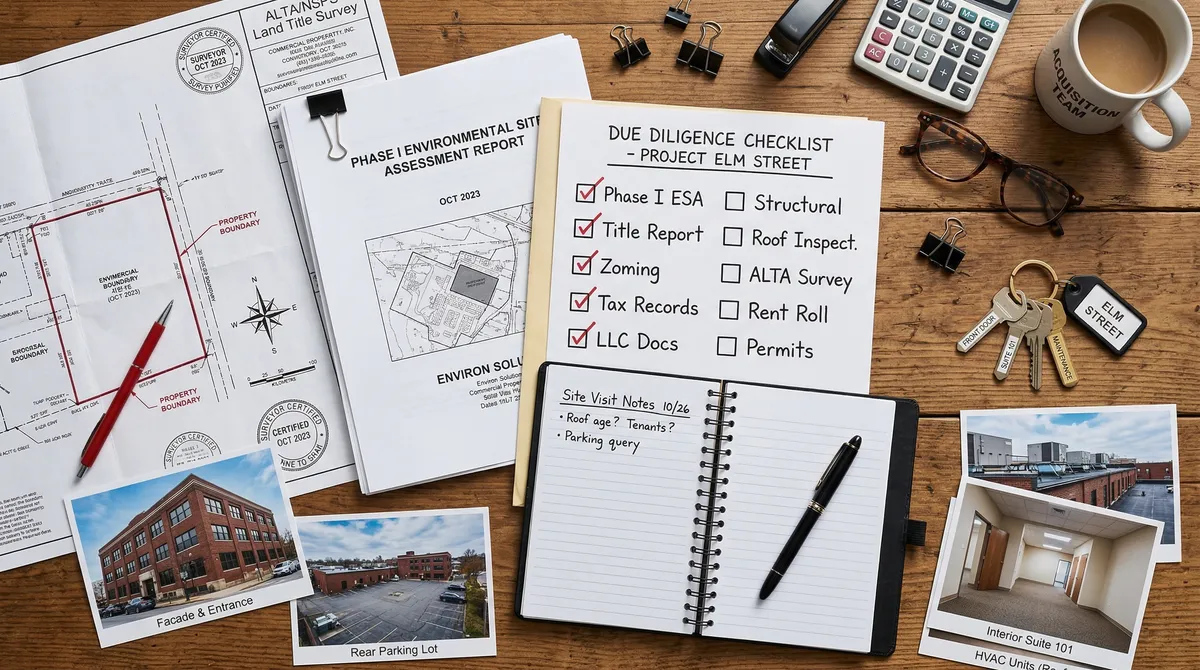
In commercial real estate, due diligence is on you. The legal standard is caveat emptor, buyer beware, and most purchase agreements give you 30-60 days to check every financial, physical, environmental, and legal corner of a property. The National Association of Realtors puts inadequate due diligence at the top of the list for post-closing disputes, which is exactly why I run a structured checklist on every deal. It protects the money, and it hands you the leverage to renegotiate.
Key Takeaways
Plan on 30-60 days from contract signing to run every investigation (National Association of Realtors).
Budget $2,500-$5,000 for the Phase I environmental assessment. Most commercial lenders require it (ASTM E1527-21).
A roof on a 20,000 SF building runs $150,000-$300,000+. Verify it (CBRE).
Seller pro formas routinely overstate income by 5-15%. Rebuild NOI from the actual operating statements (Cushman & Wakefield).
Caveat emptor is a Latin legal principle meaning "buyer beware," which places the responsibility on the buyer to investigate and discover any issues with a property before purchase in commercial real estate transactions.
Key Takeaway
Due diligence window: typically 30-60 days from contract execution to complete all investigations (National Association of Realtors)
Phase I ESA cost: $2,500-$5,000 for environmental assessment, required by most commercial lenders (ASTM E1527-21)
Roof replacement cost: $150,000-$300,000+ for a 20,000 SF building, a critical capital expenditure to verify (CBRE)
NOI verification: seller pro formas frequently overstate income by 5-15%, so always reconstruct NOI using actual operating statements (Cushman & Wakefield)
Why due diligence matters
The due diligence period is your last honest look. It's where you verify what the seller told you, find the problems that move value, and either renegotiate or walk. What you don't know in this business will cost you, and sometimes it's catastrophic.
Commercial is not residential. There are no mandatory seller disclosures on most commercial deals. The standard is caveat emptor, buyer beware. Your purchase and sale agreement hands you a finite window, usually 30-60 days, to dig into every aspect of the property. Whatever you miss in that window is your problem the day you close.
I've organized this checklist by category with specific action items for each phase. Treat it as a working document on every acquisition.
Phase 1: Financial due diligence
Start your financial analysis before you ever submit an offer. But the due diligence period is where you verify it against real documentation, not the seller's marketing package.
Operating statement review
Get 3 years of actual operating statements, not pro formas. You want the property's real income and expenses as reported to the IRS or prepared by the owner's accountant. Check gross rental income against the current leases. Line the rent roll up against the executed leases and confirm the numbers match. Account for every other income source: parking fees, storage, signage, laundry, percentage rent, antenna and cell tower leases. Look at vacancy and collection loss history. What has actual vacancy averaged over 3 years, and what credit losses have hit? Verify operating expenses line by line: - Property taxes (get the actual tax bills, not estimates)
- Insurance (request the current policy declarations page)
- Utilities (request 12-24 months of actual utility bills)
- Repairs and maintenance (review invoices for major items)
- Management fees (what percentage, and is it market rate?)
- Common area maintenance (CAM) expenses and reconciliations
- Snow removal, landscaping, and janitorial contracts
Rebuild the actual NOI off the verified numbers, then set it next to what the seller represented. Flag any one-time or non-recurring expenses that inflated or deflated the historical NOI. Pull the capital expenditure history. What has the owner actually spent on improvements over the past 5 years, and what got deferred? Rent roll analysis
Get the current certified rent roll: every tenant, unit or suite number, square footage, lease start and end dates, base rent, escalation schedule, and security deposits. Look for lease expirations inside 12-24 months. Heavy rollover means re-leasing risk and an income gap. Check tenant concentration. If one tenant is more than 25% of gross income, your risk is sitting in one basket. Read the rent escalation schedules. Are the annual bumps fixed, say 2-3%, or tied to CPI? Any flat periods? Verify tenant payment history. Ask for an aging report showing any delinquencies. Weigh the below-market and above-market leases. How does each tenant's rent compare to today's market? Below-market is upside. Above-market is risk. Lease abstract review
For every lease in the property, build or obtain an abstract that covers:
Lease term: start date, expiration, renewal options and at what terms Rent structure: base rent, NNN pass-throughs, percentage rent, escalation schedule Expense responsibility: who pays taxes, insurance, CAM, utilities, repairs Tenant improvement allowances: any obligations still open Exclusive use clauses: does a tenant restrict what others can operate Go-dark provisions: can a tenant stop operating while still paying rent Co-tenancy clauses: can tenants cut rent or terminate if an anchor leaves Assignment and subletting rights: can the tenant hand off the lease Right of first refusal: does a tenant have the right to buy the property or lease more space Kick-out clauses: can the tenant terminate early under certain conditions Landlord obligations: what maintenance, repair, and capital duties fall on the landlord
Phase 2: Physical due diligence
The physical inspection tells you the real condition of the building and the capital you'll pour in to keep it running.
Property condition assessment
Hire a qualified commercial property inspector, not a residential home inspector. Commercial inspections should follow ASTM E2018 standards for Property Condition Assessments (PCA). Roof: age, condition, remaining useful life, warranty status. A roof on a 20,000 SF building can run $150,000-$300,000+. HVAC: age, condition, maintenance history, remaining life. Commercial units typically last 15-20 years. Electrical: panel capacity, wiring condition, code compliance. Can the service handle what tenants need, EV charging, manufacturing equipment, and so on? Plumbing: pipe material (cast iron, copper, PVC), condition, any signs of leaks or past repairs. Cast iron in pre-1970 buildings may need a full replacement. Structural: foundation, load-bearing capacity, evidence of settlement, cracking, or water intrusion. Building envelope: windows, doors, exterior walls, insulation. Efficiency here drives operating costs. Parking lot and site work: pavement condition, striping, curbing, drainage, sidewalks, lighting. ADA compliance: accessible parking, ramps, restrooms, door widths. Non-compliance is liability and forced capital spend. Fire protection and life safety: sprinklers, fire alarm, exit signage, extinguishers. When was the last fire inspection? Elevator, if there is one: age, condition, inspection certificates, maintenance contract. Capital expenditure projection
Working off the condition assessment, project your capital needs across the hold period:
Immediate needs (0-12 months): code violations, safety issues, deferred maintenance Short-term needs (1-3 years): systems nearing end of life, tenant improvement work Long-term needs (3-10 years): roof, parking lot resurfacing, HVAC replacement Total capex reserve: put together a capital budget and make sure your acquisition underwriting carries these costs
Phase 3: Environmental due diligence
Environmental problems can create liabilities bigger than the property is worth. This is not the place to cut corners.
Phase I environmental site assessment
Order a Phase I ESA from a qualified environmental consultant following ASTM E1527-21 standards. It's standard on every commercial acquisition and most lenders require it. Look at the historical use of the property and the parcels next door. Gas stations, dry cleaners, auto repair, manufacturing, printing operations, those prior uses are red flags. Pull the environmental database records: EPA, MassDEP (Massachusetts Department of Environmental Protection), state underground storage tank registries, and hazardous waste records. Identify any Recognized Environmental Conditions (RECs). Those are the findings that point to potential contamination and call for a closer look. Phase II environmental site assessment (if triggered)
If the Phase I turns up RECs, a Phase II means actual soil and groundwater sampling:
Soil borings and lab analysis to establish whether contamination exists and how far it goes Groundwater monitoring where contamination is suspected A remediation cost estimate if contamination is confirmed An honest read on the hit to value and financing. Some lenders won't close on a property with open environmental issues. Additional environmental considerations
Asbestos: common in pre-1980 buildings, in insulation, floor tiles, roofing, pipe wrap. An asbestos survey belongs in any pre-1980 purchase. Lead paint: common in pre-1978 buildings. Commercial carries less regulatory weight than residential, but price out the remediation anyway. Wetlands: check the boundaries that could restrict development or expansion. In Massachusetts, wetlands answer to both the state (MassDEP) and local conservation commissions. Flood zone: get a flood zone determination. FEMA flood zones mean flood insurance and can mean development restrictions.
Phase 4: Title and legal due diligence
Title examination
Order a title search and commitment from a title company. Review for: - A clear chain of title
- Outstanding liens or encumbrances
- Easements (utility, access, drainage) that affect use
- Restrictive covenants that limit how you can use the property
- Boundary disputes or survey discrepancies
Get a current ALTA survey. It shows exact boundaries, easements, setbacks, encroachments, and flood zone designations, and it tells you whether any improvement sits over a setback or onto a neighbor's land. Read every existing easement. Know what rights others hold on the property, utility access, shared driveways, drainage, and how they hit your intended use. Get title insurance for both the lender (required) and the buyer (I strongly recommend it). Zoning and land use
Confirm the current zoning designation with the municipality. Verify the current use is permitted under the zoning code. Some properties run as legal non-conforming uses, grandfathered, and you need to know what that means for expansions, renovations, or a change of use. Review the setback, lot coverage, and parking requirements. Can you expand or add parking if you need to? Check for pending zoning changes that could help or hurt the property. Look at any special permits or variances already granted. Are there conditions attached? Check for historic district or overlay district restrictions that could limit renovation options. Government and regulatory
Pull the most recent property tax assessment and compare it to the purchase price. If your price runs well above the assessed value, expect a reassessment and higher taxes after closing. Review outstanding building permits and certificates of occupancy. Confirm every improvement was properly permitted and the certificate of occupancy matches the current use. Check for pending code violations or municipal liens. Review fire department inspection records and any open compliance orders.
Phase 5: Market due diligence
Rent comparables
Research comparable rents in the immediate area for the same property type and quality. Are the subject's rents at, above, or below market? Look at recent lease transactions in the submarket. What terms are tenants getting? Judge the rent growth potential off market trends, the supply pipeline, and the demand drivers. Sales comparables
Research recent sale transactions for similar properties. Confirm the cap rate your offer price implies lines up with actual transaction evidence. Know which way cap rates are moving in the submarket. Are they compressing (prices rising) or expanding (prices falling)? Supply and demand
Review the development pipeline. Anything competing under construction or on the drawing board? New supply eats occupancy and rents. Look at absorption trends. Is the market taking up space faster than new supply is delivered? Weigh the demand drivers. Population growth, employment, infrastructure investment, what actually supports continued demand for this property type in this spot?
Phase 6: Insurance due diligence
Get insurance quotes before closing. Make sure you can buy adequate coverage at a reasonable cost. Review the property's loss history (CLUE report). Prior claims move both insurability and premiums. Confirm the coverage requirements in every lease. Are tenants required to carry liability insurance? Do they have to name the landlord as additional insured? Weigh any special coverage needs: flood, earthquake, environmental liability, umbrella and excess.
Due diligence timeline
Here's how I'd structure a typical 45-day due diligence period:
| Days | Activity |
|---|
| 1-5 | Receive seller's document package. Order Phase I ESA, PCA, survey, and title search. |
| 5-15 | Financial analysis verify rent roll, reconstruct NOI, abstract leases. |
| 10-25 | Receive inspection reports. Identify issues and quantify capital needs. |
| 15-30 | Environmental and title reports received. Address any findings. |
| 20-35 | Market analysis verify rent comps, sale comps, supply pipeline. |
| 30-40 | Compile findings. Identify renegotiation points. |
| 40-45 | Make go/no-go decision. Request price adjustment or credit for discovered issues. |
Key negotiation points post-due diligence
When due diligence surfaces problems, you've generally got three moves:
- Renegotiate the price. Knock the number down for what you found, deferred maintenance, environmental, below-market lease terms.
- Request credits. The seller gives you a credit at closing for specific items, a roof repair or an HVAC replacement.
- Terminate. Use your right to walk if the issues are too big.
The bottom line
Due diligence is not a formality. It's the process that protects your money. Every item on this list is here because some investor skipped it and paid for it. Environmental liabilities, deferred maintenance, bad lease terms, zoning restrictions, title defects, any one of them can wreck the economics of a deal that looked good on paper.
In Central Massachusetts, accessible pricing and a mix of inventory throw off plenty of opportunities, but every one has to survive real diligence. The 30-60 days you spend investigating a property decide whether it earns the returns you underwrote.
Lornell Real Estate walks investors through every phase of a commercial acquisition, from the first screen through diligence and closing. Call our team at (860) 305-7432 to talk through current opportunities and how we work.
Limitations: Cap rates, pricing, and transaction volume cited reflect market-level averages at the time of publication and may not apply to individual properties. Property values depend on asset-specific factors including condition, tenant credit quality, lease terms, location, and financing structure. Tax rules (including 1031 exchange provisions, capital gains rates, and depreciation schedules) change with legislation. This article does not constitute investment, tax, or legal advice. Consult a qualified CPA, attorney, and commercial real estate broker before making transaction decisions.
Sources & References
- CBRE
- Cushman & Wakefield
- IRS
- National Association of Realtors
This article cites data from the sources listed above. For the most current figures, consult the original publications directly.
Data current as of publication date. Market conditions, rates, and regulations may have changed. Consult a qualified commercial real estate professional before making investment decisions.
Get the full Central MA market data
Commercial tax-base growth, development activity, and demographics across Central MA, town by town.