Historic mill conversions in Central Massachusetts can earn a developer up to 40% in combined tax credits, the 20% federal Historic Tax Credit plus the 20% Massachusetts State Historic Tax Credit, per the National Park Service and Massachusetts Historical Commission. These old textile mills, built with heavy timber and thick brick, are being turned into mixed-use residential and commercial space across Worcester County.
Tax credits: up to 40% in combined federal and Massachusetts state historic tax credits on qualified rehabilitation expenses.
Cost: conversions run about $150/SF, roughly a 30% effective cost cut against $500+/SF for new ground-up construction.
Structure: heavy timber, 150-200 PSF floor loads, and 12-16 foot ceilings.
Case study: the Crompton Mill in Worcester, a $75 million project with 180 apartments, 50,000 SF of office, and a riverwalk park.
Adaptive reuse is repurposing an existing building for a use other than what it was built for, usually keeping its historic character while extending how long it earns.
Combined 40% in tax credits, the 20% federal HTC (National Park Service) plus the 20% Massachusetts state HTC on qualified rehabilitation expenses.
Conversion costs of $150/SF against $500+/SF for comparable ground-up construction, a 30% effective cost cut after credits.
Heavy timber construction with 150-200 PSF floor loads and 12-16 foot ceilings.
The Crompton Mill in Worcester: a $75 million project, 180 apartments, 50,000 SF of office, and a riverwalk park.
The mills came back: from empty shells to real development sites
Central Massachusetts is full of the leftovers of the country's industrial run, the big brick textile mills that once ran the economy here. I think they are one of the better development plays in New England real estate today.
How we got here
From 1820 to 1920, Massachusetts was the textile capital of the country. Mills in Worcester, Lowell, and Fall River employed tens of thousands of people, turning out cotton cloth, specialty yarns, and everything in between. When the industry moved south in the mid-1900s, most of these buildings were left empty.
"These mills were built to last centuries. The heavy timber construction, thick brick walls, and large floor plates that made them ideal for manufacturing now make them perfect for modern adaptive reuse.
Why mills work so well for reuse
1. The structure is solid
Historic mills were overbuilt by today's standards:
- Floor loads of 150-200 PSF, against 50-75 PSF for modern construction
- Brick walls often 18-24 inches thick
- Heavy timber framing that beats modern fire codes
- Large, open floor plates you can lay out any way you want
2. Character you can't fake
Mill buildings have features nobody builds anymore:
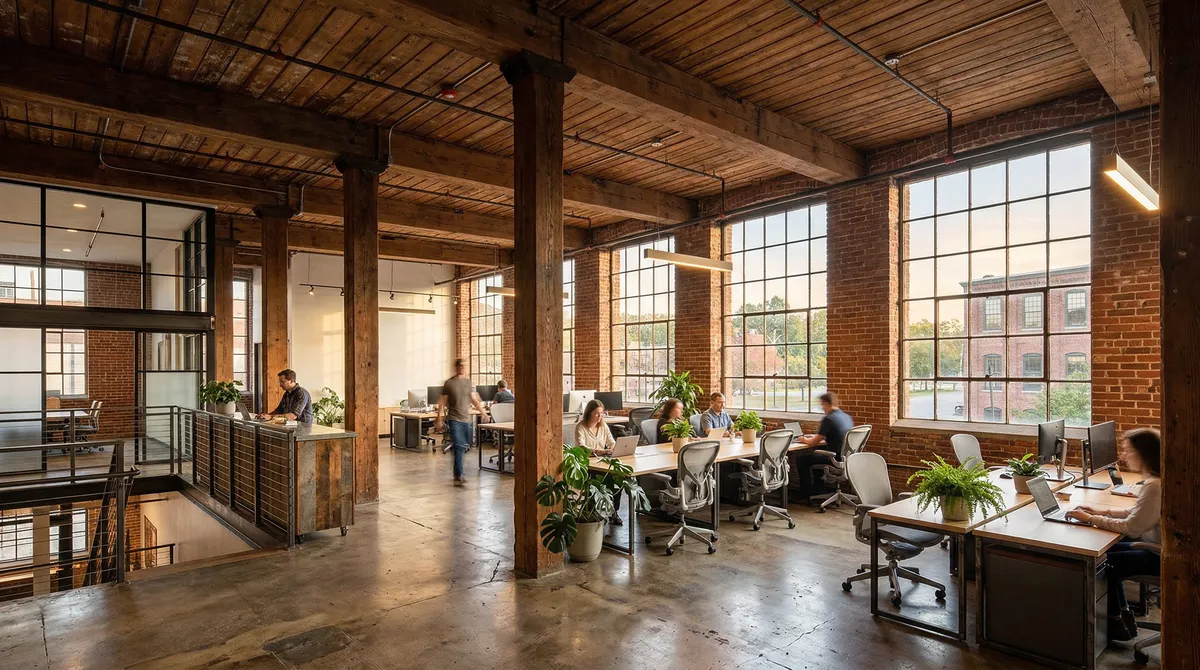
- Exposed brick and heavy timber beams
- Tall ceilings, 12-16 feet is typical
- Big multi-pane windows that pull in daylight
- Historic bell towers and distinctive exteriors
- Riverfront locations, on the water that once ran the machines
3. Good locations
Mills were put where they made sense:
- Near rail lines and transportation corridors
- Next to population centers
- Often on riverfronts that people now want for recreation
- In downtowns that are turning around
The numbers: what the tax credits do to your returns
The federal Historic Tax Credit (HTC) and the Massachusetts State Historic Tax Credit stack, and together they change the math on a mill conversion:
| Credit Type | Amount | Requirements |
|---|---|---|
| Federal HTC | 20% of qualified rehabilitation expenses | Property listed on National Register, income-producing use |
| MA State HTC | 20% of qualified expenses | Certified historic structure, income-producing use |
| Combined | Up to 40% of costs | Meet both federal and state standards |
How it pencils out:
Take a 100,000 SF mill conversion:
| Item | Amount |
|---|---|
| Acquisition | $2,000,000 |
| Rehabilitation Costs | $15,000,000 |
| Soft Costs | $3,000,000 |
| Total Development Cost | $20,000,000 |
| Federal HTC (20% of $15M) | ($3,000,000) |
| MA State HTC (20% of $15M) | ($3,000,000) |
| Effective Net Cost | $14,000,000 |
That is a 30% cut in your effective development cost, which does a lot for the returns.
Case study: Crompton Mill, Worcester
The Crompton Mill complex in Worcester is a good example of a mill conversion done right:
Before (2010):
- 400,000 SF of empty industrial space
- Environmental contamination from the old uses
- Structural deterioration
- A tax liability for the city
After (2020):
- 180 market-rate apartments
- 50,000 SF of creative office space
- Restaurant and retail at street level
- A riverwalk park along the Blackstone River
What it did:
- $75 million total investment
- 350 construction jobs
- 500+ permanent jobs once it was finished
- Property tax revenue up 10x
How the deal actually runs
Phase 1: Due diligence (3-6 months)
Before you buy any mill, dig in:
- Phase I/II Environmental Assessment
- Structural engineering evaluation
- Historic significance determination
- Zoning and permitting analysis
- Utility capacity assessment
- Title and ownership research
Phase 2: Historic designation (6-12 months)
Get the certifications you need:
- National Register of Historic Places listing, if it isn't already listed
- State Historic Preservation Office (SHPO) project approval
- National Park Service Part 1 and Part 2 applications
- Design review and modification process
Phase 3: Financing (3-6 months)
Mill projects usually run a complicated capital stack:
- Senior construction loan (60-65% LTC)
- Historic Tax Credit equity (investors buy the credits at $0.85-0.92 on the dollar)
- State and local incentives (TIF districts, brownfield credits)
- Developer equity (10-20%)
- Subordinate financing, if you need it
Phase 4: Construction (18-36 months)
The rehab has to meet the Secretary of the Interior's Standards:
- Preserve the character-defining features
- Keep changes to historic materials to a minimum
- New work has to be compatible but tell itself apart from the old
- Changes should be reversible where you can manage it
The problems you'll hit, and how to handle them
Environmental contamination
The problem: a lot of mills have asbestos, lead paint, PCBs, or petroleum contamination.
The fix: Massachusetts Brownfields programs give you:
- Liability protection for new owners
- Tax credits for cleanup costs
- Technical help with remediation
Parking
The problem: historic mills don't have the parking ratios people expect today.
The fix:
- Negotiate lower ratios with the town (transit-oriented development)
- Put structured parking on an adjacent parcel
- Partner with a nearby parking operator
- Push alternative transportation
Building code
The problem: getting an old building up to modern code.
The fix:
- The Massachusetts Historic Building Code gives you room to work
- Alternative compliance methods for historic structures
- The variance process for specific requirements
Who rents a converted mill
Residential
- Young professionals who want a unit with character
- Empty nesters coming down from a suburban house
- Remote workers who want live-work flexibility
Commercial
- Creative agencies and design firms
- Technology startups
- Professional services that want space that stands out
- Food and beverage operators
Mixed-use
- Retail or restaurant on the ground floor
- Residential or office above
- Event space in the unusual spots, top floors, old boiler rooms
Why 2026
A few things line up in 2026 for mill development:
1. Construction costs have settled after the post-pandemic run-up
2. Financing has improved: lower rates make more projects work
3. Housing demand: the state's housing shortage keeps residential demand strong
4. Work from home: demand for unusual, character space keeps building
5. Municipal support: more cities are putting incentives on the table for reuse
Where to start
If you're looking at a mill conversion:
1. Market research: find communities with housing demand, municipal support, and historic districts
2. Property sourcing: work with brokers who do development sites, and watch the tax-foreclosed property auctions
3. Build the team: line up architects, attorneys, and tax credit specialists who have done historic rehab before
4. Model the money: understand when the tax credits actually arrive and structure the deal around that timing
Lornell Real Estate knows Central Massachusetts development, historic reuse included. Call us to talk through available mill properties and how to play them.
Limitations: the timelines, construction costs, and regulatory requirements here are typical ranges and vary a lot by municipality, site conditions, environmental factors, and project scope. Permitting timelines depend on local planning boards and zoning that change on their own. Tax credit programs have specific eligibility criteria and application deadlines. This article is not development or legal advice. Bring in qualified architects, engineers, attorneys, and environmental professionals for guidance on your specific project.
Sources & References
- Massachusetts Historical Commission
- National Park Service
- National Park Service and Massachusetts Historical Commission
This article cites data from the sources listed above. For the most current figures, consult the original publications directly.
Data current as of publication date. Market conditions, rates, and regulations may have changed. Consult a qualified commercial real estate professional before making investment decisions.
Get the full Central MA market data
Commercial tax-base growth, development activity, and demographics across Central MA, town by town.