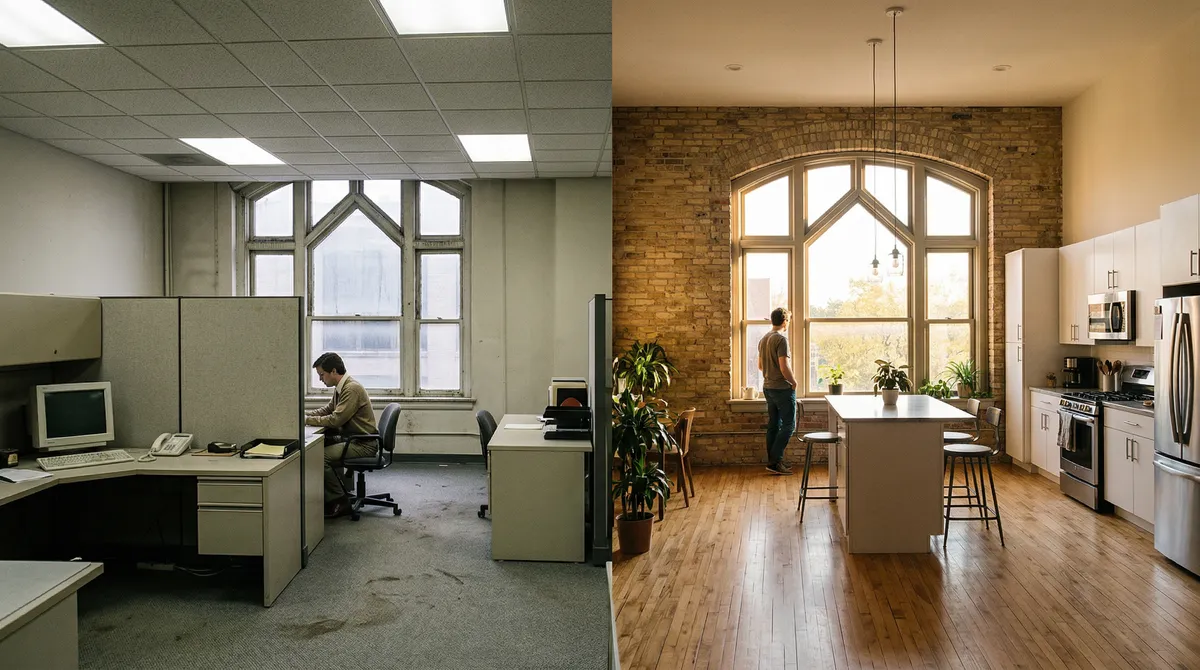
Converting office buildings to apartments hits two problems at the same time. Greater Boston office vacancy is at an all-time high of 17% (CBRE's 2025 Boston Market Report), and Massachusetts is short on housing with a median home price of $572,900. Per the City of Boston, the Office to Residential Conversion Program has already produced over 1,500 housing units, with 780 more in the pipeline.
Program Success: Boston's Office to Residential Conversion Program has already produced over 1,500 housing units, with an additional 780 currently in the pipeline.
High Vacancy Rates: Greater Boston's office vacancy rate has hit an all-time high of 17%, making many older buildings strong candidates for conversion.
Cost Efficiency: Conversion projects offer significant savings, with costs ranging from $200-$400/SF, well below ground-up construction exceeding $500/SF.
State Funding: The Healey-Driscoll Administration provides up to $215,000 per affordable unit through a $15 million initiative, capped at $4 million per project.
Program Extension: Boston's conversion program has been extended through December 31, 2026, with a construction deadline of December 31, 2027, to further incentivize development.
Adaptive reuse is the process of repurposing existing buildings or structures for a new and different use than originally intended, often transforming outdated commercial spaces into residential units to address market needs.
1,500+ housing units completed or under construction through Boston's Office to Residential Conversion Program (City of Boston), with 780 more in the pipeline.
Greater Boston office vacancy at an all-time high of 17% (CBRE), making many older buildings prime conversion candidates.
Conversion costs range from $200-400/SF, creating total basis significantly below ground-up construction at $500+/SF.
State funding of up to $215,000 per affordable unit available through the Healey-Driscoll Administration's $15M initiative (Massachusetts.gov).
Why office-to-apartment is happening now
Greater Boston office vacancy sits at an all-time high of 17% and housing costs are at crisis levels. The answer a lot of developers landed on is to take an underperforming office building and turn it into apartments.
Some developers call it "anti-NIMBYism." Whatever you call it, it is changing what these buildings are worth and it is opening up deals worth looking at.
The numbers behind Boston's program
Mayor Michelle Wu's Office to Residential Conversion Program has run ahead of what people expected:
| Metric | Status |
|---|---|
| Units Completed/Under Construction | 1,500+ |
| Units in Pipeline | 780 |
| Program Extended Through | December 31, 2026 |
| Construction Deadline | December 31, 2027 |
The program gives you faster permitting and tax incentives when you convert an office building to housing. To qualify, a project has to:
- Include 17% of units affordable at 60% Area Median Income (AMI)
- Preserve ground-floor retail where applicable
- Meet building code requirements for residential occupancy
What the state is putting in
The Healey-Driscoll Administration has put real money behind speeding conversions up:
$15 Million Initiative:
- Up to $215,000 per affordable unit
- Cap of $4 million per project
- Priority for larger-scale conversions
- Partnership with 11 municipalities to identify development-ready sites
Governor Healey: "Massachusetts is moving faster to create reasonably-priced housing and revitalize our downtowns."
Lieutenant Governor Driscoll: "By prioritizing adaptive reuse and projects with zoning in place, this program will speed up delivery of homes."
Why the math works
1. Too much empty office
Greater Boston office vacancy hit 17% in 2024, an all-time high. It is up 310 basis points year-over-year, and I expect it to keep climbing as long as remote work sticks around.
A lot of older office buildings are functionally obsolete:
- Inefficient floor plates
- Outdated mechanical systems
- Poor natural light
- Inadequate amenities
For a building like that, converting it to residential is often the highest and best use, plain and simple.
2. Not enough housing
Massachusetts is short on housing:
- Home prices up 7% year-over-year (January 2025)
- Median home price: $572,900 statewide
- Boston median: ~$750,000
- Rental vacancy near historic lows
New construction keeps coming in under demand. Conversions add units without the neighborhood fights that usually come with building from scratch.
3. The neighbors actually want it
Lawrence Curtis of WinnDevelopment calls adaptive reuse "anti-NIMBYism":
""When you take an old office building and convert it into housing or an alternative use... you get what I call the hug fest. People actually want to see it done."
Unlike new construction, conversions:
- Preserve historic buildings and neighborhood character
- Reduce construction-related disruption
- Eliminate concerns about increased density
- Often receive community support rather than opposition
Making the economics work
You have to underwrite these carefully. A building that works:
Favorable Building Characteristics:
- Floor plates under 15,000 SF (enables efficient unit layouts)
- Regular, rectangular floor shapes
- Adequate window lines for bedrooms
- Structural capacity for residential loads
- Accessible mechanical shafts
Cost Considerations:
- Conversion costs: $200-400/SF depending on building condition
- Typical timeline: 18-30 months from acquisition to occupancy
- Affordability requirements reduce revenue but come with incentives
- Historic tax credits (where applicable) can offset 20-25% of costs
Deal Structure Example:
| Metric | Value |
|---|---|
| Acquisition | $15M ($75/SF for 200K SF building) |
| Conversion Cost | $50M ($250/SF) |
| Total Basis | $65M |
| Units Created | 180 |
| Per Unit Basis | $361,000 |
| Market Rents | $2,800/month average |
| Stabilized NOI | $4.5M |
| Yield on Cost | 6.9% |
What this looks like in Worcester and Central Mass
Boston gets the headlines, but there are real conversion plays out here too.
The Slater Building (390 Main St., Worcester)
WinnDevelopment is moving on plans to turn this historic building into apartments. It is a good example of what adaptive reuse can do:
- Preserve downtown architectural heritage
- Add housing inventory in walkable locations
- Leverage state and federal historic tax credits
- Contribute to downtown revitalization
Other Central MA Opportunities:
- Former manufacturing buildings with loft character
- Suburban office buildings in residential areas
- Historic mill buildings (Leicester, Spencer, Webster)
Why I like these deals
1. Below-Market Basis
Buy an underperforming office building at $50-100/SF, convert to residential, and you are into it for $300-400/SF all in. That is a lot of embedded value against ground-up at $500+/SF.
2. Reduced Entitlement Risk
A lot of these projects already have zoning for the building's original use, and the residential conversion approval is streamlined.
3. Community Support
The neighbors tend to back conversions instead of fighting them, and that takes political risk off the table.
4. Historic Tax Credits
Buildings 50+ years old can qualify for federal historic tax credits (20% of qualified rehabilitation expenditures) plus Massachusetts state credits (another 20%). That can move a deal from marginal to good.
Where these go sideways
Building Suitability: Not every office building converts. Deep floor plates, odd shapes, and structural limits can kill the math before you start.
Construction Complexity: Turning office building systems into residential ones takes specialized people. The mechanical, electrical, and plumbing get substantially rebuilt.
Affordability Requirements: To get into the program you have to set aside affordable units, which cuts rental income. Underwrite the blended rents carefully.
What I'd tell you to do
You have office distress, a housing shortage, and government money all lining up at once. That is a good environment for adaptive reuse. If you are looking at it:
1. Screen office buildings for conversion suitability (floor plates, shape, windows)
2. Engage architects early to assess feasibility
3. Model economics including all available incentives
4. Partner with experienced conversion developers
5. Move quickly the best candidates will be acquired first
Lornell Real Estate can help identify conversion candidates across Central Massachusetts. Contact us to discuss opportunities.
Limitations: Development timelines, construction costs, and regulatory requirements cited represent typical ranges and vary significantly by municipality, site conditions, environmental factors, and project scope. Permitting timelines depend on local planning boards and zoning requirements that change independently. Tax credit programs have specific eligibility criteria and application deadlines. This article does not constitute development or legal advice. Engage qualified architects, engineers, attorneys, and environmental professionals for project-specific guidance.
Sources & References
- CBRE
- City of Boston
- January 2025
This article cites data from the sources listed above. For the most current figures, consult the original publications directly.
Data current as of publication date. Market conditions, rates, and regulations may have changed. Consult a qualified commercial real estate professional before making investment decisions.
Get the full Central MA market data
Commercial tax-base growth, development activity, and demographics across Central MA, town by town.