In 35 years leasing office space around Worcester County, I've watched plenty of trends come and go. Flex isn't one of them. It's taking real share from the standard long-term office lease, and the growing companies I work with are the ones driving it. Statista puts the global flex market at $45 billion in 2025, growing 12% CAGR through 2030, and pegs flex at up to 30% of the total office market by the end of the decade.
The global flex market runs about $45 billion in 2025 and could be 30% of the total office market by 2030.
A company moving to flex typically saves around 45% in Year 1 against a traditional office lease.
You can be in flex space in 2-4 weeks. A traditional office runs 9-18 months.
74% of companies are making hybrid work permanent, and that's what keeps pulling demand into flex.
Flex gives you short commitments (month-to-month to 2 years) and room to scale up or down without carrying a long lease or paying for buildout.
Flex space covers formats like coworking and executive suites that let a business grow or shrink its office footprint on shorter commitments than a standard lease.
Global flex space market: $45 billion in 2025, projected 12% CAGR through 2030 (Statista)
Cost savings: Companies save an average of 45% in Year 1 compared to traditional office leases (CBRE)
Speed to occupancy: 2-4 weeks vs. 9-18 months for traditional office (Cushman & Wakefield)
Demand surge: 74% of companies plan permanent hybrid work policies, driving flex adoption (JLL)
The post-pandemic workspace evolution
How companies think about their space changed for good. What started as a pandemic workaround stuck, and flex sits right in the middle of it.
Defining flex space
Flex comes in a few shapes:
| Type | Description | Typical Users |
|---|---|---|
| Coworking | Shared open desks and private offices | Freelancers, startups, remote workers |
| Executive Suites | Private offices with shared amenities | Small professional firms |
| Hybrid Flex | Flexible industrial/office combinations | Light manufacturing, e-commerce |
| Enterprise Flex | Dedicated floors with flexibility | Growing companies, regional offices |
The numbers tell the story
On the growth side:
- Global flex space market: $45 billion (2025)
- Projected growth: 12% CAGR through 2030
- Flex as share of office market: 5% → 30% by 2030 (projected)
On demand:
- 74% of companies plan hybrid work policies permanently
- 67% of employees prefer flexible work locations
- Average company saves 30% on real estate costs with flex strategies
Why businesses choose flex
Financial flexibility
A standard office lease boxes you in:
| Traditional Lease | Flex Space |
|---|---|
| 5-10 year commitment | Month-to-month to 2 years |
| Substantial buildout costs | Move-in ready |
| Full rent during downturns | Scale up/down as needed |
| Subleasing difficulties | Simply reduce footprint |
When you don't know exactly how fast you'll grow, being able to add or shed space without a penalty is worth a lot.
Speed to occupancy
Traditional office timeline:
- Site selection: 3-6 months
- Lease negotiation: 2-4 months
- Buildout: 4-8 months
- Total: 9-18 months
Flex space timeline:
- Site selection: 1-2 weeks
- Agreement signing: 1 week
- Occupancy: Immediate to 2 weeks
- Total: 2-4 weeks
"A growing tech company told us: "We won a major contract that required hiring 50 people in 90 days. Traditional office was impossible. Flex let us execute immediately."
Amenity access
Good flex buildings come with the kind of amenities a small shop could never afford to build on its own:
- High-speed fiber internet with redundancy
- Professional reception and mail handling
- Conference rooms with video capabilities
- Fully equipped kitchens and break areas
- Wellness rooms and phone booths
- Parking management
- After-hours security
Network effects
The better flex spaces turn into little business communities:
- Cross-pollination of ideas among companies
- Informal networking opportunities
- Referral business among members
- Shared vendor relationships
- Community events and programming
The tenant demographics
Who's using flex space in 2026?
Small businesses (1-10 employees): 45%
- Professional services (accountants, attorneys, consultants)
- Creative agencies
- Tech startups
Mid-size companies (11-100 employees): 35%
- Regional offices for national companies
- Growing local businesses
- Project-based teams
Enterprise (100+ employees): 20%
- Satellite offices
- Innovation labs
- Overflow space
- Geographic expansion
Cost efficiency analysis
Here's the all-in math on a 10-person company:
| Cost Category | Traditional Office | Flex Space |
|---|---|---|
| Base Rent | $30/SF | Included |
| Utilities | $3/SF | Included |
| Internet/Phone | $5,000/yr | Included |
| Furniture | $50,000 | Included |
| Buildout | $75,000 | Included |
| Reception | $45,000/yr | Included |
| Cleaning | $12,000/yr | Included |
| Year 1 Total | ~$175,000 | ~$96,000 |
That's 45% off in Year 1, and no capital out of pocket.
Central Massachusetts flex market
The flex market here is moving quickly.
Current inventory:
- Worcester: 15+ flex facilities, 400,000 SF
- Framingham: 10+ facilities, 250,000 SF
- Marlborough: 8+ facilities, 200,000 SF
Vacancy trends:
- 2023: 25% vacancy (post-pandemic recovery)
- 2024: 15% vacancy
- 2025: 8% vacancy
- 2026 projection: <5% vacancy
Pricing:
- Dedicated desk: $350-500/month
- Private office (1 person): $600-900/month
- Team suite (5 people): $2,500-4,000/month
The landlord perspective
More owners are converting traditional office to flex, and I understand why.
What owners get:
- Higher revenue per square foot (often 40-60% premium)
- Reduced tenant improvement obligations
- Diversified tenant base (reduced concentration risk)
- Shorter vacancy periods
- Higher occupancy visibility (shorter terms but more predictable)
What to weigh before you convert:
- Buildout costs of $80-120/SF
- Operating complexity increases
- Need for specialized management
- Technology infrastructure requirements
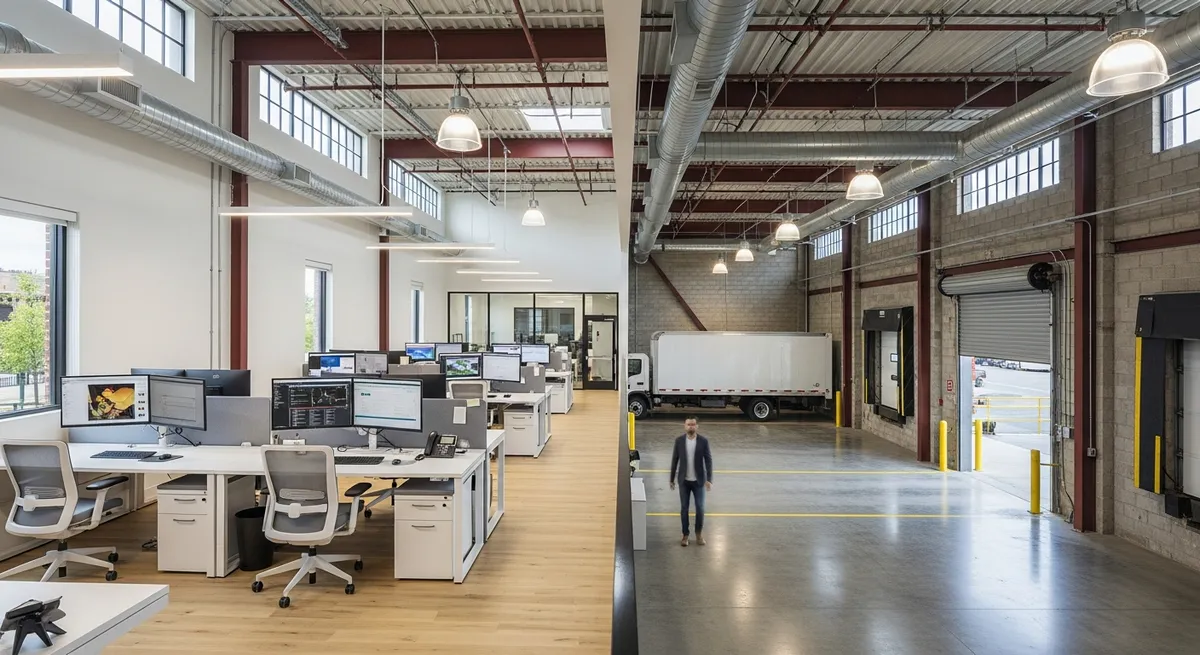
Hybrid industrial-office flex
There's a spot in Central Massachusetts I like: hybrid flex that pairs light industrial with office.
Who it fits:
- E-commerce fulfillment with administrative functions
- Light manufacturing with design/engineering teams
- Distribution with sales offices
- Research and development operations
Market dynamics:
- Limited purpose-built inventory
- Strong demand from growing companies
- Premium rents for combined functionality
- Zoning advantages in industrial parks
Investment implications
For investors, here's my read on where flex points you.
Acquire flex-ready assets
Properties with characteristics suited to flex conversion:
- Good natural light
- Flexible floor plates
- Modern infrastructure
- Accessible locations
- Adequate parking
Partner with operators
Consider flex operator partnerships:
- Management expertise included
- Revenue-sharing models
- Risk mitigation
- Faster lease-up
Value-add repositioning
Convert underperforming traditional office:
- Struggling suburban office parks
- Older buildings with character
- Properties with highway access
The future of work
My read on 2030:
- Flex will be the default, not the exception
- Traditional long-term leases reserved for headquarters
- Companies will maintain portfolio of flex options
- Space-as-a-service will dominate
We represent flex properties across Central Massachusetts. Whether you need space or you're looking at flex as an investment, call us and we'll talk it through.
Limitations: Market data, projections, and trend analyses reflect conditions at publication. Commercial real estate markets are inherently cyclical, and submarket and property-level performance can diverge significantly from the regional averages cited. Demographic data, employer information, and regulatory conditions are subject to change. This article does not constitute investment advice. Conduct property-specific due diligence and consult qualified professionals before making investment decisions.
Sources & References
- CBRE
- Cushman & Wakefield
- JLL
- Statista
This article cites data from the sources listed above. For the most current figures, consult the original publications directly.
Data current as of publication date. Market conditions, rates, and regulations may have changed. Consult a qualified commercial real estate professional before making investment decisions.
Get the full Central MA market data
Commercial tax-base growth, development activity, and demographics across Central MA, town by town.