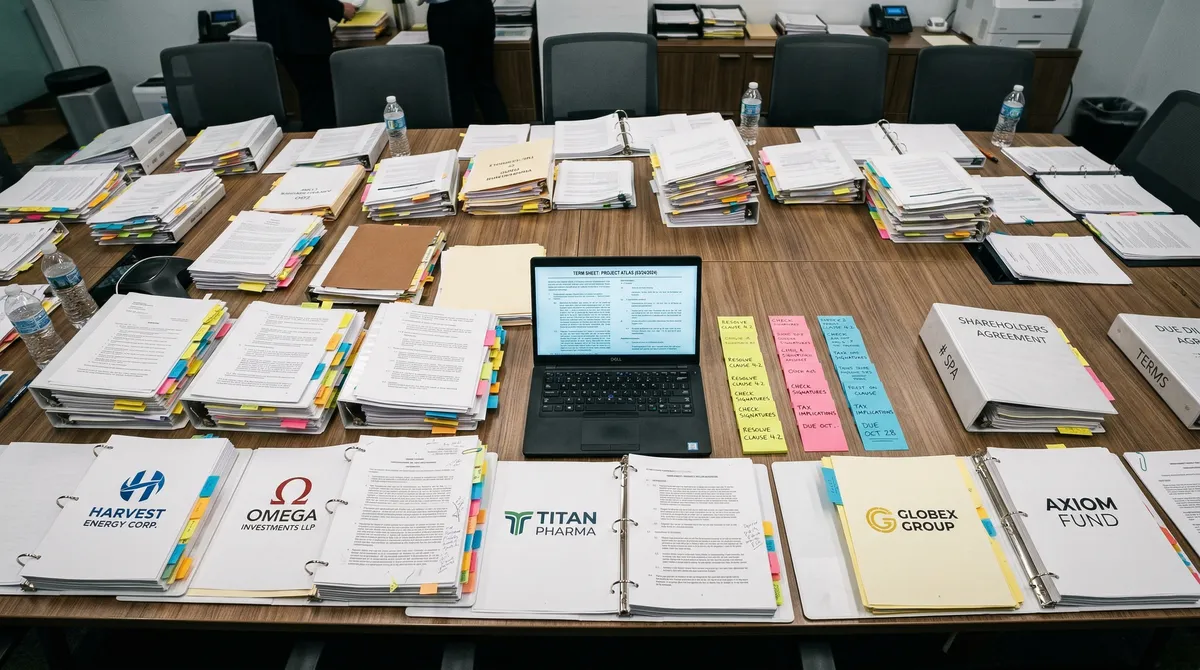
Not every commercial property sale is clean. When a property sits inside a partnership, a trust, or an estate, or when several people with competing interests all get a vote, the deal gets a lot harder than the real estate itself. In Worcester and Central Massachusetts, this comes up more than most people think. Multi-generational family holdings, aging partnerships, and estate-triggered sales make up a real share of the region's commercial deals. I've worked mill buildings in Southbridge held by third-generation families and retail plazas in Auburn split among siblings, and in both the ownership tangle was bigger than anything about the building.
Here I'll walk through the scenarios I see most, why these deals fall apart, and what actually gets them closed.
Partnership buyouts: when co-owners disagree on direction, an independent valuation and structured buyout terms keep the thing from deadlocking and protect the asset's value.
Estate and probate sales: executors are carrying fiduciary duties, beneficiary interests, tax deadlines, and court oversight, and all of it shapes timing and structure.
Trust-held properties: irrevocable trusts, family trusts, and charitable trusts each put their own limits on who can sell and how the money gets split.
Family-owned properties: multi-heir commercial holdings are about the most emotionally loaded deals in real estate, and they need neutral facilitation and hard market numbers.
1031 exchange coordination: when each co-owner runs a separate exchange, the logistics stack up, with separate intermediaries, different replacement timelines, and closings that have to line up.
Fiduciary Duty is the legal obligation of a trustee, executor, or managing partner to act in the best financial interest of the beneficiaries or co-owners they serve, rather than in their own personal interest. In multi-stakeholder real estate transactions, fiduciary duty determines who has decision-making authority and what standard their decisions must meet.
Common Multi-Stakeholder Scenarios
When a partner wants out
When one or more partners want out, whether it's retirement, a strategic split, health, or just different investment timelines, the sale of the underlying real estate becomes the whole negotiation. Partnership buyouts in commercial real estate come down to three questions: what is the property worth, who is buying whom out, and what are the tax consequences for each party.
I can't overstate the need for an independent valuation. Partners who've held property together for decades usually carry wildly different pictures of what it's worth. One anchors to the original purchase price plus improvements. Another anchors to the highest comparable sale in the submarket. Without a credible third-party broker opinion of value or a formal appraisal, the negotiation stalls before it starts.
In Worcester County, I keep running into partnerships formed in the 1980s and 1990s that are now hitting natural dissolution points. The original partners are retiring, the next generation has different priorities, and the operating agreements, if they exist at all, don't always spell out how a sale is supposed to work. In those cases, selling the whole asset to a third party is often cleaner and more tax-efficient than one partner buying out the other, especially when the buyout would need financing that eats into the remaining partner's returns.
When property passes through an estate
When commercial property moves through an estate, probate law, fiduciary duty, and court oversight run the show. The executor is balancing several pressures at once: get the most value for beneficiaries, hit tax filing deadlines (federal estate tax returns are due nine months from date of death), keep carrying costs down while the property sits in probate, and get the court to sign off on the sale terms.
In Massachusetts, a probate sale of real estate generally needs a license to sell from the Probate and Family Court, unless the will already hands the executor independent authority. That adds 30 to 90 days to the timeline and puts a judge's eyes on the sale price. For a commercial property with live tenants, lease expirations, or deferred maintenance, that time pressure will erode value if you don't get ahead of it.
The step-up in basis on inherited property is one of the biggest tax breaks in real estate. A commercial building bought for $400,000 in 1985 and worth $1.8 million at the owner's death gets a fresh cost basis of $1.8 million. If the executor sells for $1.9 million, the taxable gain is $100,000, not the $1.5 million gain you'd have had if the original owner sold. That step-up changes the whole economics, and it often makes a sale the most tax-efficient move for the beneficiaries.
Property held in a trust
Trusts are one of the most common ways commercial real estate is held in Central Massachusetts, especially in families that have owned property across generations. But trusts aren't all the same, and the type decides who can sell, how the proceeds get split, and what tax treatment applies.
Revocable trusts, the living-trust kind, give you the most room. The grantor keeps full control and can tell the trustee to sell any time. These sales run about like an individual sale.
Irrevocable trusts are tighter. The grantor has given up control, and the trustee has to stay inside the trust's terms. If the trust document doesn't clearly authorize a real estate sale, the trustee may need court approval or a trust modification, and that can run months and need every beneficiary to sign off.
Charitable remainder trusts add a layer on top: the sale has to follow the IRS rules on the charitable interest, and the proceeds have to be reinvested on the trust's distribution schedule. These need the trustee, a real estate attorney, and a tax advisor working together from day one.
Family property with multiple heirs
This is the most emotionally loaded of them all. When siblings, cousins, or extended family inherit a commercial property, they almost never share the same plan. One heir wants to hold it for income. Another needs cash right now. A third is attached to a building that's been in the family for decades.
In Worcester and the towns around it, I see this constantly. A family that's owned a retail strip center on Route 9 in Leicester since the 1970s. A mixed-use building on Main Street in Southbridge held by four cousins living in four different states. An industrial building in Auburn where two of three siblings want to sell and the third wants to buy them out but can't qualify for the financing.
The way through is separating the emotion from the numbers. An independent broker opinion of value sets what the market will actually pay, not what any one heir thinks the place is worth. From there the options get clear: sell to a third party and split the proceeds, structure an internal buyout with seller financing, or bring in a co-investor to recapitalize the property and buy out the heirs who want out.
Running 1031 exchanges across several parties
Section 1031 of the Internal Revenue Code lets investors defer capital gains taxes by exchanging one investment property for another of like kind. When a single entity owns the property, a 1031 is fairly simple. When each co-owner wants to run a separate 1031, which happens all the time in partnership dissolutions and family sales, the logistics multiply fast.
Each co-owner needs their own qualified intermediary. Each has their own 45-day identification period and 180-day closing deadline, both running from the date the relinquished property sells. Each is hunting for different replacement properties on their own criteria. And the closing on the relinquished property has to be set up to route the proceeds correctly to each party's intermediary.
In practice, the closing has to be choreographed. The purchase and sale agreement needs language covering the 1031 assignments. The closing attorney has to wire funds to multiple intermediaries at once. And if one party's exchange falls through, say they can't identify suitable replacement property in time, the tax picture changes for that party without touching the others. That level of coordination needs a broker and legal team who've run multi-party exchanges before.
Why These Deals Fall Apart
Multi-stakeholder deals die at a higher rate than single-owner sales, and the reasons are almost always human, not financial. Knowing where they break is how you avoid it.
No independent valuation. When the parties can't agree on what the property is worth, every negotiation after that, buyout price, listing price, offer evaluation, turns into a proxy fight. An independent appraisal or broker opinion of value sets a factual baseline and takes away the single most common source of disagreement.
No clear decision-making authority. Who has the legal right to sign the listing agreement? Who can accept an offer? In partnerships without clean operating agreements, estates without independent authority, and trusts with several co-trustees, the answer is often murky. Deals die when a buyer puts in an offer and nobody on the seller side can definitively say yes.
Emotion running over the analysis. Commercial real estate is an investment asset. But when a property has been in a family for generations, or a partner built the business that occupies the building, the emotion can swamp the rational call. I've watched heirs turn down above-market offers because "Dad would never have sold this building." I understand the sentiment, but it's expensive.
Taxes not modeled before listing. The net proceeds on a commercial sale swing hard depending on ownership structure, cost basis, depreciation recapture, and exchange eligibility. If the parties don't know their individual after-tax proceeds before the property hits the market, they'll turn down offers that were actually good, or take offers that trigger tax bills they didn't see coming.
Poor communication between the parties and their attorneys. These deals involve multiple attorneys, sometimes multiple accountants, occasionally multiple brokers. When those professionals aren't aligned on timeline, strategy, and terms, the miscommunication creates delays, and delays kill deals. A buyer who waits 30 days for a response to their offer goes and finds another property.
Timelines that don't line up. One party wants top dollar and will wait 12 months. Another needs cash inside 60 days. A third doesn't care about timing but wants specific terms. Those competing clocks have to be reconciled before you list, not after an offer lands.
What I Actually Do on These Deals
On a standard commercial sale, my job is clear: price it, market it, negotiate the offers, close it. On a multi-stakeholder deal, the job gets bigger. I'm a facilitator, an analyst, and a project manager who has to line up competing interests before the property ever reaches the market.
Neutral market numbers
Everything on these deals rests on objective data. I put together a full market analysis: recent comparable sales, current conditions, absorption, and a realistic price range based on the property's condition, location, and income. That analysis is the factual base every party can point to, and it gets personal opinion out of the pricing conversation.
In Central Massachusetts, you can't do that analysis without local knowledge. A retail property on Shrewsbury Street in Worcester is worth a fundamentally different number than the same square footage on Route 20 in Oxford. Cap rates, tenant quality, traffic counts, and municipal factors all shift by corridor. National valuation models miss it. A broker with a deep local transaction history brings the granularity these negotiations need.
Getting everyone aligned first
Before I list, I run structured conversations with all the parties, together or one at a time depending on the dynamics, to get each person's goals, constraints, and non-negotiables on the table. Is the priority top dollar? Speed? Tax efficiency? Keeping a tenant relationship? Family privacy?
These conversations often show the parties are more aligned than they look. Two siblings who seem to be fighting about selling actually agree on the outcome and only disagree on timing. A partner who resists selling turns out to be fine with a structured buyout on good terms. My job is to find the overlap and build the deal around it.
A framework for judging offers
These deals need clear criteria for evaluating offers. Without one agreed up front, every offer kicks off a fresh argument. I help the parties set weighted criteria before offers arrive: price (what weight?), closing timeline (what weight?), contingencies (what's acceptable?), buyer quality (does financing certainty matter more than price?), and any special conditions (leaseback, naming rights, tenant protections).
When an offer comes in, it gets measured against the framework instead of argued from scratch. That cuts the emotional decisions and speeds up the response, and both of those improve the outcome.
Marketing it quietly when it needs to be quiet
Some of these deals need discretion. A family dissolving a partnership doesn't want the local business community guessing about their finances. An estate sale may have tenants who'll be rattled by news of the owner's death. A trust disposition may have beneficiaries who'd rather keep it private.
In those cases I market through confidential channels: targeted outreach to qualified buyers, broker-to-broker networks, and confidential offering memorandums that require an NDA before the address gets released. That approach brings fewer inquiries but more serious ones, which is exactly what these sellers need.
Running the closing
The closing on a multi-stakeholder deal has more moving parts than a normal one. Multiple attorneys reviewing and approving documents. If 1031 exchanges are in play, multiple qualified intermediaries needing wire instructions. Trustee approvals or court orders. Beneficiary sign-offs. Lender payoffs on more than one loan.
I'm the one keeping it all together, holding the closing checklist, tracking the deadlines, making sure one party's delay doesn't tank the deal. In my experience, the most common reason these closings slip past their date is a document approval everybody assumed but nobody confirmed. Staying ahead of it prevents that.
The Tax Side That Decides Whether the Deal Happens
Taxes don't just change the net on a multi-stakeholder sale. They often decide whether the deal happens at all. Different ownership structures produce different tax outcomes, and you have to model those before you list.
Capital gains by ownership structure
Partnerships, meaning LLCs taxed as partnerships, pass the gain through to the individual partners based on ownership percentages and capital account balances. Each partner's rate depends on their own income and holding period. Partners at different income levels net different amounts off the same gross price.
Individual ownership, the tenants-in-common case, has each co-owner reporting their share of the gain independently. The cost basis can differ if owners bought their interests at different times or prices. That's common in inherited property, where one heir got their interest through the estate with a stepped-up basis and another bought a share from a sibling at a negotiated price.
Trust ownership depends on the trust type. Revocable trusts are disregarded for tax purposes while the grantor is alive. Irrevocable trusts are separate tax entities with their own compressed brackets. A trust hits the top federal rate of 37% at just $14,450 of taxable income (2025), which makes tax planning especially critical on a trust-held sale.
1031 eligibility
Not everyone in a multi-party sale will qualify for or want a 1031. Partners in a dissolving partnership may need to convert to tenants-in-common before the sale so they can each run an individual exchange, and that restructuring has to happen well ahead of closing. Estate beneficiaries who got a stepped-up basis may have almost no gain and no reason to exchange. Each party's exchange decision shapes deal structure and closing logistics without necessarily touching the others.
Step-up in basis
For inherited commercial property, the step-up in basis is the single biggest tax factor. A property with a $200,000 original cost basis that's worth $1.5 million at the owner's death gets a new basis of $1.5 million. If the heirs sell for $1.6 million, the taxable gain is $100,000, not $1.4 million. That changes the math for heirs deciding whether to hold or sell, and it often makes selling shortly after inheritance the most tax-efficient move.
Timing matters. The step-up applies as of the date of death, or the alternate valuation date six months later if elected. Heirs who hold and the property keeps appreciating will owe tax on that post-death appreciation. Heirs who hold and the property drops may wish they'd sold when the basis was highest.
Massachusetts specifics
Massachusetts charges a deed excise tax of $4.56 per thousand dollars of consideration on real estate transfers. On a $2 million commercial sale, that's $9,120. Modest against the size of the deal, but it goes in the closing-cost projections for every party. Massachusetts doesn't have a separate state capital gains rate. It taxes long-term capital gains at 9% as ordinary income, as of 2026, following the Fair Share Amendment surcharge on income over $1 million. On a high-value commercial disposition, the combined federal and state capital gains rate can top 30%, which makes exchange planning and basis optimization essential.
When to Seek Additional Help: Tax laws governing partnerships, trusts, estates, and 1031 exchanges are complex and change frequently. The information in this section is general guidance, not tax advice. Every multi-stakeholder transaction should involve a qualified tax advisor and, for estate and trust matters, a probate attorney. Errors in exchange timing, basis calculation, or trust compliance can result in significant unintended tax liabilities that cannot be corrected after closing.
How to Get Started
If you're staring at a multi-stakeholder commercial deal, as a partner, executor, trustee, or heir, here's a practical way to start.
:::how-to
Step 1: Identify all stakeholders and their decision-making authority. Map every person or entity with an ownership interest, a beneficial interest, or legal authority over the property. Figure out who has signing authority under the partnership agreement, trust instrument, or probate order. If that's unclear, get it resolved with counsel before you do anything else.
Step 2: Engage legal counsel for each party. One attorney can't represent everyone here because of the conflicts of interest. Each stakeholder group, or at a minimum the entity itself, needs independent legal representation. In Worcester County, several firms specialize in commercial deals involving partnerships, estates, and trusts.
Step 3: Commission an independent appraisal or broker opinion of value. This is the single most important step for keeping disagreements from wrecking the deal. A credible, independent number gives everybody a common reference point. Over $1 million, a formal MAI appraisal is usually right. On smaller properties, a detailed broker opinion of value may be enough.
Step 4: Align on objectives. Get everyone in a room, facilitated by the broker or an attorney, to define the shared goals. Top price? Speed? Tax efficiency? Keeping a tenant? Family privacy? Write down the agreed objectives and use them as the decision framework for the rest of the process.
Step 5: Select a broker experienced in complex dispositions. Not every commercial deal needs a multi-stakeholder specialist. But when partnerships, estates, trusts, or family dynamics are in it, a broker who's done these before is the difference between a closed deal and a stalled one. Ask a prospective broker directly about their experience with multi-party deals, 1031 coordination, and confidential marketing.
Step 6: Establish a communication protocol. Set who talks to whom, how often, and through what channel. Does the broker deal with all the parties directly or through their attorneys? Will there be regular status updates? Which decisions need unanimous consent and which just need a majority? Clear protocols head off the misunderstandings and delays that kill these deals.
:::
Bottom Line
These deals don't have to end in deadlock or a family fight. With the right prep, hard market numbers, and a broker who reads the human dynamics as well as the financials, they close cleanly and leave everyone satisfied.
The key is starting early: get counsel in, get an independent valuation, align the parties before the property ever hits the market. Retrofitting consensus after an offer lands is a lot harder than building it up front.
In Central Massachusetts, where multi-generational ownership is common and commercial assets keep passing through estates, trusts, and aging partnerships, handling these deals isn't a niche skill. It's a core competency, and it's what separates brokers who close complicated deals from brokers who only do the simple ones.
If you're working through a partnership dissolution, an estate sale, or any commercial deal with several decision-makers, contact Lornell Real Estate for a confidential consultation. I bring 35 years of structuring and closing the deals other brokers walk away from.
Limitations: This article provides general guidance on multi-stakeholder commercial real estate transactions and does not constitute legal, tax, or financial advice. Partnership agreements, trust instruments, probate proceedings, and tax regulations vary significantly by situation and jurisdiction. Massachusetts-specific tax rates and regulations are current as of publication but subject to legislative change. Consult qualified legal, tax, and real estate professionals before making decisions regarding any multi-stakeholder property transaction.
Sources & References
- Internal Revenue Service (Section 1031, Estate Tax)
- Massachusetts Department of Revenue
- Massachusetts Uniform Trust Code
- Massachusetts Probate and Family Court
This article cites data from the sources listed above. For the most current figures, consult the original publications directly.
Data current as of publication date. Market conditions, rates, and regulations may have changed. Consult a qualified commercial real estate professional before making investment decisions.
Get the full Central MA market data
Commercial tax-base growth, development activity, and demographics across Central MA, town by town.