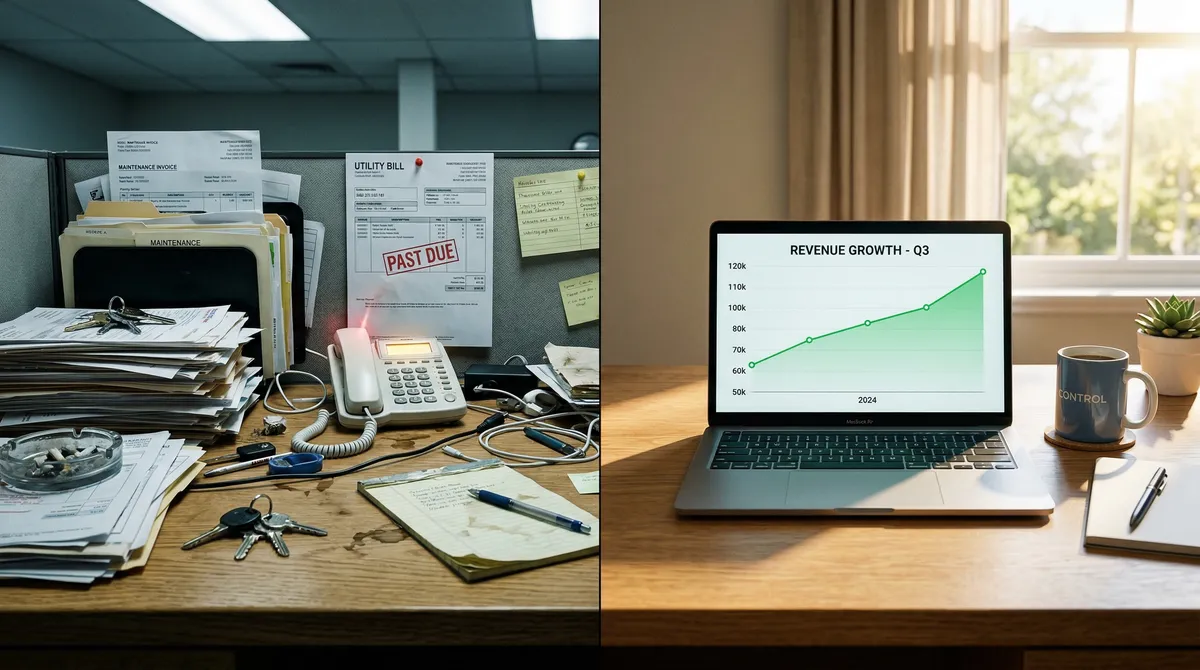
In my experience, professional property management saves a commercial landlord north of $28,000 a year once you count the hours you're burning, the rent escalations you never chased, and the vendor bills you overpaid. The Institute of Real Estate Management (IREM) puts professionally managed properties at 94% average occupancy against 78% for self-managed. That gap goes straight to your NOI and your value.
Opportunity Cost: Self-management consumes over 490 hours annually for a small retail center, representing an opportunity cost exceeding $36,750 per year.
Occupancy Advantage: Professionally managed properties achieve a 94% average occupancy rate, significantly higher than the 78% average for self-managed assets.
Net Savings: Professional property management typically costs around $15,000 annually, which is considerably less than the $43,200 true cost of self-management for a 25,000 SF center.
Rent Optimization: Professional managers can secure 5-15% higher rents by leveraging market tracking and expert negotiation skills.
Net Operating Income (NOI) is a calculation used to analyze the profitability of income-generating real estate investments before the impact of debt service, capital expenditures, and income taxes.
Time savings: Self-management consumes 490+ hours annually for a small retail center, worth $36,750+ in opportunity cost (IREM)
Occupancy improvement: Professional management achieves 94% occupancy vs. 78% average for self-managed properties (IREM)
Net cost savings: Professional management costs $15,000/year vs. $43,200 in true self-management costs for a 25,000 SF center (CBRE)
Rent optimization: Professional managers capture 5-15% higher rents through market tracking and negotiation (Cushman & Wakefield)
The self-management trap
A lot of owners, especially first-timers, decide to run their own buildings. I get the thinking: why pay someone to do a job I can do myself?
Here's where it goes sideways. Self-management eats your time, wears you down, and usually costs you more than hiring it out once you count the opportunity cost and the mistakes you make learning on the job.
The hidden costs of self-management
Time Investment:
| Task | Annual Hours (10K SF Retail Center) |
|---|---|
| Rent collection and accounting | 50 hours |
| Tenant communications | 100 hours |
| Maintenance coordination | 150 hours |
| Lease negotiations | 40 hours |
| Property inspections | 25 hours |
| Vendor management | 75 hours |
| Emergency response | Variable (50+) |
| Total | 490+ hours |
Put a modest $75/hour on your time and that's $36,750 in time value every year.
Common Self-Management Mistakes:
| Mistake | Typical Cost |
|---|---|
| Below-market rent renewal | $10,000-50,000/year |
| Deferred maintenance | $5,000-25,000 per incident |
| Late tenant violations | $5,000-15,000 legal fees |
| Poor vendor selection | 15-25% premium on services |
| Missed lease options | Variable, often significant |
"One below-market lease renewal can cost more than years of professional management fees.
What professional management provides
Property management services
Daily Operations:
- Rent collection and delinquency management
- Accounts payable processing
- Monthly financial reporting
- Tenant communication portal
- Work order management
- Vendor procurement and oversight
Physical Plant:
- Regular property inspections
- Preventive maintenance programs
- Capital planning and budgeting
- Emergency response protocols
- Code compliance monitoring
- Energy management
Financial:
- Operating budget preparation
- Monthly P&L statements
- CAM reconciliations
- Tax and insurance management
- Capital expenditure tracking
- Cash flow optimization
Leasing advisory services
Marketing:
- Property positioning and branding
- Listing syndication
- Signage and collateral
- Digital marketing
- Broker networking
Tenant Procurement:
- Lead qualification
- Showing coordination
- Proposal preparation
- Credit analysis
- Reference verification
Lease Negotiation:
- Market rent determination
- Term structuring
- Tenant improvement negotiation
- Legal coordination
- Closing management
The financial case
Cost comparison
Self-Management Costs (25,000 SF retail center):
| Category | Annual Cost |
|---|---|
| Owner time (400 hrs @ $75) | $30,000 |
| Accounting software | $1,200 |
| Legal consultations | $5,000 |
| Missed rent (poor collection) | $3,000 |
| Suboptimal vendor pricing | $4,000 |
| Total | $43,200 |
Professional Management Costs:
| Category | Annual Cost |
|---|---|
| Management fee (5% of $300K gross) | $15,000 |
| Leasing commission (when applicable) | Varies |
| Total | $15,000 |
Net Savings with Professional Management: $28,200/year
Value creation
The savings are one thing. Professional management also builds value on top of that.
Rent Optimization:
- Market rent tracking ensures no money left on table
- Professional negotiations capture full value
- Renewal strategy planning prevents tenant leverage
Example: A 5% rent improvement on $300K annual revenue = $15,000/year
Occupancy Maximization:
- Proactive lease renewal process
- Faster re-leasing when tenants depart
- Tenant retention programs
Example: Reducing average vacancy from 3 months to 1 month = $25,000/year saved
Expense Control:
- Competitive bidding on all services
- Volume purchasing power
- Professional contractor relationships
- Energy efficiency expertise
Example: 10% expense reduction on $100K annual operating costs = $10,000/year saved
Selecting a property manager
Evaluation criteria
Experience:
- Years managing similar property types
- Portfolio size and composition
- References from current clients
- Staff qualifications and tenure
Capabilities:
- Technology platform and reporting
- Accounting and financial systems
- Maintenance response protocols
- Leasing resources and relationships
Alignment:
- Fee structure transparency
- Performance metrics and accountability
- Communication style and frequency
- Cultural fit and values
Fee structures
Here's what fee structures usually look like:
| Service | Typical Fee | Notes |
|---|---|---|
| Property management | 3-6% of gross revenue | Lower for larger properties |
| Leasing (new) | 4-6% of total lease value | Or flat fee |
| Leasing (renewal) | 2-3% of renewal term value | Often negotiable |
| Project management | 3-5% of construction cost | For major CapEx |
Negotiation Points:
- Volume discounts for multiple properties
- Performance incentives/penalties
- Fee caps during lease-up
- Termination provisions
The landlord-manager relationship
Setting expectations
Define Success Metrics:
| Metric | Target | Measurement |
|---|---|---|
| Occupancy | 95%+ | Monthly reporting |
| Rent collection | <30 days | Aging report |
| Tenant satisfaction | Survey scores | Annual |
| Expense variance | Within 5% of budget | Quarterly |
| Response time | Work orders <24 hrs | System tracking |
Communication protocols
Regular Reporting:
- Monthly financial statements
- Quarterly property reviews
- Annual budgeting process
- Ad hoc issue escalation
Decision Rights:
- Expenditure approval thresholds
- Lease term parameters
- Tenant selection criteria
- Emergency authorities
Case study: the transformation
Before professional management
40,000 SF suburban office building, self-managed
| Metric | Status |
|---|---|
| Occupancy | 78% |
| Rent per SF | $18.50 (market: $21.00) |
| Operating expenses | $8.25/SF |
| Collection rate | 92% |
| Owner time | 15 hours/week |
| Owner frustration | High |
After 18 months with professional management
| Metric | Improvement |
|---|---|
| Occupancy | 94% (+16 pts) |
| Rent per SF | $21.50 (+$3.00) |
| Operating expenses | $7.50/SF (-$0.75) |
| Collection rate | 99% (+7 pts) |
| Owner time | 2 hours/month |
| Owner frustration | Low |
Financial Impact:
| Item | Before | After | Change |
|---|---|---|---|
| Gross revenue | $577,000 | $808,000 | +$231,000 |
| Operating expenses | $330,000 | $300,000 | -$30,000 |
| NOI | $247,000 | $508,000 | +$261,000 |
| Management fees | $0 | $40,000 | +$40,000 |
| Net improvement | +$221,000 |
Value Impact (at 7% cap rate): +$3.16 million in property value
Making the transition
Steps to professional management
1. Document Current Operations
- Compile all leases and tenant files
- Inventory vendor contracts
- Gather financial records
- List ongoing issues and projects
2. Interview Candidates
- Meet with 2-3 qualified firms
- Check references thoroughly
- Review sample reporting
- Understand fee structures
3. Transition Planning
- 30-60 day transition period
- Tenant notification
- Vendor contract assignment
- Bank account and system changes
4. Ongoing Oversight
- Regular performance reviews
- Annual contract evaluation
- Maintain market awareness
- Stay involved in major decisions
When to stay self-managed
There are cases where running it yourself makes sense:
- Single-tenant NNN property with no management obligations
- Owner has real estate background and available time
- Property is owner-occupied with minimal complexity
- Property is small and simple (e.g., single retail unit)
- Geographic proximity allows easy oversight
For most commercial properties, though, professional management earns its keep on a risk-adjusted basis.
Lornell Real Estate provides comprehensive property management and leasing advisory services for commercial properties throughout Central Massachusetts. Contact us to discuss how professional management can optimize your investment returns.
Limitations: Lease rates, vacancy figures, and expense estimates cited represent Central Massachusetts market averages at publication and may not apply to specific properties or municipalities. Actual occupancy costs depend on individual lease terms, property condition, location, and landlord negotiations. Commercial lease structures vary significantly. This article does not constitute legal advice. Have a commercial real estate attorney review any lease before signing.
Sources & References
- CBRE
- Cushman & Wakefield
- Institute of Real Estate Management
This article cites data from the sources listed above. For the most current figures, consult the original publications directly.
Data current as of publication date. Market conditions, rates, and regulations may have changed. Consult a qualified commercial real estate professional before making investment decisions.
Get the full Central MA market data
Commercial tax-base growth, development activity, and demographics across Central MA, town by town.