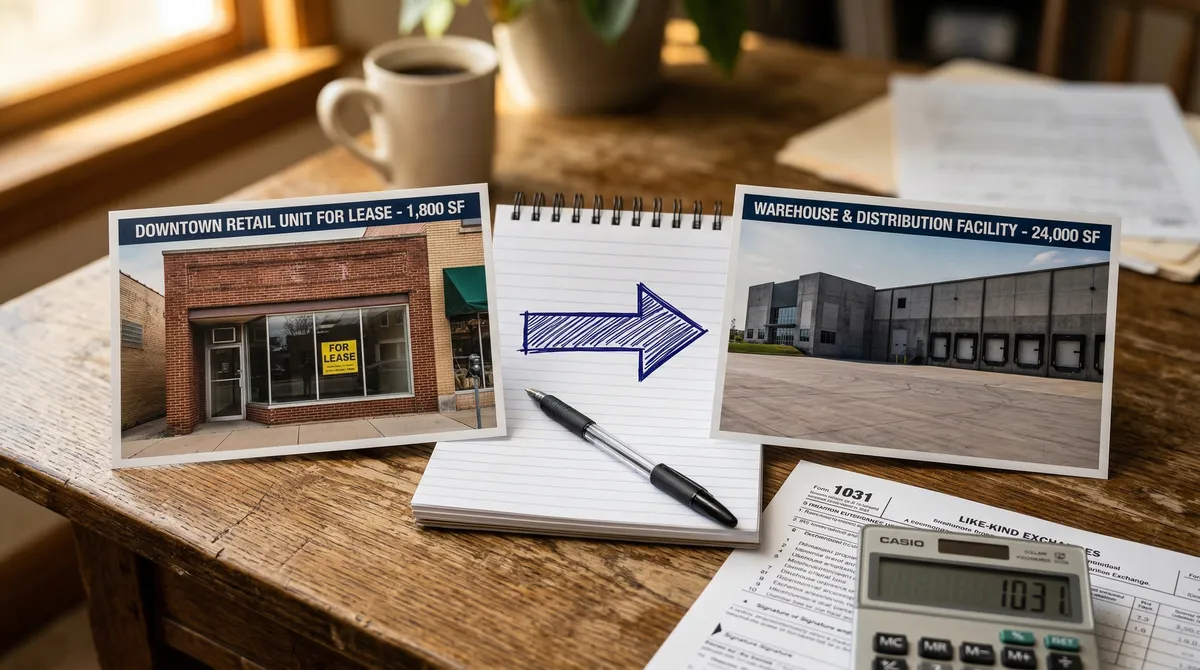
A 1031 exchange under the Internal Revenue Code lets a commercial real estate investor defer $120,000-$150,000+ in capital gains taxes on a $500,000 gain by putting the proceeds into like-kind replacement property inside the IRS timelines. Per the IRS, you have 45 days to identify replacement properties and 180 days to close. Miss either date and there is no do-over.
Significant Savings: A 1031 exchange can defer $120,000-$150,000+ in capital gains taxes on a $500,000 gain from investment property.
Strict Deadlines: Investors must identify replacement properties within 45 days of sale and close within 180 days, with no exceptions for missed deadlines.
Broad Definition: "Like-kind" property is broadly defined, encompassing any real property held for investment or business use, from commercial to residential.
Identification Strategy: Most exchangers utilize the "Three Property Rule," identifying up to three potential replacement properties regardless of their total value.
1031 exchange is a transaction under Section 1031 of the Internal Revenue Code allowing investors to defer capital gains taxes indefinitely by reinvesting proceeds from a sold investment property into a like-kind replacement property within strict timelines.
Tax deferral potential: $120,000-$150,000+ on a $500,000 gain including federal capital gains, NIIT, depreciation recapture, and state taxes (IRS)
45-day identification deadline: Must identify up to 3 replacement properties in writing to a Qualified Intermediary, with no extensions (IRS)
180-day closing deadline: Must acquire replacement property within 180 days of the sale, no exceptions (IRS)
Like-kind flexibility: Any investment real property qualifies, including commercial-to-residential, land-to-improved, or single-to-multiple properties (IRS Section 1031)
Why I put every long-term investor onto a 1031
Section 1031 of the Internal Revenue Code is the best tax break a real estate investor gets. You sell an investment property, roll the proceeds into a new one, and defer the capital gains tax, potentially for as long as you keep exchanging.
How it works
When you sell an investment property at a gain, here is what you typically owe:
| Tax Type | Rate | Example ($500K Gain) |
|---|---|---|
| Federal Capital Gains | 15-20% | $75,000-100,000 |
| Net Investment Income Tax | 3.8% | $19,000 |
| Depreciation Recapture | 25% | Varies |
| State Tax (MA) | 5% | $25,000 |
| Total Potential Tax | $120,000-150,000+ |
A 1031 exchange lets you defer all of that by buying "like-kind" replacement property inside the deadlines.
What counts as like-kind
"Like-kind" is broader than most people think.
Qualifies:
- Any real property held for investment or business use
- Commercial to residential rental
- Land to improved property
- Industrial to retail
- Single property to multiple properties
Does NOT Qualify:
- Primary residence
- Property held primarily for resale (flips)
- Partnership interests
- Foreign real estate (for U.S. property exchanges)
The two deadlines that end the deal
The 1031 deadlines are hard. There is no wiggle room.
The 45-day identification period
From the day you sell, you have exactly 45 calendar days to identify replacement properties in writing to your Qualified Intermediary (QI).
Identification Rules:
| Rule | Description |
|---|---|
| Three Property Rule | Identify up to 3 properties regardless of value |
| 200% Rule | Identify any number if total value doesn't exceed 200% of relinquished property |
| 95% Rule | Identify any number if you acquire 95% of identified value |
Best Practice: I put almost everyone on the Three Property Rule. Name your first choice and two backups.
The 180-day closing period
You have to close on the replacement property within 180 days of selling the relinquished one (or your tax return due date, including extensions, if that comes first).
WARNING: These deadlines do not move for anything. Not the market, not a financing snag, not a natural disaster. Miss by one day and the exchange is dead.
You need a Qualified Intermediary
You cannot touch the sale proceeds yourself. A Qualified Intermediary has to:
- Hold all exchange funds in a segregated account
- Prepare exchange documentation
- Coordinate with title companies
- Disburse funds at closing
Choosing a QI:
| Factor | What to Look For |
|---|---|
| Experience | 10+ years, thousands of transactions |
| Security | Segregated accounts, bonded, insured |
| Financials | Audited financial statements |
| References | CPA and attorney recommendations |
Cost: QI fees usually run $750-1,500 for a standard exchange.
CRITICAL: You cannot use your attorney, CPA, or real estate agent as your QI if they've done work for you in the past two years.
Boot: what kills the deferral
"Boot" is any value you receive that doesn't qualify for deferral. Here is where it shows up.
Cash boot
Cash at closing, even by accident, creates taxable gain.
Example: You sell for $1,000,000 and buy the replacement for $950,000. That $50,000 difference is taxable boot.
Mortgage boot
Dropping your debt level can trigger boot too.
Example:
- Relinquished property: $1M value, $600K mortgage
- Replacement property: $1M value, $400K mortgage
- Boot: $200K (debt reduction)
How to Avoid Mortgage Boot:
- Acquire replacement property with equal or greater debt
- Add cash to offset debt reduction
- Acquire additional properties to increase total debt
The variations you'll run into
Delayed exchange (the usual one)
Sell first, then buy the replacement. This is the standard structure I described above.
Reverse exchange
Buy the replacement first, then sell. More moving parts and more money ($5,000-15,000+).
Improvement exchange
Use exchange funds to improve the replacement property. Every improvement has to be finished inside the 180 days.
Partial exchange
Exchange some of the proceeds and take boot on the rest, which is taxable.
Where this pays off in Central Massachusetts
A 1031 does real work in a market like ours. A few ways I see it used:
Trading Up:
Sell a $500K duplex in Worcester → Exchange into a $1.5M strip center with additional equity
Portfolio Diversification:
Sell a single-tenant retail property → Exchange into three industrial buildings
Geographic Consolidation:
Sell out-of-state holdings → Exchange into Central MA for easier management
The mistakes that blow up exchanges
Mistake #1: Starting too late
Start planning 60-90 days before you list. Line up potential replacements early.
Mistake #2: Not reinvesting enough
You have to reinvest ALL net proceeds to defer ALL gain. Anything short of that creates boot.
Mistake #3: Touching the funds
Take possession of the money, even for a minute, and the exchange fails. Bring in a QI from day one.
Mistake #4: Related-party deals
Selling to or buying from related parties triggers special rules and can disqualify you.
Mistake #5: Not documenting intent
Keep the records that prove investment intent: business plans, rental income, marketing materials.
Is a 1031 the right move for you?
Good Candidates:
- Long-term holders with significant appreciation
- Investors seeking to trade up or diversify
- Those with high income in sale year
- Multi-generational wealth planners
Poor Candidates:
- Short-term holders (potential dealer status issues)
- Those needing cash proceeds
- Investors unable to identify suitable replacement
- Situations where timeline cannot be met
Lornell Real Estate regularly assists investors with 1031 exchanges, helping source replacement properties that meet identification and closing deadlines. Contact us to discuss your exchange strategy.
Limitations: Cap rates, pricing, and transaction volume cited reflect market-level averages at the time of publication and may not apply to individual properties. Property values depend on asset-specific factors including condition, tenant credit quality, lease terms, location, and financing structure. Tax rules (including 1031 exchange provisions, capital gains rates, and depreciation schedules) change with legislation. This article does not constitute investment, tax, or legal advice. Consult a qualified CPA, attorney, and commercial real estate broker before making transaction decisions.
Sources & References
- IRS
- Internal Revenue Code
This article cites data from the sources listed above. For the most current figures, consult the original publications directly.
Data current as of publication date. Market conditions, rates, and regulations may have changed. Consult a qualified commercial real estate professional before making investment decisions.
Get the full Central MA market data
Commercial tax-base growth, development activity, and demographics across Central MA, town by town.