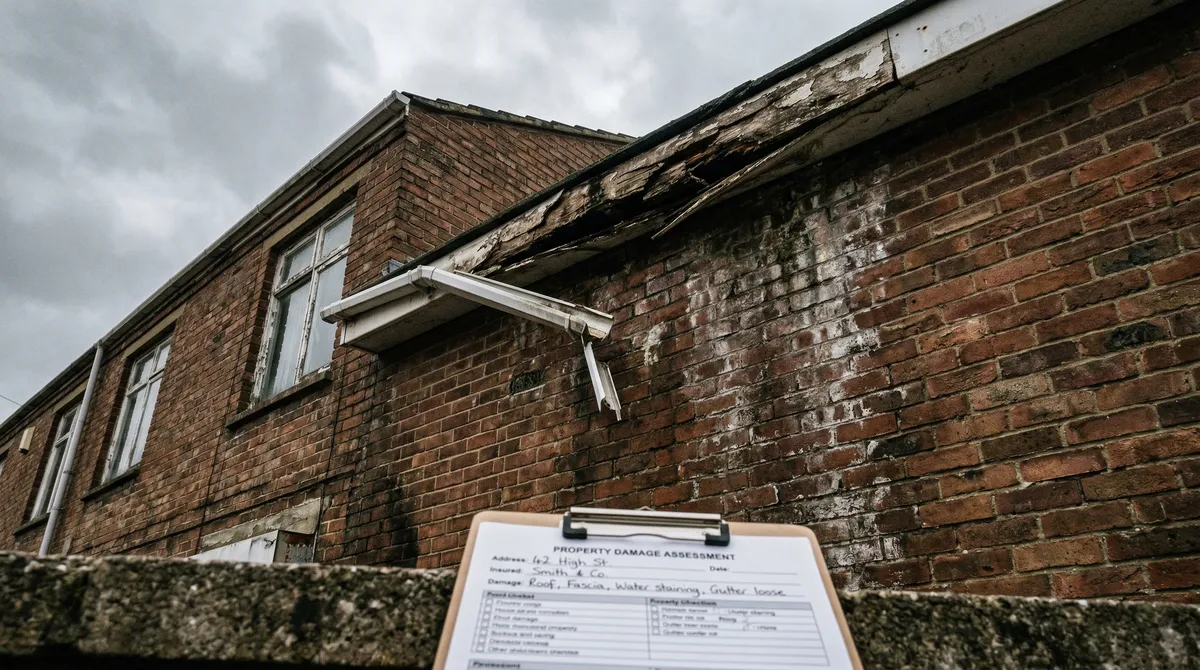
Getting your commercial property insurance right is how you protect the investment, and a lot of owners get it wrong. They carry outdated coverage amounts, skip a coverage type they needed, or trip a coinsurance penalty that costs tens of thousands they never recover. The Insurance Information Institute puts the average commercial property claim at $70,000 per incident, and owners who insure at market value instead of replacement cost can see payouts cut by 25% or more.
Insure on replacement cost, not market value. That's how you avoid a coinsurance penalty and actually get made whole after a loss.
Underinsure the building and the coinsurance clause kicks in, cutting your payout proportionally if you're below the required percentage of value.
Buy a separate flood policy. Standard commercial property policies exclude flood and surface water, no exceptions.
Carry a $5-10 million umbrella. It usually runs $1,000-$3,000 a year and it's the cheapest liability protection you'll buy.
Ballpark a building's replacement cost at $150-$400 per square foot depending on the property type.
Coinsurance is a property insurance clause that requires you to insure the property for a specified percentage of its value. Fall short and your claim payout drops by the same proportion.
Replacement cost vs. market value: Insuring at market value instead of replacement cost is the most common and costly mistake (Insurance Information Institute)
Coinsurance penalties: Underinsuring by 25% can reduce claim payouts by the same percentage, costing tens of thousands (Insurance Information Institute)
Flood exclusion: Standard property policies exclude flood damage; separate NFIP or private flood coverage is required (FEMA)
Umbrella coverage: $5-10M umbrella policies typically cost $1,000-$3,000/year, providing critical liability protection (Insurance Information Institute)
Why this matters
One uninsured loss, a fire, a flood, a liability claim, can erase years of equity and income. This isn't a corner to cut.
I still see owners who:
- Carry outdated coverage amounts
- Miss coverage types they needed
- Overpay because they never shop
- Don't know what their policy excludes
Types of coverage
Property insurance
| Type | Description |
|---|---|
| Building | Structure, fixtures, systems |
| Business Personal Property | Equipment, furniture |
| Business Income | Lost income during restoration |
| Extra Expense | Costs to maintain operations |
How the policy values a loss matters as much as the coverage itself. Replacement cost pays to rebuild without a depreciation deduction, and it's what you want. Actual cash value subtracts depreciation, so avoid it.
Liability insurance
Commercial General Liability (CGL) covers bodily injury to third parties, property damage to others, and personal injury like libel or slander. Typical limits are $1M per occurrence, $2M aggregate.
Other coverages you need
- Umbrella: $5-10M in additional liability protection
- Environmental/Pollution: important on industrial properties
- Flood: excluded from standard policies, so you buy it separately
What standard policies exclude
Read the exclusions, because they're where owners get surprised. Standard policies typically leave out:
- Flood and surface water
- Earthquake
- Mold (often limited)
- Pollution
- Wear and tear
Getting the coverage amount right
Building valuation
The common mistake is insuring at market value instead of replacement cost.
Market value includes land, which you can't insure, and it reflects depreciation. Replacement cost is what it actually takes to rebuild. Those are different numbers, and the gap is where owners get burned.
For a rough figure, commercial construction runs $150-400/SF depending on type.
What a coinsurance penalty looks like
- Building value: $2,000,000
- Coinsurance requirement: 80%
- Required coverage: $1,600,000
- Actual coverage: $1,200,000
- Loss: $500,000
- Payment: $500,000 × (1,200,000/1,600,000) = $375,000
- You're out $125,000 of your own pocket
Managing what you pay
What drives the premium
| Factor | Impact |
|---|---|
| Property age | Older = higher |
| Construction type | Non-combustible = lower |
| Fire protection | Sprinklers = lower |
| Claims history | Claims = higher |
| Deductible | Higher = lower premium |
How to bring the cost down
- Shop the market every 2-3 years
- Increase deductibles
- Add sprinklers and security
- Bundle policies
- Review annually
If you're the landlord
Make tenants carry their own
- Commercial General Liability ($1M/$2M minimum)
- Property coverage for their contents
- Workers' compensation
Get the certificate of insurance before they take occupancy, and make sure you're named as an additional insured.
Lornell Real Estate can point you to insurance people who know Central Massachusetts commercial property.
Limitations: Lease rates, vacancy figures, and expense estimates cited represent Central Massachusetts market averages at publication and may not apply to specific properties or municipalities. Actual occupancy costs depend on individual lease terms, property condition, location, and landlord negotiations. Commercial lease structures vary significantly. This article does not constitute legal advice. Have a commercial real estate attorney review any lease before signing.
Sources & References
- Insurance Information Institute
This article cites data from the sources listed above. For the most current figures, consult the original publications directly.
Data current as of publication date. Market conditions, rates, and regulations may have changed. Consult a qualified commercial real estate professional before making investment decisions.
Get the full Central MA market data
Commercial tax-base growth, development activity, and demographics across Central MA, town by town.