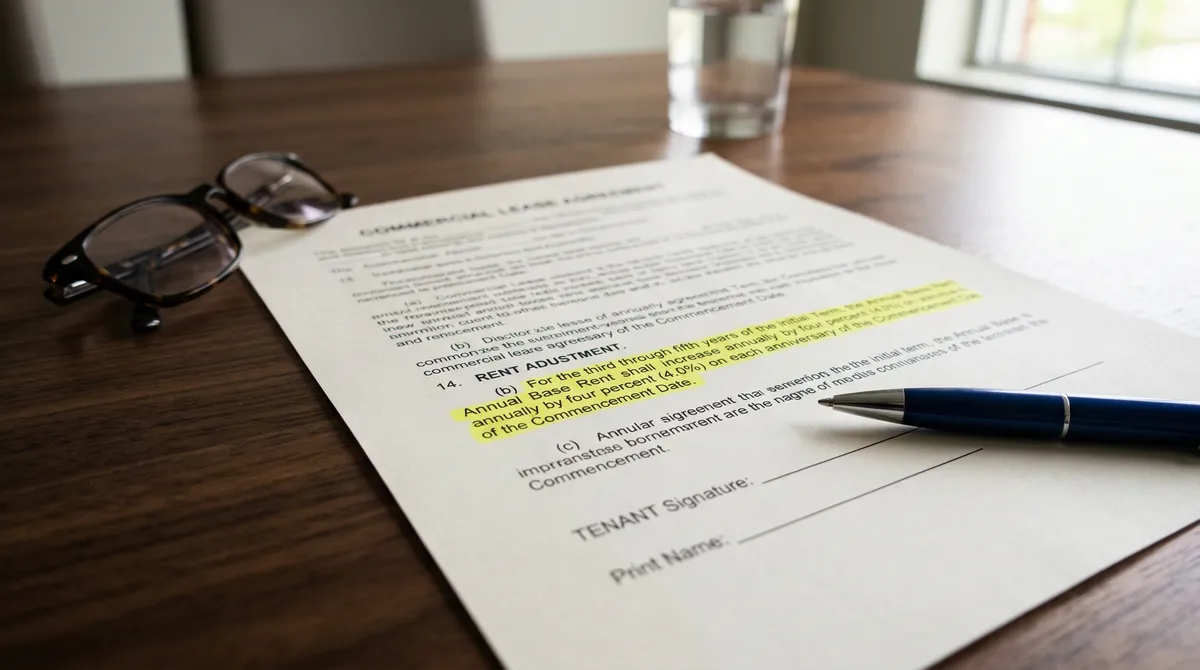
For most businesses, rent is the second or third biggest expense after payroll, and most tenants sign the landlord's draft without much of a fight, which can cost them tens of thousands of dollars. Cushman & Wakefield finds that tenants who get representation and negotiate carefully land 15-25% better lease terms, through free rent, improvement allowances, and how the escalations are structured.
Total commitment: A 5-year lease on 3,000 SF at $25/SF represents $375,000+ before operating expenses.
Hidden NNN costs: Triple-net charges can add $8-15/SF to base rent, making total occupancy cost 30-60% higher than quoted.
TI allowance benchmarks: Market tenant improvement allowances range from $20-60/SF depending on lease term.
Negotiation leverage: Tenants with multiple viable alternatives (BATNA) secure 15-25% better lease economics.
Triple-net (NNN) lease is a commercial lease structure where the tenant pays a base rent plus a proportionate share of the property's operating expenses, which typically include real estate taxes, building insurance, and common area maintenance.
Total commitment: A 5-year lease on 3,000 SF at $25/SF represents $375,000+ before operating expenses (National Association of Realtors)
Hidden NNN costs: Triple-net charges can add $8-15/SF to base rent, making total occupancy cost 30-60% higher than quoted (CBRE)
TI allowance benchmarks: Market tenant improvement allowances range from $20-60/SF depending on lease term (Cushman & Wakefield)
Negotiation leverage: Tenants with multiple viable alternatives (BATNA) secure 15-25% better lease economics (CBRE)
Why this matters
Your lease is probably your second or third biggest expense after payroll. A 5-year lease on 3,000 SF at $25/SF is a $375,000 commitment before you add anything else.
Most tenants still:
- Sign the landlord's first draft with barely a change
- Look only at base rent and miss the terms that actually cost them
- Skip the flexibility they'll need when the business changes
- Sign something they don't fully understand
Phase 1: Before You Search
Define Your Requirements
| Factor | Questions to Answer |
|---|---|
| Size | Current needs + growth projection |
| Layout | Open plan? Private offices? Retail frontage? |
| Location | Customer accessibility? Employee commute? |
| Timing | Move-in date? Lease expiration alignment? |
| Budget | All-in cost per SF you can afford |
Know your leverage
The market is on your side when:
- Vacancy is high (over 12%)
- There are plenty of competing spaces
- The economy is uncertain
- It's year-end and landlords are chasing their numbers
And know your BATNA, your best alternative to a negotiated agreement. Having two or three real options is the strongest card you can hold.
Phase 2: The Letter of Intent (LOI)
Essential LOI Terms
Rent Structure:
| Term | What to Negotiate |
|---|---|
| Base rent | Starting rate and increases |
| Rent type | Gross, Modified Gross, or NNN |
| Escalations | Fixed ($) vs. percentage (%) vs. CPI |
| Free rent | Months of abated rent |
Tenant Improvements (TI):
| Approach | Description |
|---|---|
| TI Allowance | Landlord provides $/SF for build-out |
| Turnkey | Landlord builds to your specs |
| As-Is | No landlord contribution |
When you negotiate TI:
- Market allowances run $20-60/SF depending on term
- The longer the lease, the more TI you can ask for
- If you don't use all of it, take the rest as a rent credit instead of losing it
Phase 3: Critical Lease Provisions
Know the rent types
Gross lease: you pay flat rent and the landlord covers operating expenses.
NNN (triple net): you pay base rent plus property taxes, insurance, and CAM. That can add $8-15/SF on top of the base.
Modified gross: a hybrid, with a base-year expense stop.
Whichever it is, always ask for the total occupancy cost, not just the base rent.
Watch the operating expenses
Push to exclude or cap:
- Capital expenditures, which should be amortized
- The landlord's legal fees
- Above-market management fees
- Executive compensation
And negotiate the right to audit those expenses once a year.
Personal guarantees
A few ways to limit one:
| Strategy | Description |
|---|---|
| Limit duration | Guarantee burns off after 2-3 years |
| Limit amount | Cap at 12-24 months rent |
| Good Guy Guarantee | Liability ends upon vacating with notice |
Phase 4: Protecting Your Business
Assignment and sublease rights
You'll want these because they let you:
- Sublease space you're not using in a slow stretch
- Assign the lease if you sell the business
- Share space with a business that complements yours
So negotiate for:
- Landlord consent "not to be unreasonably withheld"
- A set approval window (10-15 business days)
- The right to assign to affiliates without consent
Exclusivity and use clauses
If you're retail, an exclusivity clause keeps the landlord from leasing to your competitors. The use clause defines what you're allowed to do in the space, so write it broadly:
- Too narrow: "Operation of a yoga studio"
- Better: "Operation of a fitness and wellness facility"
- Best: "Any lawful retail or service use"
Phase 5: Renewal and Exit Planning
Renewal options
"Fair market value" renewals sound reasonable, but they're where the disputes start. Better to pin it down:
- A fixed renewal rate written into the lease
- A cap on the increase, say "not to exceed 105% of final-year rent"
- A defined arbitration process if you can't agree
Early termination
A termination right usually looks like this:
- Available after year 3 of a 5-year term
- 6-12 months written notice
- A fee of 3-6 months rent
Checklist Before Signing
- Reviewed by commercial real estate attorney
- All LOI terms reflected in lease
- Total occupancy cost understood
- TI allowance sufficient for build-out
- Personal guarantee limited appropriately
- Assignment/sublease rights adequate
- Renewal options and pricing clear
- Operating expense caps included
- Signage rights specified
- HVAC responsibilities clear
We represent both landlords and tenants across Central Massachusetts, so we know how the other side thinks. Talk to us before you sign your next lease.
Limitations: Lease rates, vacancy figures, and expense estimates cited represent Central Massachusetts market averages at publication and may not apply to specific properties or municipalities. Actual occupancy costs depend on individual lease terms, property condition, location, and landlord negotiations. Commercial lease structures vary significantly. This article does not constitute legal advice. Have a commercial real estate attorney review any lease before signing.
Sources & References
- CBRE
- Cushman & Wakefield
- National Association of Realtors
This article cites data from the sources listed above. For the most current figures, consult the original publications directly.
Data current as of publication date. Market conditions, rates, and regulations may have changed. Consult a qualified commercial real estate professional before making investment decisions.
Get the full Central MA market data
Commercial tax-base growth, development activity, and demographics across Central MA, town by town.