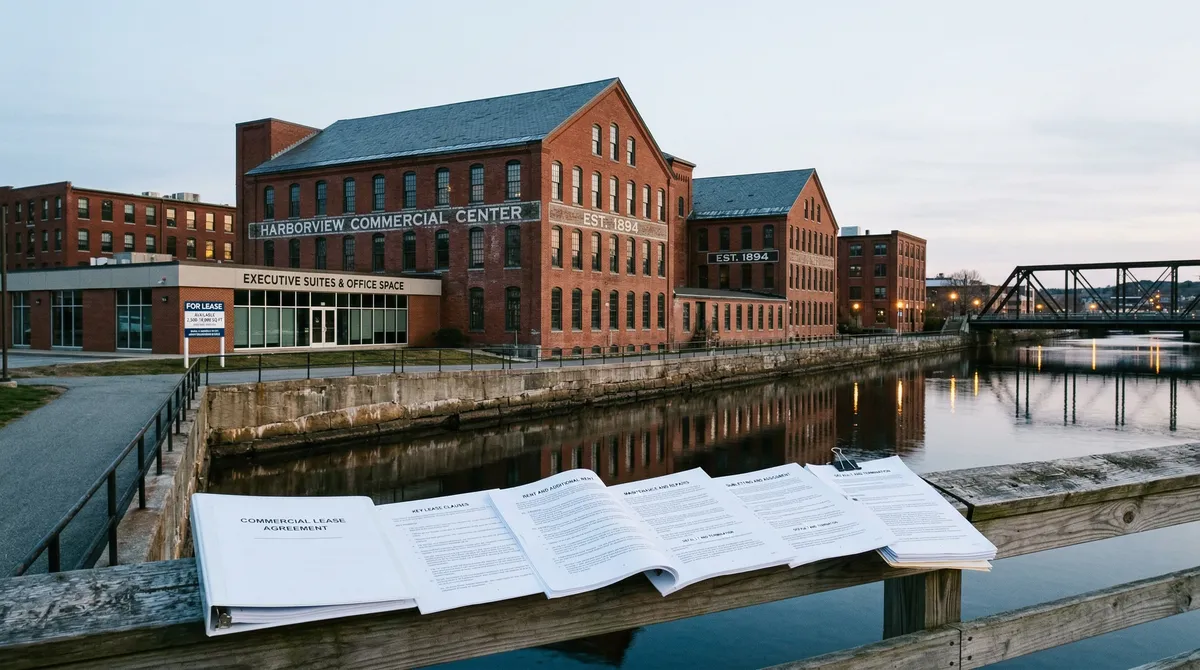
A commercial lease is not a residential lease with bigger numbers. It is a business contract that gets negotiated hard, and it splits risk, cost, and obligation between landlord and tenant for 3 to 15 years. In Massachusetts, commercial tenants get almost none of the statutory protections residential tenants have. No implied warranty of habitability, no rent control, no 30-day cure periods unless the lease spells them out. Every protection you have comes from the lease document itself.
Length and Complexity: Commercial leases usually run 20-80 pages and hold 15-25 distinct sections, and each one carries a financial or legal consequence that compounds over a 5-10 year term.
No Consumer Protection: Unlike a residential lease, a Massachusetts commercial lease is governed entirely by contract law. If a protection is not written into the lease, you do not have it.
Cost Impact: The clauses tenants skip over, CAM reconciliation language, operating expense caps, personal guarantee scope, routinely cost them $10,000-$50,000 or more over the lease term.
Negotiability: A landlord-drafted lease is a starting position, not a final document. In Worcester County's current market, tenants have real leverage on 60-70% of lease clauses.
Common Area Maintenance (CAM) is the charges a landlord passes through to tenants for running and maintaining shared building areas, lobbies, hallways, parking lots, landscaping, snow removal, and shared mechanical systems. CAM charges are spelled out in NNN and modified gross leases and get reconciled annually against actual expenses.
The gap between a lease you reviewed carefully and one you signed in a hurry can be tens of thousands of dollars and years of operational headaches. I walk through the critical sections here in the order they usually appear, with the red flags and negotiation points I care about most.
20-80 pages is standard for a commercial lease, and every section carries financial weight that compounds over the term.
CAM reconciliation without caps is the single most expensive clause tenants overlook. Annual increases of 8-15% are common in aging Worcester buildings.
Personal guarantees often run 12-24 months past the end of the lease unless you limit them. Negotiate a burn-off tied to your on-time payment history.
Assignment and sublease clauses set your exit options. A lease that requires landlord consent "in its sole discretion" traps you for the full term.
Going through it section by section
:::how-to
Step 1: Read the premises description and confirm the rentable square footage. Make sure the space described matches the space you toured. Check whether the landlord uses BOMA measurement standards, which include a load factor (common area allocation) that pushes rentable SF above usable SF by 10-20%. A 2,000 usable SF suite measured at 2,300 rentable SF raises your effective rent by 15%.
Step 2: Analyze the rent structure and escalation schedule. Find the base rent, when it starts (the commencement date can differ from the day you take possession), the annual escalation percentages or CPI adjustments, and any free rent or abatement periods. Add up the total rent over the full term, not just year one.
Step 3: Examine operating expense and CAM provisions. Figure out which expenses get passed through, whether there is a base year or expense stop, whether CAM charges are capped, and how the reconciliation works. Ask for three years of historical operating expense statements.
Step 4: Review maintenance and repair obligations. Nail down exactly what the tenant maintains versus the landlord. In NNN leases, roof, structure, and HVAC responsibility can get vague. Get explicit language on who pays for capital replacements versus routine maintenance.
Step 5: Evaluate assignment, sublease, and early termination provisions. Know your options if your business needs change. Look for landlord consent requirements, recapture rights, and whether an assignment releases you from the personal guarantee.
Step 6: Scrutinize the default and remedies section. Know your cure periods (how many days you have to fix a default before the landlord can act), what counts as a monetary versus non-monetary default, and what remedies the landlord has, including whether they can accelerate the remaining rent for the full term.
Step 7: Assess the personal guarantee and security deposit. Figure out the scope and duration of any personal guarantee, whether it burns off over time, and whether the security deposit can go toward the last month's rent or is held as extra collateral.
Step 8: Have a commercial real estate attorney review the final document. Attorney review usually runs $1,500-$5,000 for a standard commercial lease, a fraction of what you are exposed to in a 5-year, $100,000-plus-per-year commitment. Do not skip it.
:::
Premises and measurement
The premises clause defines the exact space you are leasing: suite number, floor, square footage. Two things matter here.
Rentable vs. usable square footage. Most commercial leases quote rentable SF, which folds in a proportionate share of common areas (lobbies, corridors, restrooms, mechanical rooms). The Building Owners and Managers Association (BOMA) standard allows load factors of 10-20% above usable SF. On a 3,000 usable SF suite with a 15% load factor, you pay rent on 3,450 SF. Over a 5-year lease at $20/SF, that load factor costs you another $45,000.
Right to verify. Negotiate the right to measure the premises yourself within 60-90 days of signing. If the actual square footage is off by more than 2%, rent should adjust proportionally. A landlord who fights this clause may be quoting you inflated measurements.
Rent, escalations, and commencement
The rent section sets base rent, the commencement date, and the escalation schedule. Watch these three things.
Commencement date triggers. The lease may define commencement as the date of execution, the date the landlord delivers the space, or a fixed calendar date. If you are doing a build-out, tie the commencement date to substantial completion of tenant improvements, not the day the landlord hands you keys to a raw shell.
Escalation structures. Fixed annual increases of 2-3% are predictable and easy to budget. CPI-tied escalations bring uncertainty. CPI in the Boston metro area rose 4.7% in 2023 and 3.2% in 2024. Over a 7-year term, the gap between a 2.5% fixed escalation and a CPI-tied one can top $15,000 on a 3,000 SF space.
Free rent and abatement. In the current Worcester office market, tenants leasing 2,000-plus SF on terms of 5 years or more can often get 2-4 months of free rent. That concession does not cut the landlord's reported rental rate, which is why landlords like it better than a base rent reduction. Make sure free rent applies to base rent and NNN charges. Some landlords grant base rent abatement while still charging full NNN during the free period.
Operating expenses and CAM
This is where most tenants lose money. The operating expense section decides what costs flow through to you beyond base rent.
What is included. Standard NNN pass-throughs are property taxes, property insurance, and common area maintenance. But the definition of CAM swings wildly from lease to lease. Some landlords fold in capital improvements, management fees (usually 3-5% of gross revenue), administrative charges (up to 15% on top of actual CAM), and even legal and accounting fees.
Expense caps. Negotiate an annual cap on CAM increases. 3-5% per year is reasonable and shields you from a surprise reconciliation bill. Without a cap, a landlord who re-paves a parking lot or replaces a roof can push the cost through to tenants in a single year. In older Worcester buildings, I have seen annual CAM increases of 8-15% without caps.
Capital expense exclusions. Insist that capital expenditures (roof replacement, structural repairs, HVAC system replacement) are either excluded from operating expenses or amortized over their useful life (usually 10-15 years), so you pay only your proportionate share during your term.
Audit rights. The right to audit the landlord's operating expense books once a year is standard but not always in the draft. Negotiate it in. National studies suggest 50-60% of commercial CAM reconciliations have errors, and they usually favor the landlord.
Maintenance and repair obligations
In a NNN lease, the tenant carries most of the maintenance. But the line between "maintenance" (the tenant's job) and "capital replacement" (usually the landlord's job) often gets blurred.
HVAC. The most common fight. Many leases make the tenant maintain HVAC systems and pay for repairs but leave it vague who pays when a 20-year-old rooftop unit needs full replacement, a $15,000-$40,000 expense. Negotiate clear dollar thresholds: tenant pays for repairs under $2,500 per occurrence, landlord pays for replacements or repairs above that, amortized over the useful life.
Roof and structure. In a standard NNN lease, the landlord keeps responsibility for structural elements (foundation, load-bearing walls, roof structure). The tenant handles the roof membrane and interior ceiling. Get this in writing. "Roof" by itself is ambiguous.
Assignment, sublease, and exit options
Your exit strategy is set the day you sign. If your business outgrows the space, shrinks, or closes, your ability to assign the lease or sublease the space rides entirely on these clauses.
Consent standards. "Landlord shall not unreasonably withhold consent" is what you want. "Landlord may withhold consent in its sole discretion" hands the landlord veto power with no recourse. In Massachusetts, courts generally do not read a reasonableness standard into a commercial lease. If the lease says "sole discretion," the landlord can refuse for any reason.
Recapture rights. Some leases let the landlord recapture (take back) the space if the tenant asks to assign or sublease. That means the act of trying to sublease can cost you the space outright. Negotiate to strike recapture rights or limit them to assignments only.
Continued liability. In most commercial leases, the original tenant stays liable for rent even after an assignment unless the landlord agrees to release you. A personal guarantee that survives an assignment puts your credit on the hook for a space you no longer occupy.
For more on lease negotiation strategy, see: A Tenant's Guide to Negotiating Your Commercial Lease.
Default, remedies, and cure periods
The default section sets what triggers a breach and what the landlord can do about it.
Monetary default. Late or missed rent. Negotiate a cure period of at least 5-10 business days with written notice before the landlord can declare a default. Without one, a single late payment, even from a bank processing error, is a default.
Non-monetary default. Breaking lease terms: unapproved alterations, prohibited uses, letting insurance lapse. A 30-day cure period for non-monetary defaults is standard. For defaults you cannot fix within 30 days, negotiate language that gives you more time as long as you have started curing and are working at it diligently.
Rent acceleration. The most punishing remedy. Some leases let the landlord demand all remaining rent for the full term the moment you default. On a 5-year lease at $5,000/month with 3 years left, that is $180,000 due right now. Negotiate to cap accelerated rent at 6-12 months, or require the landlord to mitigate by making reasonable efforts to re-let the space.
Personal guarantee
Many landlords want the business owner to personally guarantee the lease, which makes you individually liable if the business entity defaults. It is standard for small businesses and startups, but the scope and duration are negotiable.
Burn-off provisions. Negotiate a guarantee that shrinks over time. For example, full guarantee for years 1-2, dropping to 50% for years 3-4, and gone in years 5 and beyond. Tie the burn-off to your on-time rent payment history.
Cap the guarantee. Instead of guaranteeing the entire remaining obligation, cap the personal guarantee at 12-24 months of rent plus estimated expenses. That limits your personal exposure while still giving the landlord real security.
Spousal guarantee. In Massachusetts, a landlord cannot require a spousal guarantee unless the spouse is an owner of the tenant entity. Push back firmly on any ask for a spouse's personal guarantee.
Red flags that need immediate attention
- No cap on CAM or operating expense increases - you are writing a blank check
- Landlord consent "in sole discretion" for assignment or sublease - you have no exit
- Rent acceleration for the full remaining term with no mitigation obligation
- Personal guarantee that survives assignment - you stay liable even after you leave
- Commencement date not tied to TI completion - you pay rent on space you cannot use
- No right to audit operating expenses - you cannot check what you are being charged
- Relocation clause - the landlord can move you to a different suite whenever they want
- Continuous operation clause without dark store protection - you have to stay open even when it is losing money
When to bring in help
A commercial lease is a six- or seven-figure commitment. The cost of professional review is small next to that.
Tenant rep broker (free to the tenant). A commercial broker representing the tenant can help you compare spaces, negotiate terms, and spot clauses that need changing. In most commercial deals the landlord pays both the landlord's and the tenant's broker commissions, so tenant representation costs you nothing.
Real estate attorney ($1,500-$5,000). An attorney who specializes in commercial leases will read every clause, flag the risks, and negotiate changes to the landlord's form. For a lease with a total commitment over $100,000, this is not optional.
Lornell Real Estate provides tenant representation across Worcester County and Central Massachusetts. We review the terms, negotiate for you, and make sure you understand every clause before you sign. Call (774) 745-0015 or email [email protected].
Limitations: This article gives general guidance on reading and understanding commercial lease documents and is not legal advice. Commercial lease terms vary a lot by property, landlord, and market conditions. Massachusetts commercial lease law runs on contract principles, and specific clauses can have legal implications that need professional interpretation. Always have a qualified commercial real estate attorney review any lease before you sign it.
Sources & References
- Building Owners and Managers Association (BOMA)
- Massachusetts General Laws Chapter 186 (landlord-tenant)
- Cushman & Wakefield (tenant improvement and concession benchmarks)
- Lornell Real Estate transaction and negotiation data
This article cites data from the sources listed above. For the most current figures, consult the original publications directly.
Data current as of publication date. Market conditions, rates, and regulations may have changed. Consult a qualified commercial real estate professional before making investment decisions.
Get the full Central MA market data
Commercial tax-base growth, development activity, and demographics across Central MA, town by town.