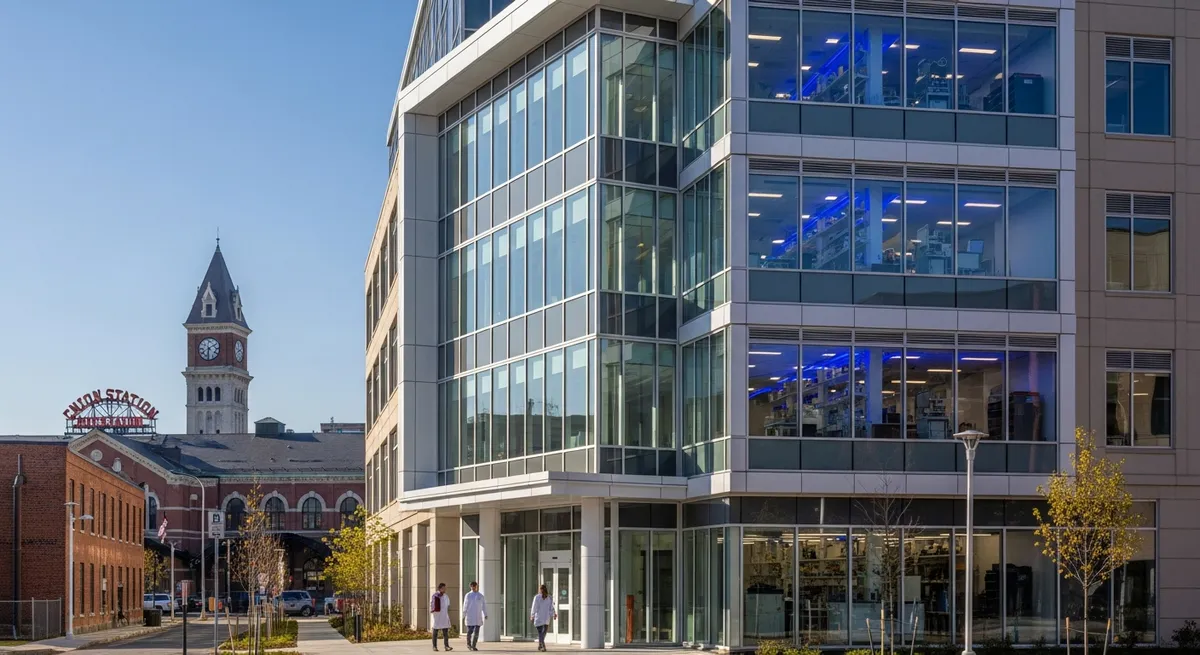
Worcester is where Massachusetts is putting its biomanufacturing, with 1.1 million SF of life sciences space in the development pipeline and lab rents of $20-30/SF NNN against $80+/SF in Cambridge. The Massachusetts Life Sciences Center puts nearly 25% of the state's biomanufacturing jobs in Worcester County. UMass Medicine Science Park is 100% occupied with a waitlist, and the incubator networks, MBI and ABI-LAB, keep turning out biotech startups that need commercial space. I've watched this build for years, and the demand is ahead of the supply.
Significant Pipeline: Worcester has a 1.1 million square foot life sciences development pipeline, which points to real growth past Cambridge.
Cost Efficiency: Lab rents in Worcester are $20-30/SF NNN, a 60-75% discount to the $80+/SF you pay in Cambridge.
High Demand: UMass Medicine Science Park is 100% occupied with a waitlist, and there's a plan for a new 100,000+ SF Biotech 6 building to catch the overflow.
Strategic Niche: Worcester is running its own game, biomanufacturing, contract research, and early-stage incubation, instead of going head-to-head with Cambridge on R&D.
Biomanufacturing Hub: Worcester County holds nearly 25% of Massachusetts' biomanufacturing jobs.
NNN (Triple Net Lease) is a commercial lease where the tenant pays the real estate taxes, building insurance, and all common area maintenance on top of base rent.
Life sciences pipeline: 1.1 million SF of lab and flex space in development across Worcester (Massachusetts Life Sciences Center)
Lab rent advantage: $20-30/SF NNN in Worcester vs. $80+/SF in Cambridge, a 60-75% discount (CBRE)
Biomanufacturing jobs: Worcester County holds 25% of Massachusetts' biomanufacturing employment, growing at 7.9% (Massachusetts Life Sciences Center)
Full occupancy: UMass Medicine Science Park at 100% occupancy with a waitlist; Biotech 6 (100,000+ SF) proposed to meet demand (UMass Chan Medical School)
Worcester isn't trying to be Cambridge, and that's the whole point
Cambridge owns the national life sciences story. Lab rents north of $80/SF, vacancy in the single digits, and a cluster density nobody else in the country can copy. But that dominance came with a catch: there's no room left, and the cost of getting in has pushed out a growing pile of biotech and biomanufacturing companies.
Worcester isn't fighting Cambridge for the same tenants. It's taking a different slice, biomanufacturing, contract research, and early-stage incubation at a fraction of the cost, with institutional anchors that stand up against any life sciences cluster in the Northeast.
For an investor or developer, that difference is the story. The gap between what tenants want and what's available in Worcester's lab and flex market is real, you can measure it, and it's widening.
The institutions that make Worcester work
Life sciences clusters don't show up on their own. You need research universities, a medical school, a talent pipeline, and incubator space. Worcester has all four.
UMass Chan Medical School
This is the anchor. UMass Chan is a top-tier research institution pulling in hundreds of millions in annual research funding. The UMass Medicine Science Park, the commercial side of that research engine, is 100% occupied with a waitlist of companies looking for lab and office space. UMass Medical School is now weighing Biotech 6, a proposed 100,000+ SF Class A laboratory and life science building to take on demand the current buildings can't hold.
Worcester Polytechnic Institute (WPI)
WPI's Gateway Park has grown into a biotech hub on its own, mixing university research space with commercial tenants on a campus next to downtown Worcester. WPI's engineering and life sciences programs push out graduates who'd stay in Worcester if there were companies and lab space to hire them.
The incubators
Two incubator networks are feeding Worcester's biotech pipeline:
- Massachusetts Biomedical Initiatives (MBI): Signed 7 new biotech startup companies in Q1 2025 alone, which tells you early-stage demand for affordable lab space is steady
- ABI-LAB: Opened its next incubator building in late 2024, adding 35,000 SF to an existing 105,000 SF campus, a straight answer to waitlist-level demand from startups outgrowing bench space
The rest of the roster
- College of the Holy Cross and Clark University add to the academic base
- Tufts University School of Veterinary Medicine over in Grafton brings veterinary and comparative biomedical research
- Worcester holds a Platinum BioReady Community designation, a state certification that says the city's infrastructure, workforce, and permitting are ready for life sciences work
The numbers: occupancy, pipeline, and jobs
The math here is simple: demand is running past supply.
Current supply and pipeline
| Metric | Data |
|---|---|
| Life sciences/lab space in pipeline | 1.1 million SF |
| UMass Medicine Science Park occupancy | 100% (waitlist) |
| Proposed Biotech 6 | 100,000+ SF Class A lab |
| ABI-LAB total campus (post-expansion) | 140,000 SF |
| MBI new company signings (Q1 2025) | 7 startups |
Employment
- Worcester County holds nearly 25% of Massachusetts' biomanufacturing jobs, a number built over decades by employers like AbbVie, Curia Global, and WuXi Biologics
- Biomanufacturing employment in Worcester County grew 7.9%, ahead of the statewide pace
- Big biomanufacturing operations need specialized industrial and flex space that standard office or warehouse stock can't give them: clean rooms, controlled environments, loading docks, high-bay ceilings
The biomanufacturing angle: what sets Worcester apart
Cambridge's life sciences economy runs on drug discovery, clinical research, and venture-backed therapeutics companies. Worcester's is a different animal: biomanufacturing, contract development and manufacturing (CDMO), and process-scale production.
That difference hits the real estate directly:
- Bigger footprints: 20,000-100,000+ SF buildings with specialized mechanical, electrical, and plumbing (MEP) systems
- Longer leases: Manufacturing tenants sink real money into build-out and don't move easily, so you see 7-15 year lease commitments
- Industrial/flex zoning: These tenants need land zoned for manufacturing and lab use, not a standard office park
- Workforce proximity: Biomanufacturing runs on technician and operator roles, and those people need housing they can afford, which is where Worcester beats Greater Boston
AbbVie (biologics manufacturing), Curia Global (CDMO services), and WuXi Biologics (contract manufacturing) are already here. That tells you Worcester is a proven biomanufacturing location with the supply chain and workforce already in place.
What Worcester costs against Cambridge and Boston
The dollars make the case.
| Metric | Cambridge | Boston (Seaport/Fenway) | Worcester |
|---|---|---|---|
| Lab rent (NNN) | $80+/SF | $65-80/SF | $20-30/SF |
| Office vacancy | ~5% (lab) | 18.5% (office) | Higher availability |
| Spec lab availability | Extremely tight | Limited new delivery | Significant supply gap |
| Commute from Boston | N/A | N/A | 50 min (commuter rail) |
| Housing cost index | Very high | Very high | Moderate |
Worcester lab and flex rents will push toward $25-30/SF NNN as institutional demand builds and new Class A space delivers. Even there, a tenant saves $50-60/SF against Cambridge, and that gap piles up fast on a 50,000 SF lease over 10 years.
Boston's office market is sitting on 18.5% vacancy, but lab space stays tight across the metro. The problem isn't demand, it's developable land, entitlement timelines, and construction costs over $1,000/SF for ground-up lab buildings in Cambridge. Worcester gives you faster entitlements, lower construction costs, and land you can actually buy.
The opportunity: what kind of space is missing
1. Spec lab suites (3,000-15,000 SF)
This is the clearest gap. Companies coming out of MBI and ABI-LAB need their first standalone lab, usually 3,000-15,000 SF with basic wet lab infrastructure, chemical storage, and HVAC that can handle fume hoods and biosafety cabinets. Almost none of this exists in Worcester today outside the incubators themselves.
2. Lab-ready flex space (15,000-50,000 SF)
Mid-stage companies going from proof-of-concept to pilot manufacturing. They need flex buildings with high ceilings (16-20 ft clear), reinforced floors, real power (minimum 30 watts/SF), and room to drop in clean rooms or controlled environments. You can convert existing industrial stock, but very few buildings in Worcester get marketed as lab-ready today.
3. Purpose-built biomanufacturing (50,000-150,000 SF)
Large-scale CDMO and biologics manufacturing. These are build-to-suit or heavy renovation jobs with $200-400/SF in tenant improvements. The credit is strong: AbbVie, WuXi, and operators like them sign long-term leases backed by institutional balance sheets.
4. Property near the biotech cluster
Property near UMass Medical School, WPI, and the biotech cluster along Route 9 and Plantation Street carries a premium. Proximity to the research institutions, the workforce, and peer companies matters. Life sciences tenants cluster for the same reasons tech companies clustered in Silicon Valley.
The thesis and the risks
The bull case
- 100% occupancy with waitlists at the existing lab facilities is unmet demand, plain and simple
- 1.1 million SF pipeline says the institutions believe in where this market is headed
- 25% of state biomanufacturing jobs in Worcester County gives you employment density that holds demand through the down cycles
- Lab and flex rents at $25-30/SF NNN put attractive yields on converted industrial you buy at $80-120/SF
- Biomanufacturing tenants sign long leases and pour money into TI, which cuts your rollover risk
The risks
- Boston suburbs are hunting the same tenants: The Route 128 and I-495 corridors (Waltham, Lexington, Burlington, Framingham) are after lab tenants too, with better transit into Cambridge
- Tenant credit: Early-stage biotech carries more default risk than an institutional tenant. Spec lab suites pull in pre-revenue companies, so underwrite them that way
- Regulatory and permitting: Lab and manufacturing uses need environmental permits, hazardous materials handling, and local board sign-offs that add 6-12 months to a project
- Construction costs: Lab fit-out is expensive. Converting a standard industrial building to lab-ready runs $100-200/SF in MEP upgrades, and that capital has to pencil against a realistic lease-up
- Market depth: Worcester's life sciences market is still young. One large tenant leaving could soften demand for a while
How I'd position
If you're an investor or developer looking at Worcester life sciences, here's the playbook I'd run:
- Buy industrial and flex property near UMass Medical School and Gateway Park at today's industrial pricing ($80-120/SF)
- Convert to lab-ready spec suites in the 3,000-15,000 SF range to catch the incubator graduates
- Target $25-30/SF NNN rents on the converted space, a real step up from standard industrial at $10-14/SF
- Underwrite conservatively on tenant credit and aggressively on demand, because the waitlists are real
- Get to know MBI, ABI-LAB, and UMass Chan so you see the tenant pipeline before those companies hit the open market
Worcester's life sciences story isn't a bet on something that might happen. The institutions are here, the jobs are here, and the supply gap is one you can measure. The only open question is who builds the space to meet demand that already exists.
Lornell Real Estate tracks life sciences and flex space opportunities across Worcester County. Contact our team at (860) 305-7432 to discuss positioning in this market.
Limitations: Market data, projections, and trend analyses reflect conditions at publication. Commercial real estate markets are inherently cyclical, and submarket and property-level performance can diverge significantly from the regional averages cited. Demographic data, employer information, and regulatory conditions are subject to change. This article does not constitute investment advice. Conduct property-specific due diligence and consult qualified professionals before making investment decisions.
Sources & References
- CBRE
- Massachusetts Life Sciences Center
This article cites data from the sources listed above. For the most current figures, consult the original publications directly.
Data current as of publication date. Market conditions, rates, and regulations may have changed. Consult a qualified commercial real estate professional before making investment decisions.
Get the full Central MA market data
Commercial tax-base growth, development activity, and demographics across Central MA, town by town.