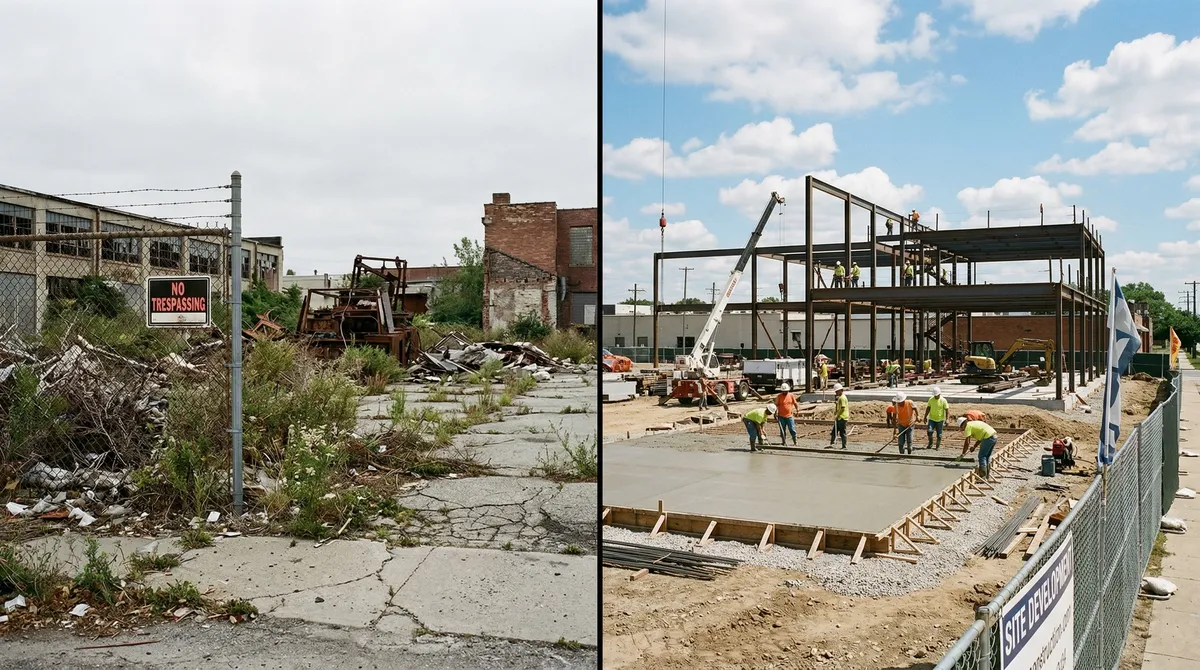
I've seen brownfield sites in Central Massachusetts trade at 50-95% discounts to clean land. That gap is where the money is, if you know how remediation actually works. The EPA counts over 450,000 brownfield sites nationwide, and Massachusetts runs its cleanup through Licensed Site Professionals (LSPs), which lets you move faster and cheaper than most states.
Acquisition discounts: Brownfield sites trade at 50-95% below clean land prices, with moderate contamination sites at $2-5/SF vs. $8-15/SF for clean land.
State incentives: MassDEP Brownfields Tax Credit covers up to $50,000 in cleanup costs; EPA grants up to $500,000 per site.
Streamlined process: Massachusetts' LSP-driven cleanup process avoids direct DEP involvement for most sites, accelerating timelines.
AUL flexibility: Activity and Use Limitations allow development without full cleanup, reducing remediation costs by 40-60%.
Brownfield is a property whose expansion, redevelopment, or reuse is complicated by potential or actual environmental contamination, often from past industrial activity.
Acquisition discounts: Brownfield sites trade at 50-95% below clean land prices, with moderate contamination sites at $2-5/SF vs. $8-15/SF for clean land (EPA)
State incentives: MassDEP Brownfields Tax Credit covers up to $50,000 in cleanup costs; EPA grants up to $500,000 per site (MassDEP / EPA)
Streamlined process: Massachusetts' LSP-driven cleanup process avoids direct DEP involvement for most sites, accelerating timelines (MassDEP)
AUL flexibility: Activity and Use Limitations allow development without full cleanup, reducing remediation costs by 40-60% (MassDEP)
The brownfield opportunity
A brownfield is a property where expansion, redevelopment, or reuse gets complicated by environmental contamination. Around here you can't swing a cat without hitting one: old textile mills, machine shops, gas stations, manufacturing plants.
Why brownfields?
Acquisition Economics:
| Site Type | Typical Price | Discount |
|---|---|---|
| Clean industrial land | $8-15/SF | Baseline |
| Brownfield (moderate) | $2-5/SF | 50-75% |
| Brownfield (significant) | $0.50-2/SF | 80-95% |
Location Advantages:
- Often in established commercial areas
- Existing infrastructure (roads, utilities)
- Zoning typically in place
- Near labor and transportation
Understanding contamination types
Common Contaminants in Central MA
Petroleum Products:
- Source: Gas stations, heating oil tanks
- Cleanup: Often straightforward
Chlorinated Solvents:
- Source: Dry cleaners, metal degreasing
- Cleanup: More complex, can migrate in groundwater
Heavy Metals:
- Source: Plating operations, manufacturing
- Cleanup: Soil removal or stabilization
Asbestos:
- Source: Building materials, insulation
- Cleanup: Removal or encapsulation during demolition
The Massachusetts Cleanup Process (MCP)
Massachusetts lets a Licensed Site Professional (LSP) run the cleanup without direct DEP involvement on most sites. That's the piece that makes the numbers work.
Key Phases
Phase I Environmental Site Assessment:
- Historical research and records review
- Site inspection (no sampling)
- Cost: $2,500-5,000
- Timeline: 2-4 weeks
Phase II Environmental Site Assessment:
- Soil and groundwater sampling
- Laboratory analysis
- Cost: $10,000-50,000+
- Timeline: 4-8 weeks
Tier Classification:
| Tier | Description | Oversight |
|---|---|---|
| Tier I | Significant risk | DEP involvement |
| Tier II | Lower risk | LSP supervised |
Most commercial sites land in Tier II, which is what lets the cleanup move.
Financial incentives
Massachusetts Programs
Brownfields Tax Credit:
- 25-50% of cleanup costs
- Up to $3 million per project
- Transferable credits
MassDevelopment Brownfields Redevelopment Fund:
- Up to $100,000 for assessments
- Up to $500,000 for cleanup
Federal Programs
EPA Brownfields Grants:
- Assessment grants: Up to $500,000
- Cleanup grants: Up to $500,000
Case study: a Worcester industrial site
The Site: 5-acre former manufacturing facility
Acquisition:
- Asking price: $1,200,000
- Negotiated price: $400,000
- Estimated cleanup: $600,000
Financial Stack:
| Item | Amount |
|---|---|
| Acquisition | $400,000 |
| Cleanup costs | $650,000 |
| Brownfields tax credit (50%) | ($325,000) |
| EPA grant | ($200,000) |
| Net land cost | $525,000 |
| Cost per acre | $105,000 |
| Comparable clean land | $350,000/acre |
Outcome: Effective land cost 70% below market
Best practices
1. Start with the end in mind
Know your intended end use, what restrictions you can live with, the timeline you need, and the budget you're working inside. Decide that before you write an offer.
2. Assemble the right team
- Licensed Site Professional (LSP)
- Environmental attorney
- Environmental consultant
- Environmental insurance broker
3. Secure liability protection
Options:
- Prospective Purchaser Agreement (PPA)
- Bona Fide Prospective Purchaser status
- Environmental insurance
- Seller indemnification
4. Keep the schedule flexible
Build 20-30% schedule contingency into your development timeline. Regulatory approvals, weather, and contamination you didn't know about will all push the dates.
Common pitfalls
1. Underestimating Costs: Add 25-50% contingency
2. Ignoring Groundwater: Can extend cleanup significantly
3. Missing Neighboring Sources: Contamination may migrate from adjacent properties
4. Assuming "Clean" Sites Are Clean: Even sites without obvious history can have issues
Lornell Real Estate has worked brownfield sites across Central Massachusetts. Call us to talk through a specific property or a development you have in mind.
Data current as of publication date. Market conditions, rates, and regulations may have changed. Consult a qualified commercial real estate professional before making investment decisions.
Get the full Central MA market data
Commercial tax-base growth, development activity, and demographics across Central MA, town by town.